
A typical offer ends with power, operating range, and speed "up to 7000 mm/s." Meanwhile, a metal laser marker in a facility marking parts for automotive, electronics, or medical applications isn't judged by whether it "creates a code," but rather by whether that code can be read by a verifier after painting, galvanizing, or sterilization, and whether it passes a customer audit.
This text supplements what is not found in the product cards: the requirements of each type of mark, the quality standards of the DataMatrix code and module sizes according to GS1, the order of marking and processing, and the differences between stationary, mobile and line stations – numbers always with attribution.
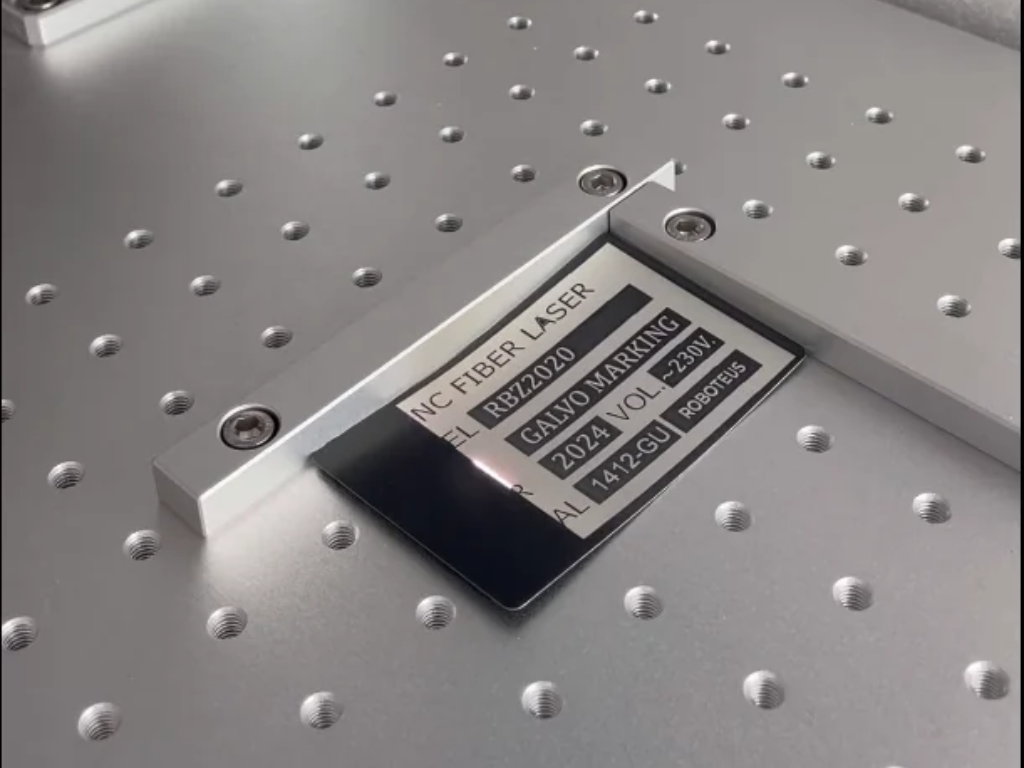
The benchmark is the RBZ 2020 fiber marker with a 50W Raycus source, priced for the process. General selection criteria are described in the text on how to choose a laser marker ; here we deal exclusively with metal and identification.
1. What do we mark on metal: table of requirements
The five character types are five tasks for the same galvo head; they differ in what determines quality.
| What do we mark? | Typical metal process | What determines quality | Field and mount | Time for art |
|---|---|---|---|---|
| Serial number, batch, date | annealing (black without loss) on stainless steel and titanium; surface engraving on steel and aluminum; removal of the anode layer | contrast; minimum character height (RBZ 2020: 0.3 mm) | small field; turntable next to the rollers | a fraction of a second to a few seconds |
| DataMatrix / QR | as above, with full module fill | contrast, module uniformity, quiet zone; evaluation according to ISO/IEC 15415 or ISO/IEC TR 29158 | code + silence zone + mounting tolerance | entire Data Matrix "under 1 s" |
| Logo, graphics | annealing or engraving with raster filling | uniformity of filling, repeatability of shade | field with a reserve | seconds to minutes |
| Graduation, scale | thin vector lines, one pass | positioning accuracy (RBZ 2020: 0.01 mm) | the entire scale in the field | short, without fillings |
| Nameplate, CE | text and pictograms on anodized aluminum or stainless steel | durability in machine operating conditions | field plate (RBZ 2020: 200 × 200 mm) | seconds to minutes, depending on fill |
The time in the last column is intentionally descriptive – it depends on the power, lens, filling and material; measure it by testing it on your own part.
2. Code quality standards: ISO/IEC 16022, ISO/IEC 15415 and ISO/IEC TR 29158
Three customer-required standards describe three different things. ISO/IEC 16022 defines the Data Matrix symbology. According to the GS1 DataMatrix Guideline, only the ECC 200 variant, the only one with Reed-Solomon error correction, is acceptable in GS1 applications. GS1 DataMatrix differs from regular Data Matrix by the leading FNC1 character.
ISO/IEC 15415 evaluates the quality of printed symbols. GS1 states explicitly that "ISO/IEC 15415 is not sufficient to measure the quality of DPM symbols," meaning those marked directly on the part. ISO/IEC TR 29158 (AIM DPM guidelines) is used for this purpose, and the result is called a "DPM grade." The grade is numerical, ranging from 4.0 (best) to 0.0, with letter equivalents A–F. According to Axicon, a manufacturer of verifiers, ISO/IEC 15415 evaluates eight parameters, and "the parameter with the lowest grade becomes the overall grade":
| Parameter (ISO/IEC 15415) | What does it measure? | What reduces it when marking with a laser |
|---|---|---|
| Decode | whether the symbol is decoded | damaged pattern, module too small in relation to the spot |
| Symbol contrast | difference in brightness of modules | poor annealing, gray engraving on aluminum, reflections |
| Modulation | contrast uniformity | uneven filling, change of focus on the curve |
| Axial non-uniformity | symbol proportions | incorrect calibration of the galvo field |
| Grid non-uniformity | module grid deviation | as above plus mounting vibrations |
| Unused error correction | error correction reserve | anything above; a low value is a borderline code |
| Fixed pattern damage | damage to the L and clock patterns | broken shorelines, spalling |
| Print growth | increase or decrease of modules | too large a spot or power, melted edges |
The result only makes sense with the measurement conditions. GS1 stores it as grade/aperture/wavelength/angle, e.g., "3.0/10/660," and for DPM adds illumination codes (30Q, 45Q, 30T, 30S, 90). The customer's application standard must specify the minimum grade; GS1 uses 1.5 as an example.
3. Module size and laser spot: numbers from GS1
The X-dimension is the size of a single barcode cell. GS1 provides separate tables for direct marking; below are the minimum, target, and maximum values.
| Application (according to GS1 DataMatrix Guideline) | X-dimension min / target / max | Required quality (GS1 notation) | ||||
|---|---|---|---|---|---|---|
| Healthcare, printed symbols | 0.254 / 0.380 / 0.495 mm | 1.5/08/660 | ||||
| DPM, non-medical devices | 0.254 / 0.300 / 0.615 mm | 1.5/06/660 | ||||
| DPM-A (Laser, Etching – Combined Modules), Small Medical Instruments | 0.100 / 0.200 / 0.300 mm | DPM1.5/04-12/650/(45Q | 30Q | 30T | 30S | 90) |
| DPM-B (dot peen – unconnected modules) | 0.200 / 0.300 / 0.495 mm | DPM1.5/08-20/650/(45Q | 30Q | 30T | 30S | 90) |
Two rules from the same guideline: a Quiet Zone of 1X on each of the four sides is mandatory, and below 1X the symbol will fail verification; the measurement aperture is typically 40-80% of the maximum X-dimension of the application.
How does this relate to the machine? Shops (A–D) declare minimum fiber line widths ranging from 10 µm (shop C) through 15 µm (shop D), to 50 µm (shop B). A 0.100 mm module from the GS1 table represents several line widths, while a 0.300 mm module represents a dozen or so; each module is filled with several touching lines, and adjacent modules merge into continuous fields—hence GS1's type A, "connected modules," as opposed to the separate microdots (type B). More important than the "minimum line" is therefore repeatability: positioning accuracy (RBZ 2020: 0.01 mm) and consistent sharpness across the entire field.
For example, let's assume a code with 16 rows and columns with a module of 0.300 mm: the symbol is 4.8 mm long, and with a 1X silence zone on each side, 5.4 mm wide. This is an illustration, not a recommendation; the symbol size depends on the amount of data and the reader.
Contrast depends on the metal. According to the engraving machine manufacturer, engraving on bare aluminum produces shades of gray, not black, which does not interfere with 2D code verification. On anodized aluminum, the beam removes the dye in the oxide layer, leaving a bright mark (according to JPT). On stainless steel and titanium, a black mark is created by annealing without loss (according to two laser manufacturers), as discussed in the text about blackness and depth of laser engraving in metal (source in Polish) .
4. GS1 and UDI: When a Code on Metal is Required
For medical devices, identification is not an option. According to the European Commission's UDI Helpdesk (MDR 2017/745, Annex VI, Part C, point 4.10), reusable devices must bear the UDI carrier on the device itself, and if they are cleaned, disinfected, sterilized, or reprocessed between uses, the carrier must remain permanent and legible after each such process. Exceptions: when direct labeling would interfere with the safety or performance of the device or is not feasible.
Durability after reprocessing is a specific test. JPT recommends steam sterilization at 134°C as a test of exposure for the annealed mark. An industrial laser manufacturer describes a more difficult case: passivation in nitric acid "unfortunately also removes laser marks." According to the manufacturer, a dark mark resistant to passivation and autoclave can be achieved on 304 and 316 steels; more difficult cases require UV or picosecond sources. The manufacturer recommends an on-machine passivation test.
Outside of medicine, the requirements are dictated by the client's application standard – ask for it before testing, as the selection of the module, process and verifier depends on it.
5. Readability after processing: sequence of operations
The most common reason for unreadable codes lies not in the machine, but in the route: a mark made before the operation that covers or removes it ceases to exist.
| Post-marking operation | Mark before or after | Why (with attribution) |
|---|---|---|
| Painting, powder coating | after — ablation of the coating gives contrast; before — only deep engraving | According to the machine manufacturer, a typical engraving is 10–50 µm; the coating covers the plate mark |
| Galvanizing, plating | after, as ablation of the coating (plated metals give high contrast); before – only deep engraving | According to the laser manufacturer, the dot peen mark "withstands post-plating processes" because it is deep; the laser must engrave equally deep. Note: zinc ablation exposes the steel in the code field and locally removes the corrosion protection—for parts exposed to corrosion, verify this with a test. |
| Grinding, shot-blasting, polishing | after | they remove the top layer in which the annealing and engraving plates lie |
| Heat treatment | after; annealing check on the finished structure | the annealing color depends on the oxide layer (according to JPT) |
| Stainless steel passivation | parameters of both processes should be selected together; mandatory test | According to the laser manufacturer, passivation after annealing "tends to degrade the mark" |
| Washing, sterilization, working in liquids | annealing without loss | according to JPT, the risk of crevice corrosion after annealing is very low, after engraving it is high |
Rule of thumb: mark the code on the last surface the part will be used on. If the mark must be present from the first operation, choose an engraving deeper than what subsequent operations will remove, and consider the time, as depth costs passes.
6. Stationary, portable or in-line
The three types of stations differ not in the quality of the sign, but in what needs to be provided around the head.
| Type of position | Examples | For what? | What needs to be provided |
|---|---|---|---|
| Stationary with column and table | RBZ 2020 (M6 raster table, foot switch, 50 kg); 20 W fiber (shop B); 30 W Raycus fiber 150×150 mm (shop C) | series on the table, devices for several pieces | a mounting device, a stay, a housing or a Class 4 stand with goggles |
| Portable | fiber 20 W (stores B and C; also battery-powered in B); mobile (store A, 6.8 kg according to the card) | elements that will not fit under the column: frames, tanks, customer's machines | stable application, because the sharpness and the code grid depend on the head position; verification after each application |
| Inline | on-the-fly marking (in the description RBZ 1515UV, UV sources for plastics; for metal, ask about fiber with encoder input); systems with a CCD camera and belt feeder (50 W in shop C; shop A) | each piece on the conveyor, small parts | start/stop signals and data from the master system, encoder, post-station verifier |
Net list prices (as of October 2026): stationary from PLN 8,500 (store B, 20 W) and PLN 9,900 (store C, 30 W), portable from PLN 7,800.00 (store C, 20 W) to PLN 14,634.15 (store B, 20 W battery), systems with a feeder and CCD camera PLN 40,000.00 each (stores C and A), RBZ 2020 — pricing for the process; store A declares leasing "from PLN 250/month" for a portable 30 W (store declaration, not a financing offer), and the full table according to power is compiled in the text on the selection of a laser marker .
Speed is an argument for the inline laser: according to the marking manufacturer, the fiber marking machine marks the entire Data Matrix in less than 1 second, while the microdot (dot peen) requires 3–8 seconds per mark. Deviation of the manually applied head from perpendicularity violates the axial and grid non-uniformity parameters from Section 2.
7. Power and Source: What is Enough for Codes and What is Enough for Deep Engraving
For numbers, codes, and logos on steel and aluminum, fiber in any power class offered in stores is sufficient; according to GS1, DPM lasers are "commonly 10-100 W." Power buys time for fills and depth for engraving; it doesn't, by itself, improve code grading.
RBZ 2020 as a reference: Raycus 50 W source, 200 × 200 mm field, operating speed up to 7000 mm/s, 0.01 mm accuracy, 0.3 mm minimum character, EZCAD controller, air cooling, optional rotary axis. The manufacturer lists applications: barcodes, QR codes, serial numbers, logos on metals and selected plastics, nameplates. 50 W provides the capacity for coating removal and engraving in multiple passes without extending the run.
When isn't fiber with a Q-switch enough? When the customer requires a black mark on bright anodized aluminum or repeatable colors on stainless steel and titanium, according to marking manufacturers, this is the domain of MOPA with adjustable pulse length. When the metal is highly reflective (copper, silver, gold), the marking manufacturer suggests UV as an option, noting that fiber is usually faster.
Is laser the best method for microdot, print or label – a comparison of techniques is included in the text on permanent marking of parts (source in Polish) .
8. Station: verifier, reader, extraction and laser class
A verifier is not a reader. A reader responds "read" or "didn't read"; the verifier measures eight parameters at a specific aperture, wavelength, and illumination angle and issues a rating. A code that a reader reads on the shop floor may receive a rating below the customer's threshold; if you're marking to a customer standard, the verifier is part of the station.
Extraction is also necessary for metal, as dust and oxides from annealing and engraving settle on the lens. The laser class applies to the entire station: an open galvo head is a Class 4 laser, while an enclosed machine can be Class 1 according to the Central Institute for Labor Protection and National Research Institute (CIOP-PIB). The selection of enclosure, glasses, and extraction is described in the text on selecting a marking machine. You can find an overview of the machines in the Roboteus laser marking category; for a RBZ 2020 quote, please provide the material, marking content, batch size, and code quality standard.
Frequently asked questions
Which metal laser marker is suitable for DataMatrix codes?
1064 nm fiber in any power class from Polish stores (20 W, 30 W, 50 W) will produce a DataMatrix code on steel and aluminum. The code's evaluation is determined by the module selected for the spot size, fill power, 1X quiet zone, and surface area, not watts. A test on your part and measurement with a verifier are more decisive than a datasheet.
Will a metal marking laser mark aluminum and copper?
Aluminum, for example: bare aluminum produces shades of gray, while anodized aluminum produces a bright mark after the dye in the oxide layer is removed (according to JPT). Copper is highly reflective, but the laser manufacturer lists copper, bronze, and silver among the metals for fiber, and the laser vendor describes direct engraving of uncoated brass; the marking manufacturer suggests UV as an alternative, noting that fiber is usually faster.
What is the power of a stainless steel marking machine?
For annealed numbers and codes (black without loss), classes of 20-30 W are sufficient; 50 W, as in RBZ 2020, provides room for filling and engraving. Colors and repeatable black with adjustable pulse are called MOPA; for post-marking passivation, the parameters of both processes are selected together (Section 5).
Is a portable marking machine sufficient for DataMatrix marking?
For large components, yes, but each code from manual application requires verification, as head tilt distorts the module grid. In catalogs (net, as of October 2026), one store prices the portable 20W from PLN 7,800.00, another from PLN 12,000, and a third lists the portable 20W at PLN 13,000. For tabletop and line production, a stationary machine with a fixture or a system with a feeder is better.
Sources
- https://roboteus.com/pl/maszyny/znakowarki-laserowe/znakowarka-fiber-rbz-2020/ — RBZ 2020 parameters and applications
- https://roboteus.com/pl/maszyny/znakowarki-laserowe/rbz1515uv/ — on-the-fly marking in the RBZ 1515UV description
- https://ref.gs1.org/guidelines/datamatrix/ — GS1 DataMatrix Guideline: ECC 200, FNC1, X-dimension tables for healthcare and DPM, 1X quiet zone, 40–80 % aperture, evaluation record, ISO/IEC 15415 vs. ISO/IEC TR 29158, DPM laser power 10–100 W
- https://axicon.com/2d-barcode-verification – eight parameters of ISO/IEC 15415, lowest score rule, result recording format
- https://webgate.ec.europa.eu/udi-helpdesk/en/udi-carrier/direct-marking.html — UDI on reusable devices (MDR 2017/745, Annex VI, Part C, point 4.10)
- https://jpt-laser.com/applications/laser-annealing-marking/ — annealed oxide, crevice corrosion, steam sterilization 134 °C
- https://jpt-laser.com/learn/laser-engraving-anodized-aluminum/ – Bright mark on anodized aluminum
- https://www.ciop.pl/CIOPPortalWAR/file/99433/Ochrona_przed_promieniowaniem_laserowym_MatInf_M.Okrasa_I.PN.06.pdf — classes according to PN-EN 60825-1:2014-11, glasses PN-EN 207:2017, example OD ≈ 5
Editorial note
List prices in the text are from retailer websites as of October 2026 and are subject to change. Before making a decision, please check the current offer and configuration. Module sizes and code quality thresholds are derived from the 2018 GS1 guidelines and may be updated in later editions. The customer's application standard is binding. Marking parameters depend on the machine, lens, and material, and the text does not replace the manufacturer's instructions or occupational health and safety regulations for working with lasers, particularly Class 4.