
Fiber laser plotters
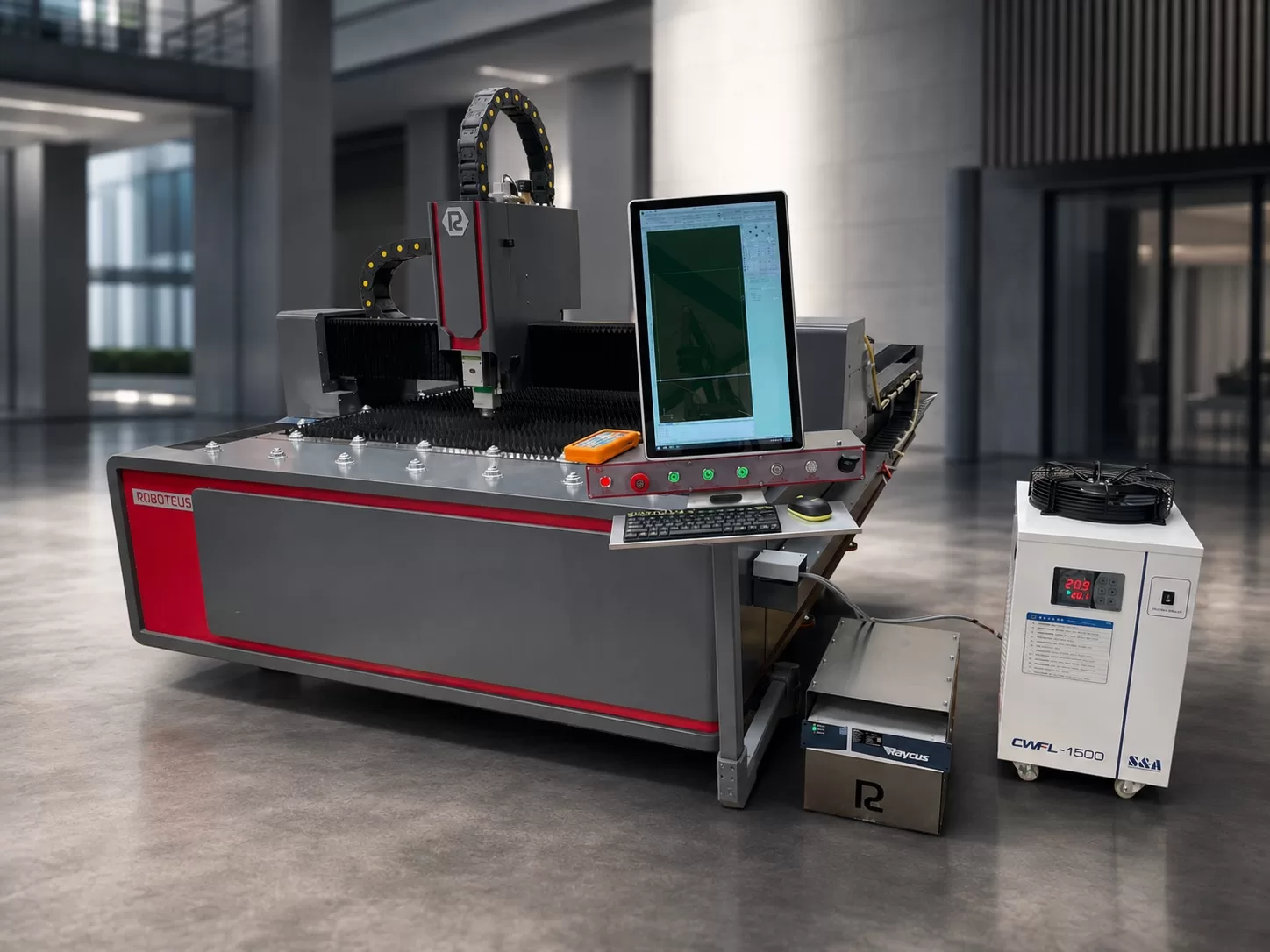
A fiber laser cutter - the laser cutting machine for metal - guides its beam through an optical fibre. Roboteus supplies it as the RBFIB 1530: a 1500 W source and a 1500 × 3000 mm bed.
Why a fiber laser rather than CO2
A fiber laser produces a beam of roughly one micrometre wavelength. Metals absorb it far better than the ten times longer CO2 wavelength - which is exactly why the laser cutting machine for metal is a fiber laser, not a CO2 one.
The RBFIB 1530 material specification lists steel, aluminium and stainless steel: the usual set for a shop that cuts sheet on plasma today, or subcontracts the cutting altogether.
What the RBFIB 1530 is made of
The source is a Raycus 1500 W fiber laser. The beam is delivered by a Raytools head with autofocus, which sets the focal position for material type and thickness on its own - the operator does not reset the optics for every new sheet.
The 1500 × 3000 mm working area matches a standard sheet, so full plates go on the bed without being cut down first.
Laser cutter or plasma
A fiber laser gives a clearly narrower kerf than plasma and an edge that usually needs no further work. Plasma cuts wider and with a larger heat-affected zone, but costs less and copes better with rusted or painted stock.
If precise sheet-metal parts are the product and edge quality drives your finishing cost, choose fiber. If you cut heavy sections and weldments, look at the plasma plotters.
Fiber laser cutting - frequently asked questions
How much does a fiber laser cutter cost?
The indicative net price for RBFIB 1530 is on its machine card above. Source power, table enclosure, extraction and material handling all move the final figure, so the quote is built for a specific configuration.
What laser power for what thickness?
RBFIB 1530 runs a 1500 W source. Power sets maximum thickness and cutting speed at the same time: the same laser will cut thicker material slowly or thinner material much faster. We confirm the thickness range for your exact material grade before quoting.
How does a fiber laser differ from a CO2 laser?
Fiber cuts metals and is no use on acrylic, wood or leather. CO2 is the exact opposite: it cuts and engraves non-metals and does not cut metal. Two separate machines for two separate jobs, not two versions of one product.
Does a fiber laser need assist gas?
Yes - laser cutting needs an assist gas to blow molten material out of the kerf. The gas is chosen for the material and the edge quality you want; budget for it alongside power and consumables.