On metal, the choice is simple: a 1064nm fiber laser marks most alloys, and only highly reflective metals (copper, silver, gold) require testing. On plastics, the same beam produces a black, contrasting mark on one part and nothing on the other, even though both look identical. The difference lies in the polymer, dye, and filler, not in the machine settings.
Laser marking plastics therefore requires a different order than steel: first the material, then wavelength, then power and speed. This text organizes this into a single matrix: material × wavelength (10.6 µm CO2, 1064 nm fiber, 355 nm UV) × effect × whether a laser-active additive is required. We only fill in this matrix with information confirmed by source manufacturers and publications; the remaining fields are marked as "requires testing."
At the end, there's a pre-implementation test sheet and a section on fumes, as exhaust is part of the process for plastics. Marking methods and the difference between a mark and an engraving are discussed separately in the text on permanent part marking (source in Polish) .
Four Mechanisms: What a Laser Does to a Polymer
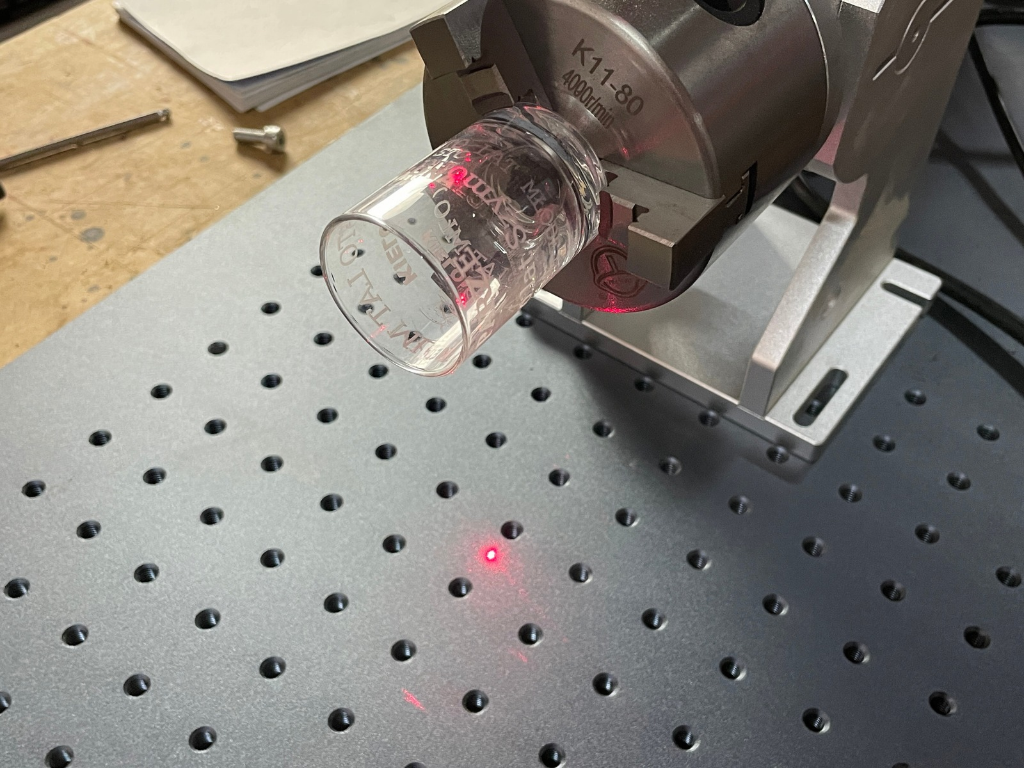
A laser doesn't "burn" the inscription into the material in a single way. According to the laser machine manufacturer, the method of changing the material depends primarily on the wavelength and pulse duration, and in practice, four mechanisms are used.
| Mechanism | What's going on | Typical appearance | Is there any material loss? |
|---|---|---|---|
| Color change | Chemical reaction of a pigment or polymer | Dark sign on a light background or light sign on a dark background | No – smooth surface |
| Carbonization | Matrix pyrolysis; black mark is carbon products (Polymers 2019) | Black or dark brown | Minimum |
| Foaming | Melting and gasification; bubbles scatter light (Polymers 2019) | Bright, raised mark on dark plastic; according to the machine manufacturer, 20–40 µm | No – the sign sticks out |
| Removing a layer | Photo of the varnish or print | Contrast from the layer underneath (keys, panels) | Yes – top coat only |
The rule of thumb stems from the marking manufacturer's materials: on light-colored materials, the target is a dark mark (carbonization or color change), while on darker materials, a light mark (foaming). Which mechanism is triggered on the part depends on whether the polymer and its dye absorb a given wavelength—and this is the crux of the selection.
What each wavelength does on the material
CO2 (10.6 µm) is absorbed by most organic materials; the marking manufacturer describes its effect as heating and melting the surface, producing a convex or concave mark. This beam is suitable for transparent materials (works on glass and PET), for removing layers and packaging; color contrast on solid technical plastics is limited.
Fiber (1064 nm), according to the marking manufacturer, "primarily heats the surface to create a mark" and does not mark transparent objects. The laser manufacturer lists the following materials marked with fiber: ABS, polyamide, polycarbonate, PMMA, and "plastics with laser additives." Where the material absorbs 1064 nm, fiber is the cheapest and fastest source; PE and PP without the additive do not produce a legible mark.
Green (532 nm) is, according to the machine manufacturer, a "wider range of materials" than the standard 1064 nm; it is rare in Polish stores, and apart from this general declaration, there is no data per material, so we do not include it in the matrix – check with the manufacturer for sources.
UV photons (355 nm) disrupt molecular bonds instead of melting the material—this is "cold marking" with minimal thermal stress. The marking machine manufacturer specifies UV for PC, ABS, and PA, for transparent plastics without additives, for silicone, and for PE/PP; the machine manufacturer specifies UV for flame-retardant plastics. The UV spot is smaller, which is important for fine-grained codes on electronics.
Material × Wavelength × Effect × Additive Matrix
Below, we've summarized what can be supported by sources. "Trial" means that the cited sources don't provide a definitive conclusion for this combination—the result depends on the dye and additives and requires testing on your own batch.
| Material | CO2 10.6 µm | Fiber 1064 nm | UV 355 nm | Typical effect | Laser-active additive |
|---|---|---|---|---|---|
| ABS | attempt | yes, without additives | yes – black mark on natural | color change / carbonization | NO |
| PC | attempt | Yes | yes – also the sign inside the transparent one | color change, dark mark | NO |
| PA6 / PA66 | attempt | Yes | yes – a light sign on a dark | foaming / color change | NO |
| PA with glass fiber | attempt | test – with filler "may be marked differently" | attempt | depends on the dye and additives | depends on the party |
| POM | attempt | no manufacturer source – don't assume it works | attempt | depends on the dye and additives | attempt |
| PE | attempt | absorbs poorly, hardly changes color | yes, with specific parameters | color change | yes in IR; no in UV |
| PP | attempt | absorbs poorly, does not carbonize | yes, with specific parameters | color change | yes with IR, but it doesn't always help |
| PET | yes – transparent | yes – high susceptibility | yes, transparent and colored | color change | NO |
| PMMA | yes – matte engraving | Yes | attempt | relief / color change | NO |
| PS | attempt | yes – high susceptibility | attempt | carbonization / color change | NO |
| PEEK | attempt | attempt | attempt | depends on the dye and additives | attempt |
| Silicon | attempt | attempt | yes – very high contrast | color change | not with UV |
| TPU | attempt | usually requires an addition | attempt | color change | yes with IR |
| PBT | attempt | attempt | attempt | depends on the dye and additives | attempt |
| PVC | not without chemical filtration — chlorine → HCl | not without chemical filtration — chlorine → HCl | no source; same chlorine | gold mark (CO2) with chemical filtration only | — |
Why the "yes" in the table: fiber on ABS, PA, PC, and PMMA — laser manufacturer; ABS, PS, PET under IR, poor absorption for PE and PP, additives for PE, PP, and TPU — Polymers 2019; UV on ABS, PC, PA, PET, silicone, and PE and PP, CO2 on transparent PET, glass filler — marking machine manufacturer; PVC — marking system manufacturer. The marking machine manufacturer notes that carbon black plastics "often mark well," while recyclates are more difficult — the same trade name in two batches can yield two different results.
Why PE, PP and transparent plastics require UV or additives
Polyethylene and polypropylene are the most common packaging materials and also the most difficult for fibers. A study by Czyżewski and co-authors (Polymers 2019) clearly states that HDPE and PP absorb 1064 nm radiation poorly, so they barely change color, and PP does not carbonize.
There are two options. The first is a laser-active additive (LMA, masterbatch) added during injection or extrusion, which absorbs infrared radiation and initiates the color change. This solution is for the component manufacturer, not the marking agent: the finished part cannot be "refined." The additive is also not a guarantee—in the cited study, LMA in PP reduced contrast, and PP pigmented with carbon black marked best.
The second option is UV. The marking machine manufacturer states that PE and PP "require specific UV parameters," but they mark without additives. Transparent materials, which required chemical additives with older IR lasers, do not require them under UV. If you're marking other people's parts and have no control over the formula, marking plastics with a UV laser is the only way to do it, regardless of what the processor added.
UV Cold Marking: When 355nm Is Worth the Extra Cost
The marking manufacturer explains that plastics "retain" heat: a thermal source can warp or swell the part, so they recommend UV for sensitive parts. Other manufacturers add that shorter pulses (MOPA) limit foaming and melting—this is an indirect approach that doesn't replace other wavelengths.
Roboteus offers this role with the RBZ 1515UV UV marker : a JPT 5 W (355 nm) UV source, a working area of 150 × 150 mm, a workpiece height of up to 250 mm, a galvanometric head speed of up to 7 m/s, an accuracy of up to 0.01 mm, and a source life of up to 20,000 operating hours according to the manufacturer. Power consumption: maximum 900 W at 230 V; EZCAD 2 included, LightBurn optional. The manufacturer describes the process as photochemical ablation without thermal damage and lists plastics, glass, ceramics, electronics, and on-the-fly marking. Approximate price on roboteus.com: from PLN 19,512.00 net (as of October 2026), configured for the process.
The UV surcharge is measurable. According to list prices as of October 2026, one store prices a 5W UV at PLN 28,455.28 net, compared to PLN 15,121.95 net for a 30W fiber (a difference of PLN 13,333.33); in two other stores, the difference between a 5W UV and a 30W fiber is similar—a full breakdown is provided in the text on selecting a marker. This difference makes sense if your components include PE, PP, transparent plastics, silicone, or medical parts—the marker manufacturer states that the UV mark on medical materials is resistant to solvents, autoclaves, and abrasion, and that pad printing fades after sterilization.
If you're primarily marking ABS, PC, and PA, as well as plastics and metal, fiber is usually sufficient. The RBZ 2020 fiber marker (Raycus 50 W, 200 × 200 mm field) is described by the manufacturer as a machine for metals and selected plastics. We've covered power, field, and source selection in our guide on how to choose a laser marker .
PVC and Chlorinated Plastics: Chlorine, HCl and Chemical Filtration
PVC produces a legible mark under the laser—the marking system manufacturer describes a "unique gold mark" made of CO2, durable and abrasion-resistant, in its application note—and that's a trap. The same note states that laser marking PVC releases chlorine vapor, and that chlorine combined with water vapor creates hydrochloric acid, which degrades metals and plastics in the production environment. The manufacturer calls exhaust ventilation "a fundamental requirement," and filters for PVC are replaced "monthly or quarterly."
Laser Focus World adds that PVC and PET fumes contain hydrogen chloride and benzene, and the sticky particles can clog standard filters in minutes. Hence the three-stage filtration: pre-filter, HEPA, and chemical section. The marking system manufacturer claims a HEPA efficiency of 99.997% at 0.3 µm for its exhausters, and a separate model with a chemical insert for PVC is available.
Rule of thumb: don't accept orders for PVC, "vinyl" cable sheaths, PVC self-adhesive foils, or leather-like materials of unknown composition without a chemical filter. This note applies to CO2, and fiber source manufacturers don't even describe PVC as a marking material—so apply the same rules to fiber.
Common Parts and What Works on Them
The translation of the matrix into real details looks like this:
- Device housings (ABS, PC, PC/ABS) — fiber or UV; dark mark on light housing. For recyclate or flame retardants, test on each batch; machine manufacturer specifies UV for flame retardant materials.
- Electrical Connectors and Components (PA, PBT, PA GF) — PA fiber and UV; PBT and PA with glass fiber are the "test" field. Fine DataMatrix codes are an argument for a smaller UV spot.
- Cables and sheaths (PE, PVC, TPU) – PE and TPU on fiber usually require an additive, UV marking PE without it; PVC with chemical filtration only.
- Packaging (PET, PP, PE) – PET on CO2 and UV; PP and PE on fiber depend on additive; on line on-the-fly marking and cycle time decide.
- Electronics and promotional items – removing varnish from keys, light markings on dark casings, pens and key rings made of materials of unknown composition; UV wins here because it works on the widest range of materials without asking for a recipe.
Pre-Implementation Tests: Test Card
The biggest waste in plastics doesn't come from a faulty machine, but from skipped trials. Every new part, color, and batch goes through the same test sheet before it's sent to the order:
- Material identification – marking on the detail (e.g. ">ABS<", ">PA66-GF30<"), processor's technical data sheet, information on the dye, filler, retardants and recyclate share.
- Parameter grid —a single-detail field of increasing power, decreasing speed, and varying focus. You're looking for the lowest energy that produces full contrast; too much results in foaming, undershooting, and distortion.
- Contrast and edge assessment —under the microscope: edge sharpness, character convexity, hairline cracks. Check 2D codes with a scanner, and if the client requires a quality assessment, with a verifier.
- Durability testing involves wiping with isopropyl alcohol, rubbing with a cloth, and, for medical or cleaning parts, a washing or sterilization cycle from the customer's process. Manufacturers do not provide numerical abrasion standards, so the criteria are agreed upon with the customer.
- Recording — material, batch, source, power, speed, frequency, focus, result, date. Start the next batch with the saved settings and check for repeatability.
Health and safety: plastic fumes and laser class
Every plastic under the beam emits smoke and volatile decomposition products—not just PVC. The plastic extraction system has three stages—a pre-filter, a HEPA filter, and a chemical section (activated carbon)—this is how BOFA, among others, designs it, because volatile compounds are not only produced by PVC (Laser Focus World: PET releases benzene). Chlorinated plastics require a dedicated chemical cartridge and more frequent filter changes (marking system manufacturer). The Machinery Regulation (EU) 2023/1230, applicable from January 20, 2027, requires that emissions of hazardous substances be retained, captured, discharged, or filtered.
The second issue is the laser class. According to CIOP-PIB, the classification according to PN-EN 60825-1:2014-11 also includes fully enclosed high-power lasers in Class 1; an open galvo head above the table is Class 4, where even diffuse reflection is dangerous. Reflections are real with shiny and transparent materials, so a housing or glasses matched to the wavelength (355 nm is a different filter than 1064 nm) are mandatory; the selection of housing and glasses is described in the text on selecting a marking machine. You will find enclosed and open machines among Roboteus laser marking machines .
Frequently asked questions
Will a fiber marker mark plastic?
It depends on the material. According to the fiber laser manufacturer, 1064 nm marks ABS, polyamide, polycarbonate, PMMA, and plastics with laser additives. It leaves a faint or no mark on PE and PP without any additives, as these polymers absorb 1064 nm poorly (Polymers 2019). Before purchasing, test on your own parts.
Does laser marking of plastics require extraction?
Yes, with any plastic, because polymer decomposition produces smoke and volatile compounds. For PVC, the marking system manufacturer calls exhaust a "fundamental requirement," and the filter must have a chemical section, because chlorine and water vapor create hydrochloric acid. Without such an exhaust system, PVC cannot be marked at all.
Why can't PP and PE be marked with a fiber laser?
Because they absorb 1064 nm poorly, the fiber beam passes through the material instead of releasing energy at the surface, and PP does not carbonize (Polymers 2019). The solution is a laser-active additive introduced during injection or a 355 nm UV laser, which marks PE and PP without additives.
What are laser-active additives?
These masterbatches, added to the granulate during injection or extrusion, absorb infrared radiation and trigger a color change in the polymer, which is poorly responsive to lasers. They cannot be added to the finished part and do not guarantee contrast: in the Polymers 2019 study, the addition of LMA to PP worsened the result, while PP with carbon black showed the best color.
Can transparent material be marked?
Yes, but not with fiber—fiber doesn't mark transparent objects. CO2 and UV are suitable for transparent PET; UV marks transparent PC "excellently," even inside the material, and doesn't require the additives that older IR lasers required.
Sources
- https://pmc.ncbi.nlm.nih.gov/articles/PMC6835448/
- https://www.laserfocusworld.com/optics/article/16558543/fume-extraction-for-laser-marking-of-plastics
- https://www.ciop.pl/CIOPPortalWAR/file/99433/Ochrona_przed_promieniowaniem_laserowym_MatInf_M.Okrasa_I.PN.06.pdf
- https://eur-lex.europa.eu/eli/reg/2023/1230/oj
- https://roboteus.com/pl/maszyny/znakowarki-laserowe/rbz1515uv/
- https://roboteus.com/pl/maszyny/znakowarki-laserowe/znakowarka-fiber-rbz-2020/
Editorial note
Retailer list prices and guide prices on roboteus.com are subject to change; the amounts shown are as of October 2026 and are for reference only. Marking results vary depending on the specific machine, material, dye, and batch—the matrix is a test map, not a guarantee. This text does not replace the machine manufacturer's instructions or occupational health and safety regulations regarding lasers and work station ventilation.