
Laser or plasma—this question is usually asked when a plant can't meet a subcontractor's deadlines or when an old cutting machine can't keep up with quality. The usual answer is a cliché: laser is precise, plasma is cheap and suitable for thick sheet metal. While this is true, clichés alone don't provide a definitive decision for a specific production.
This text compares both technologies in two tables: a process table (thickness, heat-affected zone, kerf, edge angle, weldability, materials) and a cost table (machine, equipment, operation, power supply). Each figure is based on the ISO 9013:2017 standard, manufacturer data (SSAB, Hypertherm, selected cutting machine manufacturers), technical publications (RP Photonics, The Fabricator), or retailer list prices as of October 2026.
Finally, there is a rule that Roboteus uses when selecting a machine and five typical betting scenarios.
Two technologies in one paragraph
Plasma cuts with an electric arc that ignites between the torch electrode and the sheet metal in a stream of compressed gas. The gas transforms into a plasma state at a temperature exceeding 20,000°C, according to SSAB, melting the metal and blowing it out of the kerf. The sheet metal is part of a circuit, so the plasma only cuts electrically conductive materials. A fiber laser (the beam is generated in an optical fiber) cuts with a focused beam with a wavelength of approximately 1.07–1.08 µm. The metal melts in the spot, and an accompanying gas—oxygen, nitrogen, or compressed air—blows it out of the kerf.
Laser or Plasma: Process Comparison Chart
The manufacturer's maximum thickness is not the production thickness; where we state a maximum, we state it explicitly.
| Criterion | Fiber laser | CNC plasma | Source |
|---|---|---|---|
| Thickness range covered by the standard | 0.5–32 mm | 0.5–150 mm | ISO 9013:2017 (process scope) |
| Where the method is most powerful | thin sheets; best quality, performance and cost below 6 mm | medium and thick sheets, structures | Hypertherm (2012), SSAB |
| Heat Affected Zone (HAZ) | 0.2–2 mm | 2–5 mm | SSAB |
| Cutting gap | close to the beam diameter; for thick plates approx. 2 mm | at 65 A from 1.6 mm (2–3 mm sheet metal) to 3.7 mm (25 mm sheet metal) | RP Photonics; Powermax125 manual |
| Edge angle according to ISO 9013 | ranges 2–4 | Airborne: Range 5; High Precision (HPR): Ranges 2–4 | Kjellberg; Hypertherm |
| Edge for welding | with nitrogen no oxides; with oxygen the oxide layer interferes with welding and coating | air "requires preparation"; nitrogen in the edge risks weld porosity | RP Photonics; Hypertherm; The Fabricator |
| Materials | steel, stainless steel, aluminum; copper and brass have lower thicknesses (reflectivity, thermal conductivity), and their reflections, similarly to galvanizing, may damage the source | only conductive metals, including stainless steel and aluminum | cutting machine manufacturers; Roboteus |
| Surface condition | paint and corrosion are removed before cutting | it is easier to handle rusty or painted sheet metal | SSAB; Roboteus |
Two numbers from the table are most significant in the workshop. The heat-affected zone (HAZ) is several times smaller with a laser: according to SSAB, 0.2–2 mm compared to 2–5 mm with plasma, while oxy-fuel cutting with a gas torch introduces the most heat. Less heat means less distortion in a thin part. An edge angle in the 5° range indicates a pronounced bevel—insignificant for a gusset plate for a weld, but important for a pin hole or a press-fit part.
Thickness: Where the Laser Ends and the Plasma Begins
SSAB provides an indicative selection of the method according to the steel thickness ("oxygen" here means a gas burner, not an oxygen laser):
- below 2 mm – laser;
- below 3 mm – plasma or laser;
- below 10 mm – water, plasma or laser;
- above 10 mm – laser, plasma, oxygen or water;
- above 30 mm – plasma, oxygen or water;
- above 50 mm – oxygen or water.
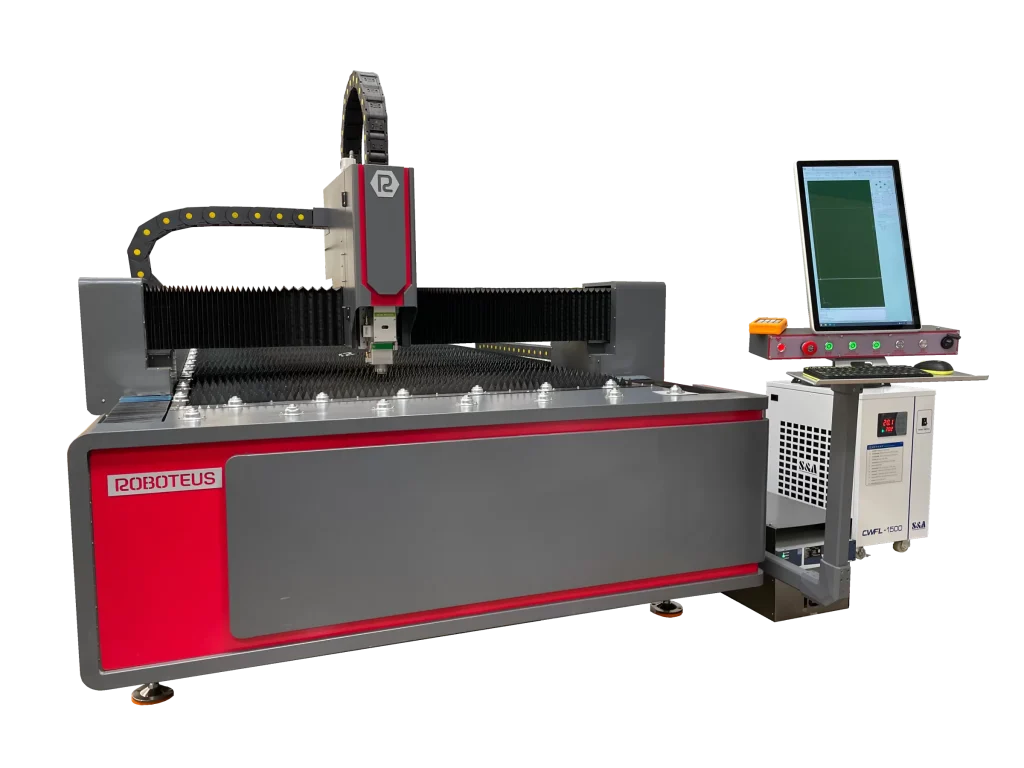
A laser "above 10 mm" is considered a high-power laser. The cutting machine manufacturer specifies a maximum of 20 mm of steel for a 3 kW source, and 25 mm for a 6 kW source—these are maximum values, not cost-effective thicknesses. We couldn't find the manufacturer's original thickness table for the 1500 W power. Roboteus confirms the thickness range for a specific material type before pricing the RBFIB 1530 fiber laser plotter . Approximate vendor declarations for 1500 W are summarized in the "Metal Laser Cutting Machine: How to Choose Power" guide.
In plasma, thickness is determined by the source, not the frame. According to Hypertherm, the Powermax45 XP cuts 16 mm of steel at 500 mm/min and slits 29 mm at 125 mm/min; the Powermax125 cuts 38 mm at 457 mm/min and 57 mm at 57 mm. Roboteus puts it this way: "The maximum thickness is determined not by the cutter itself, but by the power of the plasma source selected for the order." The difference between recommended, slit, and pierce thicknesses is shown in the plasma thickness by current table .
Conclusion: For sheet metal up to a few millimeters, both methods will work, but the laser wins in terms of kerf and edge. In the range of a dozen or so millimeters, laser power and the required tolerance are decisive. Above 30 mm, the laser is removed from SSAB's list.
Edge and Weldability: What Happens After Cutting
ISO 9013 evaluates an edge with a tolerance of perpendicularity or angularity (u) and a roughness of Rz5. According to Hypertherm, the lower the range, the smaller the cut surface angle. Lasers fall within the Kjellberg range of 2–4, while standard air plasma falls within the range of 5. High-precision plasma (HPR) reaches ranges of 2–4 and is, according to Hypertherm, "weld-ready." The industrial, mechanized MAXPRO200 falls within the range of 4, also "weld-ready," according to the same guide, and costs PLN 105,165 net in one store (list price as of October 2026). Polish stores do not publicly price HPR systems.
According to The Fabricator, with nitrogen and air plasma, the nitrogen penetrates the edge of carbon steel and risks causing porosity in the weld, so the edge must be ground; oxygen plasma produces a weld-friendly edge.
Lasers face the same problem in a different form. Laser cutting with oxygen is fast on carbon steel, but according to RP Photonics, it leaves an oxide layer that interferes with welding and coating. Nitrogen produces an oxide-free edge at the expense of speed—this choice is discussed in the guide to gases for laser cutting .
Machine and operating costs in a comparison
Competitor prices are net list prices as of October 2026. Configurations are not identical, so the table shows an order of magnitude, not a ranking.
| Position | Fiber laser | CNC plasma |
|---|---|---|
| Roboteus | RBFIB 1530 (1500 W, 1500 × 3000 mm): from PLN 105,610.00 net, indicative price, process-specific configuration | RBP 1515W (1500 × 1500 mm): from PLN 30,893.00 net, indicative price, configuration for the process; RBP 1530 and RBP 1530 PRO: pricing for the process |
| Competition | Store A, 1500 W: PLN 77,235.77; Store B, 1.5 kW: PLN 150,000.00 | shop B: PLN 31,000.00 without source, PLN 41,000.00 with Spartus ProCUT 125CNC; shop C, with 120 A source: PLN 69,900.00 |
| Accessories separately | CWFL-1500 chiller: PLN 9,500.00; THEOR H1520 compressor with dryer: PLN 23,252.03 (shop B) | Powermax45 SYNC source, CNC kit: PLN 13,399.19 (shop D) |
| Exploitation | nozzles PLN 40.00–42.00, protective glasses PLN 40.00–90.00 (shop B) | Spartus CUT BOX SP125HY set: PLN 550.13 (shop D); the Powermax45 set withstands 3–5 hours of arc on the machine (Hypertherm) |
| Gas | oxygen, nitrogen or air; nitrogen 5.0 in a 50-liter cylinder: PLN 165.00 net (example contract price, Wrocław City Hall) | Compressed air; Powermax105: 217 l/min at 5.9 bar (shop B) |
| Power supply | RBFIB 1530: 380V, 3 phase | RBP frame: 230V; source depends on model (Powermax45 XP also 230V, 65 and 85 SYNC CE – 380-400V) |
The RBFIB 1530 includes an S&A CWFL-1500 chiller and two automatic gas valves (oxygen, nitrogen/air). When using plasma cutters, remember that the plasma source is selected on a case-by-case basis: it determines the cutting thickness and final price, so a fair comparison with a laser is only possible after factoring in the source.
Labor costs are calculated differently. According to RP Photonics, energy and gas per meter of cut constitute a significant portion of laser costs; typical industrial fiber sources have an efficiency of over 30%, according to Laser Focus World. Nozzles and electrodes dominate plasma, and each breakdown shortens their lifespan. A full breakdown of a meter of plasma is available in the article about the cost of plasma cutting , and the "to contract or buy" threshold for lasers is available in the article about the cost of cutting services and your own cutting machine .
Roboteus rule: plasma structures, fiber details
When selecting a machine, Roboteus follows a simple rule: steel structures, sections and elements intended for further welding – plasma; precise details made of thin sheet metal and repeatable edge quality without additional processing – fiber laser plotter.
The justification is provided in the tables. In welded construction, the joint tolerance is determined by the weld, not the edge angle, and plates for butt welds are beveled anyway. According to Hypertherm, an air plasma edge "requires pre-treatment," and nitrogen in the air can cause porosity in the weld, so edge cleanup time must also be included for fillet welds.
In a thin part, the opposite is true: a narrow kerf, a small SWC, and an edge that, with well-selected parameters, usually requires no deburring, allow the part to be sent for bending or assembly without finishing. The savings on finishing can offset some of the difference in machine price—calculate this on your own parts.
Five scenarios: which plant chooses what
Locksmith and steel structures
Gusset plates, column feet, ribs, and bolt holes in thicker steel. Choice: CNC plasma on a sheet format, e.g., an RBP 1530 plasma cutter with a 1500 x 3000 mm field and a ventilated table, with a source selected for the most common thickness. Also, check the thickest plate with holes, as you won't be able to start the hole from the edge: Hypertherm's Powermax65 SYNC penetrates 16 mm, and the Powermax85 SYNC 20 mm. Air plasma holes have a bevel (range 5 according to ISO 9013), so plan for reaming or drilling the fitted holes.
Manufacturer of housings, cabinets and covers
Thin steel and stainless steel, numerous holes and cutouts, and post-cut bending. Choice: fiber laser. Stainless steel is cut with nitrogen to ensure an oxide-free edge before welding or polishing (fiber cutter manufacturers). We describe how the gas changes the edge of stainless steel and aluminum in the article on laser sheet metal cutting .
Advertising and decorative elements
Fine contours, lettering, stainless steel, and thin aluminum. Choice: fiber laser, provided that aluminum reflects the beam and dissipates heat quickly (fiber cutter manufacturers)—thickness for a specific alloy should be confirmed by testing.
Repair shop and small series
Various sheet metals, often rusty or painted, limited budget and space. Choice: RBP 1515W compact plasma cutter – 1500 x 1500 mm field, saber table with integrated water tank, 230V powered frame. Check the power requirements of your chosen plasma source.
Manufacturer of mixed-product machines
Thin covers and thick plates in one order. Choice: both technologies, or fiber for thin sheet metal and ordering thick plates. A second machine means a second station and a second program to master (RBFIB 1530 runs on Cypcut, RBP 1515W and RBP 1530 plotters on FASTCAM), so it makes sense when both groups of parts are constantly demanding work.
Water and Oxygen: When Neither of the Two
According to SSAB, waterjet cutting cuts almost any material without heat (SWC 0 mm) and with tight tolerances, but the equipment is expensive, operation is costly, and speed is low. According to SSAB, oxygen cutting with a gas torch (not to be confused with laser cutting with oxygen) covers 3–300 mm, with the largest heat-affected zone being 4–10 mm. Hypertherm adds that oxygen will not cut stainless steel or aluminum. Scissors and saws are "cold" methods, good for straight cuts. Roboteus doesn't offer these technologies—we're listing them because for plates thicker than 50 mm, the choice between "laser and plasma" is no longer the right question.
Occupational health and safety: different hazards, common extraction
According to CIOP-PIB, a cutting laser is a Class 4 device according to PN-EN 60825-1:2014-11: direct, reflected, and scattered beams are hazardous. A fully enclosed high-power device can be Class 1, which changes the requirements for the workplace (more in the text about fiber lasers in practice ). Plasma is an arc with strong UV—CIOP-PIB recommends filter 11 according to PN-EN 169 (now replaced by PN-EN ISO 16321) for currents of 60–150 A—and a very loud process, requiring hearing protection.
The common factor is smoke. Stainless steel produces chromium VI compounds, for which Directive (EU) 2017/2398 sets a value of 0.005 mg/m³. An exhaust or water table is therefore not an add-on; the differences between a water table and a ventilated table are discussed in the text about what determines what in a CNC plasma cutter .
Frequently asked questions
Laser or plasma for sheet metal up to 3 mm thick?
According to SSAB, both methods will work for thicknesses below 3 mm, and laser will work for thicknesses below 2 mm. Laser produces a narrower kerf, a smaller heat-affected zone, and an edge that typically requires no machining, so for thin sheet metal parts, it usually wins. Plasma makes sense when thin sheet metal is a production margin and tolerances are loose.
From what thickness does plasma have an advantage over laser?
There's no single limit, as it depends on the laser power and the plasma source. According to SSAB, lasers are removed from the list of methods above 30 mm, while Hypertherm indicated that lasers are most efficient below 6 mm. With a 1500 W laser, plasma's advantage begins earlier than with multi-kilowatt machines.
Which method has a smaller heat-affected zone?
Laser. According to SSAB, typical HAZ is 0.2–2 mm for laser, 2–5 mm for plasma, and 4–10 mm for oxy-fuel cutting.
Can I weld immediately after plasma cutting?
Air plasma usually doesn't: Hypertherm labels such an edge as "requires preparation," and according to The Fabricator, nitrogen in the air can cause weld porosity. Mechanized oxygen systems (MAXPRO200, HPR) produce a "weld-ready" edge, according to Hypertherm, but are significantly more expensive than air plasma.
Will a 1500 W fiber laser replace plasma in a locksmith's shop?
In thin sheet metal, yes, with a better edge. In medium thicknesses, 1500W operates close to the limit of vendors' estimated claims, so it's slower and with less process margin, and plasma is often more practical. Roboteus confirms the RBFIB 1530 thickness range for a specific grade before quoting. If thick plates and sections predominate, plasma remains cheaper – compare both categories: fiber laser plotters and CNC plasma plotters , or request a quote for your material.
Sources
- https://roboteus.com/pl/maszyny/plotery-laserowe-fiber/ploter-laserowy-fiber-rbfib-1530/
- https://roboteus.com/pl/maszyny/laser-plotery-fiber/
- https://roboteus.com/pl/maszyny/plotery-plasma/
- https://roboteus.com/pl/maszyny/plotery-plazmowe/ploter-plazmowy-rbp-1515w/
- https://roboteus.com/pl/maszyny/plotery-plazmowe/ploter-plazmowy-rbp-1530/
- https://www.ssab.com/en/support/how-to-process/how-to-cut/20-questions-about-cutting
- https://www.evs.ee/en/iso-9013-2017
- https://www.hypertherm.com/en-US/hypertherm/powermax/powermax45-xp/
- https://www.hypertherm.com/en-US/hypertherm/powermax/powermax125/
- https://www.hypertherm.com/en-US/hypertherm/powermax/powermax65-sync/
- https://www.hypertherm.com/en-US/hypertherm/powermax/powermax85-sync/
- https://www.weldersupply.com/Content/files/ProductPDFs/Powermax125CutSheets.pdf
- https://www.kjellberg.de/quality-parameters.html
- https://www.thefabricator.com/thefabricator/article/plasmacutting/you-can-plasma-cut-it-but-can-you-weld-itr
- https://www.rp-photonics.com/laser_cutting.html
- https://www.rp-photonics.com/fiber_lasers.html
- https://www.laserfocusworld.com/lasers-sources/article/16547048/photonic-frontiers-high-efficiency-optical-pumping-going-green-cranks-up-the-laser-power
- https://www.umw.edu.pl/sites/default/files/2025-11/Cennik%20-%20gazy%20techniczne%20i%20medyczne%2C%20dzier%C5%BCawy%20butli_obowi%C4%85zuje%20do%202.11.2026.pdf
- https://www.ciop.pl/CIOPPortalWAR/file/99433/Ochrona_przed_promieniowaniem_laserowym_MatInf_M.Okrasa_I.PN.06.pdf
- https://www.ciop.pl/CIOPPortalWAR/file/91673/202102050613&BP_8_2020_Owczarek_Szkudlarek.pdf
- https://eur-lex.europa.eu/legal-content/PL/TXT/HTML/?uri=CELEX:32017L2398
Editorial note
List prices quoted in the text are accurate as of October 2026 and are subject to change; please verify with the source before making a decision. Thicknesses, gaps, and edge quality vary depending on the specific machine, source, gas, and material type—the values provided are manufacturer declarations and approximate data, not a guarantee for your part. This text does not replace the manufacturer's instructions or occupational health and safety regulations for working with Class 4 lasers and plasma cutting.