
Metal laser cutters in Polish store catalogs look similar: a 1500 x 3000 mm table, fiber source, autofocus head, and CypCut software. The differences include power, built-in features, and what the seller includes in the price. Power is the most controversial, as the thickness tables in the descriptions rarely specify whether they refer to production cutting or a cut limit.
This text organizes the decision in the following order: product range, power, format, construction, equipment, price. The numbers come from manufacturer tables, from store cards as of October 2026, and from the RBFIB 1530 fiber laser plotter card, always with the source.
"Fiber" refers to a fiber-optic source: the beam is generated in an optical fiber pumped by diodes. We describe how this works and its implications for operation in the text "Fiber Laser in Plant Practice ." If you're still deciding whether to buy, start with the laser cutting calculation—a service or your own cutter .
1. Start with the range, not the watts
Power is selected based on what the plant cuts most frequently, not the thickest sheet metal, which only comes in once a quarter. Take orders from the last year and break them down by material (mild steel, stainless steel, aluminum, galvanized), thickness, and cutting meters.
This list reveals two things. First, what thicknesses most meters are used for, as this determines the efficiency and cost of the part. Second, which items exceed the power considered, and whether it's cheaper to outsource them than to pay extra for a more powerful source.
For example, let's take a metalworking shop where most of its work is made of 1-3 mm mild steel and up to 2 mm stainless steel, and once a month, a 10 mm plate is cut. For this type of profile, speed on thin sheet metal and gas cost are key (see the text for a comparison of nitrogen and oxygen for laser cutting ), and the plate can be commissioned.
Roboteus prefers plasma for the reverse profile, meaning thick sheet metal structures for welding. Edge preparation must be factored in, as Hypertherm claims that air plasma edges "require preparation" before welding. A broader comparison of laser and plasma cutting for steel .
2. Power and thickness: manufacturer data and store declarations
The table below compares two types of data. The cutting machine manufacturer and the cutting system manufacturer provide maximum thicknesses. Shops, marked A–F, provide declarations for their machines, usually with the disclaimer "approximately."
| Power | Data source | Black steel | Stainless steel | Aluminum |
|---|---|---|---|---|
| 1500 W | shop A, table 1300 × 900 mm (shop declaration, approximate) | 10–12 mm | 2–3 mm | 1–2 mm |
| 2000 W | cutting system manufacturer, source IPG YLS (manufacturer's maximum) | up to 5/8″ (approx. 16 mm) | up to 1/2″ (approx. 13 mm) | up to 7/16″ (approx. 11 mm) |
| 3000 W | cutting machine manufacturer (manufacturer maximum) | 20 mm | 16 mm | 16 mm |
| 3000 W | shop A (shop declaration) | 16–18 mm | 5–6 mm | 4–5 mm |
| 3000 W | shop B (shop declaration) | approx. 20 mm | approx. 10 mm | approx. 10 mm |
| 6000 W | cutting machine manufacturer (manufacturer maximum) | 25 mm | 25 mm | 25 mm |
| 12 kW | cutting machine manufacturer (manufacturer maximum) | 30 mm | 40 mm | 30 mm |
Both manufacturers' values are maximums ("maximum sheet thickness," "up to"), not thicknesses at which production is profitable. The cutting system manufacturer adds that the result depends on gas purity, material quality, and site conditions. Shop A states: "Cutting thicknesses are approximate. The range depends on the metal type and process configuration."
The range of declarations is wide. For stainless steel at 3000W, stores quote from 5-6 mm (store A) to approximately 10 mm (store B), while the cutter manufacturer quotes 16 mm as the maximum from its own source. Store C goes the furthest, declaring up to 35 mm of steel for 6 kW, which is higher than the manufacturer's maximum for cutters with a thick sheet metal package (32 mm). The store also notes that the price of the device is calculated based on a request for quotation, so such a declaration must be verified by testing.
Everyone uses a different machine, a different gas, and a different standard of quality, so cards from different stores aren't directly compared. A test cut on your own material is the deciding factor.
We couldn't find a manufacturer's table for 1500 W. Roboteus doesn't publicly provide a thickness table for the RBFIB 1530: "We confirm the thickness range for a specific material type before quoting." Shop A's declaration refers to a different machine and is only a guide.
Copper and brass have significantly lower values in the tables than steel, and aluminum often does as well. There are two reasons for this: unalloyed steel is cut with oxygen, which adds reaction heat (RP Photonics), while non-ferrous metals strongly reflect the beam and dissipate heat quickly (fiber cutter manufacturers). For copper and brass, the cutter manufacturer specifies a maximum of 6 mm at 3 kW, and 20 mm for steel.
Reflections are a separate issue. According to the cutter manufacturer, reflections when cutting copper, brass, galvanized sheet metal, and stainless steel with foil can damage the laser, while Laser Focus World describes the return of reflected light to the fiber. Consult the machine manufacturer before cutting these materials.
3. Maximum and production thickness: where the laser makes money
Speed decreases with thickness. According to RP Photonics, at a power of several kilowatts, several meters per minute of cutting is achievable for sheets several millimeters thick, while the process slows down significantly for thicker sheets. Roboteus addresses this in its FAQ category: power determines both maximum thickness and speed, so the same laser will cut thicker sheet metal slower and thinner sheet metal much faster.
This leads to a simple rule for selection: thicknesses from the dominant part of the assortment should be clearly below the maximum specified on the card. At the limit, the machine cuts slowly, and the grade, surface condition, and gas begin to determine the result. SSAB emphasizes that with laser cutting, clean sheet metal, free of paint and rust, is crucial. We describe how gas and material change the edge in the text on laser cutting of sheet metal: steel, stainless steel, and aluminum .
4. Table format: 1300 × 900, 1500 × 3000 or larger
The format determines what sheet will fit on the table without division, how much space the machine will take up and how much it costs.
- 1300 × 900 mm (e.g., cutter from store A). Small format for details and scraps. It won't accept a full sheet; it must be cut first. The 1500 W version costs PLN 81,219.51 net (as of October 2026).
- 1500 × 3000 mm. Market standard and RBFIB 1530 format. According to Roboteus, the field corresponds to a standard sheet metal array, so the machine accepts a full sheet without pre-splitting.
- 2000 × 4000 and 2000 × 6000 mm. Large sheets and longer details at a higher price: 3000 W and 4050 × 2030 mm in store D for PLN 243,902.44 net, 2000 × 6000 mm in store E for PLN 289,000.00 net (list prices, as of October 2026).
Also, consider the hall. The RBFIB 1530 measures 450 x 220 x 200 cm and weighs 1,700 kg. It also includes a sheet loading area on the side of the table, a chiller, and a waste area. The machine requires a 380 V (3-phase) power supply.
5. Open frame or closed cabin
Many 1500 x 3000 cutters in catalogs are open designs, such as the basic series in Store E or the cutter from Store B with an open table. For example, the 6000 W variant in Store E is fully enclosed.
The difference concerns primarily occupational health and safety: according to CIOP-PIB, cutting lasers are class 4, while a completely enclosed device can be classified as class 1. In the case of an open machine, there is a risk assessment, a separate zone and eye protection selected for the wavelength of the source, because the filters of laser glasses attenuate radiation of a specific wavelength (CIOP-PIB, PN-EN 207:2017-07).
We describe what the laser class means for a workplace in the article on fiber lasers in practice . It's best to discuss safety measures with your health and safety representative before purchasing, not after installation.
6. Head, interchangeable tables and pipe attachment
Autofocus. The head motor-driven focus is adjusted to the value from the technological table for the given thickness and material, so the operator doesn't have to manually adjust the optics with each sheet change. The RBFIB 1530 has a Raytools BM110 head with autofocus. The E-Shop describes autofocus as "above 1500W" in the basic series, so check if it's standard for lower-power versions.
Interchangeable tables. A second table allows you to load a sheet while the machine is cutting the previous one, which is important for batches. The cutting machine from Shop D has a double table, while the more expensive version from Shop B has automatic interchangeable tables.
Pipes and profiles. This is a separate attachment with a turntable. In the catalogs: a 1500 W with attachment in store E for PLN 155,000.00 net ("unavailable for purchase" on the day of the review) and a sheet metal and pipe machine in store B from PLN 290,000.00 net (list prices, as of October 2026). If pipes are rare, it's usually more prudent to outsource them.
7. What is included in the price: chiller, compressor, software, installation
| Offer | Cooling | Control | Facilities and services by site |
|---|---|---|---|
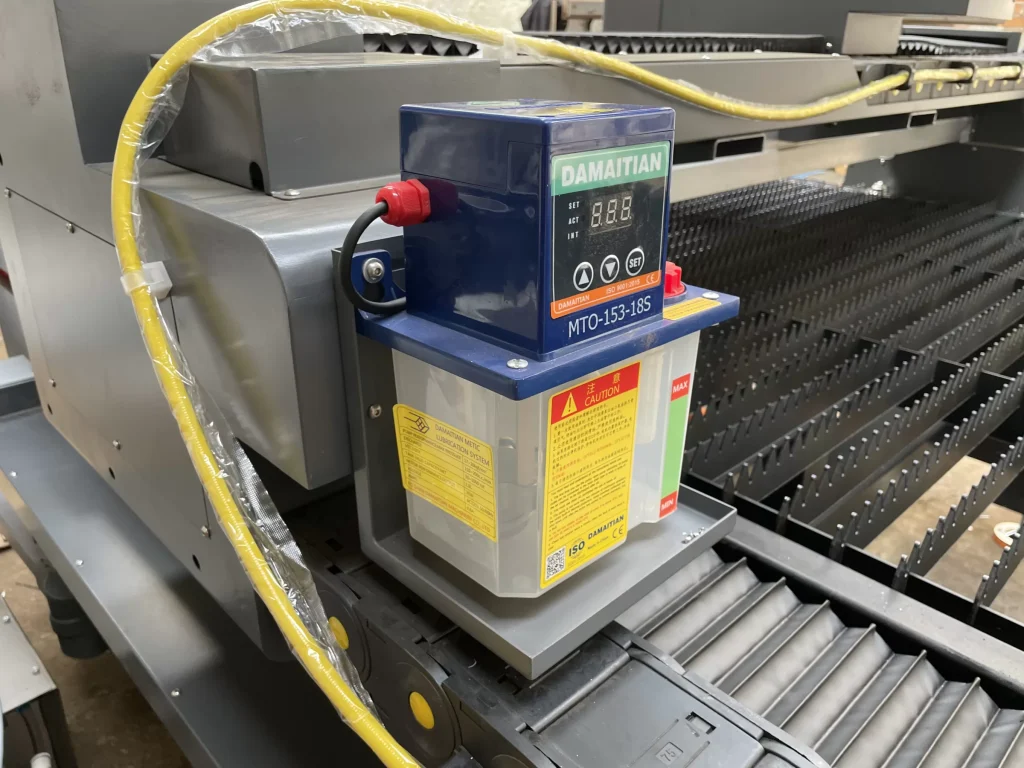
| Roboteus RBFIB 1530 | S&A CWFL-1500 chiller included | Cypcut CypOne, MPG remote control, built-in computer | 2 automatic gas valves, lubricator, waste trays |
| E Store, Open Series | S&A chiller | CypCut, TNS voltage stabilizer | 12/24 month warranty |
| Shop B | – | CypCut | delivery and assembly, operator training, 24-month warranty |
| Shop D | – | CYPCUT 2000, double table | free training, 12-month warranty |
| Shop A, table 1300 × 900 mm | CWFL-1000 chiller included | CypCut2000s on integrated computer | – |
| Shop F | S&A 3000 cooler included | CYPCUT with autofocus | – |
The dash indicates that the data sheet doesn't list it, not that the component is definitely missing. Shop A lists the CWFL-1000 chiller for 1500W, while Shop E describes the CWFL-1500 as a cooler for lasers up to 1500W, so ask if the chiller is sized for the source. A compressor isn't listed in the specifications for either of these machines, including the RBFIB 1530. Cutting with compressed air requires a high-pressure compressor with a dryer.
Example prices of equipment purchased separately (E store, net, as of October 2026): CWFL-1500 chiller PLN 9,500.00, THEOR H1520 compressor with dryer PLN 23,252.03, Raytools 3000 W head PLN 19,512.19. Add 3-phase installation, gas and fume extraction to your budget.
8. How much does a metal laser cutter cost: list prices by power
Net list prices, as of October 2026, format 1500 × 3000 mm, unless otherwise stated.
| Power | Shop or model | Comments | Net price |
|---|---|---|---|
| 1000 W | E-shop | open | 142,800.00 PLN |
| 1500 W | Roboteus RBFIB 1530 | indicative price, configuration for the process | from PLN 105,610.00 |
| 1500 W | D store | 3050 × 1530 mm, double table | 77,235.77 PLN |
| 1500 W | E-shop | open | 150,000.00 PLN |
| 2000 W | E-shop | open | 165,600.00 PLN |
| 3000 W | D store | 3050 × 1530 mm | 105,691.06 PLN |
| 3000 W | E-shop | open | 178,800.00 PLN |
| 3000 W | shop B | delivery, assembly, training, 24-month warranty | 185,000.00 PLN |
| 3000 W | F store | "up to 3000W" | 199,900.00 PLN |
| 4000 W | E-shop | open | 222,000.00 PLN |
| 6000 W | D store | 3050 × 1530 mm | 203,252.03 PLN |
| 6000 W | shop B | as above | 235,000.00 PLN |
| 6000 W | E-shop | closed | 240,000.00 PLN |
The same power costs significantly differently in different stores. The price is influenced by the source brand, the head, the housing, the number of tables, and the services included in the package. The scale of the differences is demonstrated by the component itself: store E prices the 2000W IPG source at PLN 82,000.00 net. In catalogs that offer 1500W and 3000W variants of the same machine (stores A, B, D, and E), the additional charge for 3000W ranges from several thousand to almost thirty thousand zloty net.
So compare configurations, not just watts. You can spread your purchase over time: Roboteus describes leasing and financing for machines .
9. Ten questions to ask the seller before purchasing
- What thicknesses do you provide for my species and gases: maximum or production? Will you perform a test cut on my material?
- What brand and model of the source, and what is the warranty on the source itself?
- What head and is autofocus standard?
- Is a chiller included and does it match the power of the source?
- What gases does the machine support, how many valves does it have, and is a compressor with a dryer included?
- What software and nesting, in what language version and with what license? What file formats does it accept?
- Open or closed structure, what laser class and what health and safety measures do I need to provide?
- What power supply, dimensions, weight, and flooring requirements are required? Who is responsible for transport and installation?
- Who conducts the commissioning and training, where is the service center located, and are nozzles and protective glass readily available?
- What exactly does the price include: delivery, installation, training, software? Is the amount net?
With a list of answers, it's easier to compare offers. We price the RBFIB 1530 and other Roboteus fiber laser cutters for a specific process— request a quote with a list of materials and thicknesses.
Frequently asked questions
How thick does a 1500W laser cut?
For the RBFIB 1530, Roboteus confirms the material range for a specific material type before quoting. Shops provide approximate specifications for their machines, for example, one shop for a 1500W machine: steel 10–12 mm, stainless steel 2–3 mm, aluminum 1–2 mm. These are the limiting values, and the machine typically operates on thinner sheets.
Is it worth paying extra for 3000W?
Yes, if a significant portion of your orders are close to the 1500W mark, or if speed on medium-thickness sheets is important. If thick sheets are a bit of a stretch, it's often cheaper to outsource them. Calculate this on your own inventory before deciding on power.
How much does a 1500 × 3000 mm fiber laser cutter cost?
In the listed catalogs (net, as of October 2026), prices start at PLN 77,235.77 (1500 W), and the 6000 W versions cost from PLN 203,252.03, both from the same distributor. The RBFIB 1530 has a guide price from PLN 105,610.00 net, configured for the process.
Is a 1500 W laser enough for a small locksmith shop?
If the majority of the meters are thin black and stainless steel, and thick plates are rare, then usually yes, and the plates can be ordered. Roboteus confirms the RBFIB 1530 thickness range for a specific grade before quoting, so first list the assortment as in point 1.
Does a laser cutter require 3-phase power?
Machines of this class are powered from a three-phase network: the RBFIB 1530 requires 380 V, while one store specifies 400 V. Plan the connection, chiller, and any compressor before delivery.
Sources
- https://roboteus.com/pl/maszyny/plotery-laserowe-fiber/ploter-laserowy-fiber-rbfib-1530/ — RBFIB 1530 specifications, indicative price
- https://roboteus.com/pl/maszyny/plotery-laserowe-fiber/ — FAQ category: thickness range confirmed before quotation, power and speed
- https://www.rp-photonics.com/laser_cutting.html — cutting speed vs. thickness, oxygen heat of reaction
- https://www.laserfocusworld.com/industrial-laser-solutions/article/14218987/laser-processing-reflective-materials — Reflections to Fiber
- https://www.ssab.com/en/support/how-to-process/how-to-cut/20-questions-about-cutting – sheet metal surface for laser cutting
- https://www.ciop.pl/CIOPPortalWAR/file/99433/Ochrona_przed_promieniowaniem_laserowym_MatInf_M.Okrasa_I.PN.06.pdf — laser classes according to PN-EN 60825-1:2014-11, eye protection and PN-EN 207:2017-07
Editorial note
List prices are from retailer websites as of October 2026 and are subject to change; some are promotional prices, and some models were unavailable at the time of review. Cutting thicknesses vary depending on the specific machine, material type, and gas, and manufacturer values are maximums, not production parameters. This text does not replace manufacturer instructions or occupational health and safety regulations for working with Class 4 lasers.