
Nitrogen or oxygen? Laser cutting of black steel can be performed with either of these gases, as well as compressed air. However, the results are not the same. The edge, speed, suitability of the part for welding and painting, and the cost per hour of machine operation vary.
In a fiber optic cutter, the edge is also determined by power, focus, and speed, but its chemistry—oxides or the lack thereof—is determined by the accompanying gas, also called the process gas, which flows through the nozzle along with the beam.
In this post, we describe the mechanism of each of the three gases and provide a table for selecting the gas for the part's intended use. We discuss nitrogen purity and pressure, supply methods with sample prices from tender agreements, and the calculation of gas costs per hour with explicit assumptions. Finally, we show how this works in a cutting machine with two gas lines.
1. What does the accompanying gas do?
The gas has two purposes: to blow molten metal out of the cutting kerf and to protect the cutting head's optics from spatter. Whether or not it reacts with the metal in the process divides laser cutting into two methods:
- laser cutting with oxygen (with oxidation, exothermic) : oxygen burns the metal in the gap and adds reaction heat; this is not the same as oxygen cutting with a gas torch,
- fusion cutting : an inert gas, most often nitrogen, only blows away the metal melted by the beam.
Compressed air, a mixture of nitrogen and oxygen, lies between them.
2. Oxygen: cutting with oxidation and additional heat
According to RP Photonics, oxygen oxidizes the blown metal and provides additional heat, which can be "significantly greater than the heat input from the laser." Therefore, oxygen cuts relatively thick mild steel quickly with the same source power.
The price is the edge. RP Photonics notes that the surface treated with oxygen tends to be rougher and covered with an oxide layer, and the oxides can interfere with welding and coating. Air Products adds that laser cutting with oxygen is only suitable for unalloyed and low-alloy steels. On stainless steel and aluminum, oxygen does not produce a usable edge.
3. Nitrogen: alloy cut and oxide-free edge
With an inert gas, "all the energy to melt the metal is supplied by the laser," write the Air Products authors. The nitrogen blows away the molten metal and cools the cutting zone, resulting in a clean, oxide-free surface. Cutting machine manufacturer A puts it more succinctly: nitrogen "eliminates oxidation."
The lack of reaction heat comes at a cost. The manufacturer of C-cutting systems writes that nitrogen cutting of unalloyed steel results in an oxide-free edge, but cutting speeds are "significantly lower." Furthermore, alloy cutting requires high pressure because all the molten metal must be blown out with a single gas jet. Therefore, nitrogen consumption is high, as discussed in point 8.
Nitrogen is standard for stainless steel. B-cutter manufacturer recommends it when an oxide-free edge is to be removed before welding or polishing.
4. Compressed Air: A Compromise and a Standard for Aluminum
Manufacturer A describes air as a gas that causes a slight exothermic reaction but can produce "mild oxidation." Manufacturer B considers it an alternative for medium-gauge carbon steel when a bright edge is not required. For aluminum, high-pressure air cutting is considered by Manufacturer B to be the "standard method," and Manufacturer A also indicates air as a better choice for aluminum.
The advantage of air is its cost. It's generated on-site using a compressor, without cylinders or supplies. Quality is a prerequisite: air for laser cutting must be dry and clean, as oil and water from the system enter the cutting head and settle on the optics. Therefore, compressors for cutting machines are sold with a dryer and filters.
5. Nitrogen, oxygen or air: selection according to the intended use of the part
| Detail and purpose | Gas | Edge | Cost and pace |
|---|---|---|---|
| Black steel, the edge remains raw | oxygen | oxide layer | quickly thanks to the heat of reaction (RP Photonics) |
| Black steel for powder coating or welding | nitrogen or oxygen and edge cleaning | Oxide-free with nitrogen; oxides interfere with welding and coating (RP Photonics) | nitrogen significantly slower (producer C) and with high gas consumption |
| Medium-thick black steel, edge color irrelevant | compressed air | slight oxidation (producer A) | alternative according to manufacturer B; gas from its own compressor |
| Stainless steel for display, for welding or for polishing | nitrogen with a purity of 99.995% | bright, oxide-free (Air Products) | oxygen is not compatible with high-alloy steel (Air Products) |
| Aluminum | compressed air or nitrogen | slight oxidation in air | air is the standard method; aluminum reflects the beam and dissipates heat quickly (manufacturer B, Laser Focus World) |
We describe the details of edge, burr, and file preparation for each of these materials in the article on how laser cutting of steel, stainless steel, and aluminum sheet metal is performed. We discuss why non-ferrous metals are difficult to source in the article on what fiber lasers mean in plant practice .
6. Nitrogen purity and pressure
Nitrogen purity is described as a percentage or in ppm of impurities. Air Products provides a simple conversion: 99.9% is 1000 ppm, 99.99% is 100 ppm, and 99.999% is 10 ppm. The most important sentence from the same publication is that a bright, clean surface is achieved "only with a purity of 99.995% or higher."
Cylinder price lists include classes 4.0, 4.6, 5.0, and 6.0, as well as "technical" nitrogen. Air Liquide describes 5N+ nitrogen as having a purity above 99.999%, which is well above the Air Products threshold. Technical and class 4.x nitrogen will not provide a reliable bright edge for stainless steel; don't assume they meet the 99.995% threshold. Confirm the purity of a specific cylinder with the supplier (certificate) and test it on your own material.
Atlas Copco points out the other side of the coin: nitrogen from deliveries usually has a constant purity of 99.999%, which is sometimes overestimated, so it is worth selecting the purity according to the actual need.
Pressure during alloy cutting is high. Manufacturer C specifies "up to 25 bar," while Atlas Copco writes that fiber lasers typically require 8–20 bar of nitrogen, depending on the material and thickness. Manufacturer B adds that with thick stainless steel, quality is determined more by gas pressure than focal point position.
We don't provide oxygen pressure because we couldn't find it in verifiable manufacturer data. You can find the correct values for the material and thickness in the machine's control technology tables. In its deburring guide, Raycus recommends adjusting the gas pressure in small increments of 0.1–0.2 bar, and assessing the edge after each change.
7. Where to get the gas: cylinders, bundles, liquid nitrogen, generator, compressor
Cylinders. This is the simplest form and a good place to start. Below are sample contract prices from university tender agreements. These are not retail prices, but rather negotiated rates in public procurement contracts, so a company purchasing several cylinders a month will receive its own quote.
| Gas, 50 l cylinder | Price per cylinder | Agreement |
|---|---|---|
| Nitrogen 5.0 (9.6 m³, 200 bar) | 165.00 PLN net | Medical University of Wrocław |
| Nitrogen 4.0 (9.6 m³) | 96.60 PLN net | as above |
| Nitrogen 5.0 / 4.6 / technical | 120.00 / 100.00 / 80.00 PLN net | Messer for ZUT in Szczecin |
| Technical nitrogen / N5.0 (gross prices) | 135 PLN / 246 PLN gross (14 / 25 PLN gross per m³) | Messer for the Warsaw University of Technology |
| Oxygen, classes 2.5–5.0 (oxygen 5.5: PLN 550.00) | 110.00–180.00 PLN net | Messer for ZUT in Szczecin |
The gas price includes cylinder rental. The Wrocław contract is PLN 0.80 net per cylinder per day or PLN 250.00 per year, while the Szczecin contract is PLN 0.55 per day and PLN 50.00 for transportation.
Cylinder bundles and liquid nitrogen in a tank. For larger consumption, suppliers offer connected cylinder bundles or a liquid nitrogen tank with a vaporizer. We couldn't find prices for these solutions in published price lists; the gas supplier prices them based on annual consumption.
Nitrogen generator. Produces nitrogen from compressed air on-site. Manufacturer A states that 2.8 m³ of air can produce 1 m³ of nitrogen at a cost of "about 5 cents," with a purity of 99.9999% and a pressure of nearly 30 bar. This is marketing data from the manufacturer who sells such systems. Manufacturers (Atlas Copco, Inmatec) provide generator prices upon request.
Air cutting compressor. Example from the store catalog, as of October 2026: THEOR H1520 COMPACT screw compressor with dryer, 15 kW, up to 20 bar, 1050 l/min at 16 bar and 930 l/min at 20 bar, costs PLN 23,252.03 net. The pressure range matches Atlas Copco's nitrogen range.
8. How much does gas cost per hour – example with assumptions
Gas consumption depends on nozzle diameter, pressure, and thickness, and an accurate value can only be obtained by measuring it on your own machine. Air Products reports nitrogen consumption for stainless steel ranging from several hundred cubic feet per hour (SCFH) for sheets below 2.5 mm to several thousand for sheets above 12.7 mm. As a guide, 1000 SCFH is approximately 28 m³/h.
| Parameter | Value | From where |
|---|---|---|
| Gas consumption during cutting | 10 m³/h | we accept, thin stainless steel |
| Nitrogen 5.0, 9.6 m³ cylinder | 165.00 PLN net | contract price, Wrocław City Hall |
| compressor | 15 kW, 1050 l/min at 16 bar | store card, THEOR H1520 |
| Energy price | PLN 1.00 net per kWh | we accept |
| Cutting speed | 3 m/min, i.e. 180 m/h | we assume, without assigning to thickness |
| Variant | Calculation | Gas per hour of cutting | Gas per meter |
|---|---|---|---|
| Nitrogen from a 5.0 cylinder | estimate: PLN 165.00 / 9.6 m³ = PLN 17.19 per m³ | 171.88 PLN net | estimated PLN 0.95 |
| Nitrogen 5.0, Messer contract with PW | estimate: PLN 25 per m³ gross | 250 PLN gross | estimated PLN 1.39 gross |
| Compressed air | estimate: 15 kWh / 63 m³ = PLN 0.24 per m³ | 2.38 PLN net | estimated 0.01 PLN |
The cost of gas per meter increases inversely with the speed: when cutting twice as slow, it is twice as high, and with thicker stainless steel, the nitrogen consumption also increases (Air Products).
Three conclusions emerge from this example. First, at assumed consumption, one nitrogen cylinder is sufficient for less than an hour of cutting, approximately 58 minutes. When producing with nitrogen, cylinders quickly become insufficient, and a bundle, tank, or generator must be considered.
Secondly, air is several dozen times cheaper than bottled nitrogen. The estimate doesn't include compressor, filter, or service depreciation, but even with these, the difference remains significant.
For a nitrogen generator starting from compressed air, the energy required to compress 2.8 m³ of air, based on our assumptions, is estimated at PLN 0.67 per m³ of nitrogen, excluding the price of the device. This is significantly more than manufacturer A's declaration, demonstrating how strongly the result depends on the assumptions about the compressor and energy prices.
Third, we don't count oxygen in the table: without data from the technical data sheet of a specific machine, we can't provide either pressure or oxygen flow. Measure it with a test: weigh the cylinder or read the pressure drop before and after the change.
For comparison, the price list for the Cut It Fast service in Katowice (net prices, as of October 2026) is PLN 5.00/m for 3 mm black steel and PLN 13.50/m for 1.4301 stainless steel of the same thickness. High-pressure nitrogen is one of the factors that accounts for this difference. The full "outsource or buy" calculation is described in the article "Laser cutting: service price vs. your own cutter ."
9. Two gas lines in RBFIB 1530 and installation safety
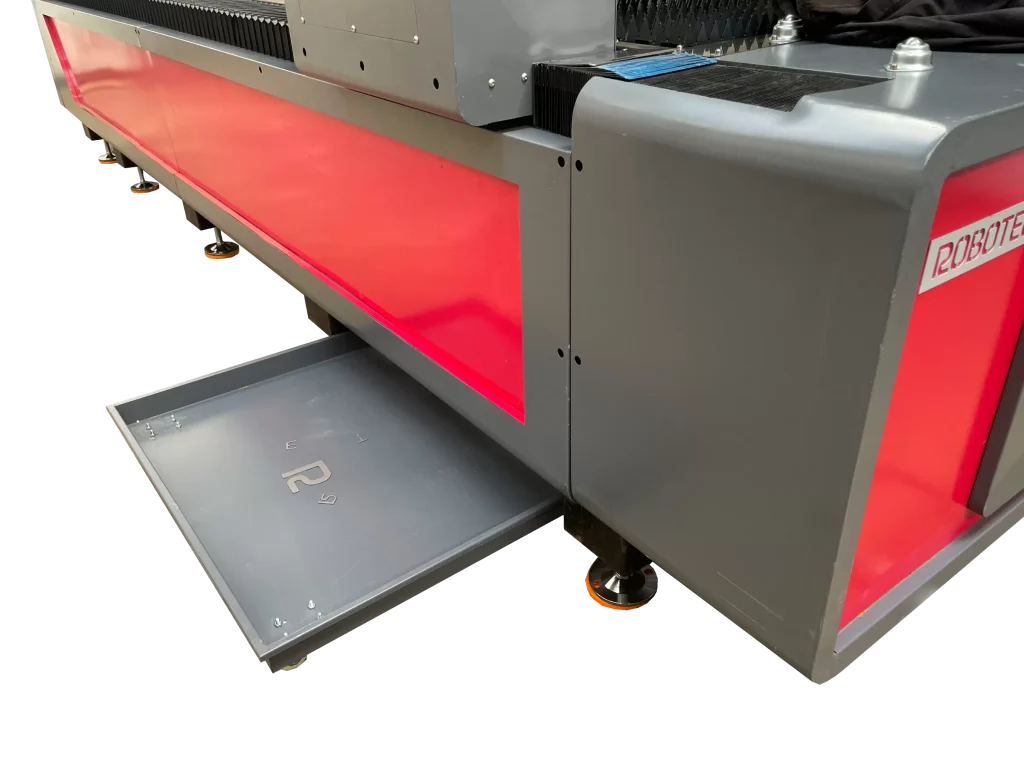
The RBFIB 1530 fiber laser cutter has two automatic gas valves: one for oxygen, and the other for nitrogen and air. According to the machine's data sheet, these separate valves allow for quick switching of cutting technologies depending on the metal being processed. The oxygen line uses either a cylinder or an oxygen beam. The other line uses nitrogen or compressed air, depending on which the facility cuts more frequently.
The machine features a Raycus 1500W power source, a Raytools BM110 autofocus head, Cypcut control, and a 1500 x 3000 mm field; the guide price is from PLN 105,610.00 net (process-specific configuration). Roboteus confirms the thickness range for a specific material type before quoting, and at this power, stainless steel is primarily thin sheet metal in nitrogen.
Some safety rules for gas installations:
- Oxygen. Air Products requires that oxygen systems be "oxygen cleaned," meaning they are free of grease and oil in accordance with CGA G-4.1, NFPA 99, and ASTM G93 standards. Conventional lubricants are not used on oxygen fittings.
- Nitrogen. This inert gas displaces oxygen from the air. Cylinders and tanks should be placed in a well-ventilated area, and for large installations, an oxygen sensor in the room is worth considering.
- Cylinders. They are secured against tipping and connected via regulators appropriate for the gas and pressure.
- Laser. According to CIOP-PIB, industrial cutting lasers are class 4 devices unless they are completely enclosed; the protection principles are described in the text " Fiber Laser in Plant Practice ."
If you'd like to select the right gas and supplies for your parts, please provide the grades, thicknesses, and monthly meter count, then request a quote . Other machines are available on the Roboteus fiber laser plotters page.
Frequently asked questions
Nitrogen or oxygen – laser cutting of black steel: which to choose?
Oxygen, when speed and thickness are important, and the oxide-bearing edge doesn't interfere with further processing. Nitrogen, when the part is to be powder-coated or welded without grinding, because the edge is oxide-free. Producer C notes that nitrogen cuts black steel much slower, so the cost per meter increases.
What gas is used for laser cutting stainless steel?
Nitrogen. Air Products states that a bright edge is achieved only at a purity of at least 99.995%, so don't rely on technical nitrogen or class 4.x; confirm cylinder purity with your supplier. Oxygen, according to the same source, is only compatible with unalloyed and low-alloy steel.
Will compressed air replace nitrogen?
Partially. For aluminum, air is the standard method according to manufacturer B, and for medium-thickness mild steel, it's an alternative when a bright edge isn't required. For stainless steel, which requires a bright edge, air causes slight oxidation and is not a substitute for nitrogen.
What is the nitrogen pressure for fiber laser cutting?
Atlas Copco typically specifies 8–20 bar depending on material and thickness, while manufacturer C states pressures of "up to 25 bar" for alloy cutting. The machine's technology table provides the correct value for a specific sheet.
How much nitrogen does a laser cutter use?
According to Air Products, from several hundred SCFH for thin stainless steel to several thousand SCFH for sheets over 12.7 mm thick; 1000 SCFH is approximately 28 m³/h. Consumption depends primarily on the nozzle and pressure. In our example, assuming 10 m³/h, one 50-liter cylinder is sufficient for less than an hour of cutting.
Sources
- https://www.rp-photonics.com/laser_cutting.html
- https://www.airproducts.ca/-/media/files/en/330/330-18-003-us-optimizing-gas-supply-for-industrial-lasers.pdf
- https://www.airproducts.com/applications/laser
- https://www.atlascopco.com/en-ly/compressors/industry-solutions/laser-cutting
- https://sg.airliquide.com/sites/al_sg/files/2026-03/laser-cutting.pdf
- https://en.raycuslaser.com/view/2156.html
- https://www.laserfocusworld.com/industrial-laser-solutions/article/14218987/laser-processing-reflective-materials
- https://www.umw.edu.pl/sites/default/files/2025-11/Cennik%20-%20gazy%20techniczne%20i%20medyczne%2C%20dzier%C5%BCawy%20butli_obowi%C4%85zuje%20do%202.11.2026.pdf
- https://zamowienia.zut.edu.pl/fileadmin/pliki/zam/xSlawomir_Tarnawski/gazy_26-27/umowy/cennik_messer_zad1.pdf
- https://www.ch.pw.edu.pl/index.php/content/download/12632/80961/file/Roczne%20dostawy%20gaz%C3%B3w%20w%20butlach%20umowa%20Messer%20Polska%20do%2008.06.2027%20r..pdf
- https://cutitfast.pl/
- https://www.ciop.pl/CIOPPortalWAR/file/99433/Ochrona_przed_promieniowaniem_laserowym_MatInf_M.Okrasa_I.PN.06.pdf
- https://roboteus.com/pl/maszyny/plotery-laserowe-fiber/ploter-laserowy-fiber-rbfib-1530/
Editorial note
Gas prices are derived from university procurement contracts (as of October 2026) and are examples, not retail prices; list prices for machines and services are also subject to change. The numbers in the gas cost example are illustrative, and pressures, flow rates, and edge quality vary depending on the machine, nozzle, and material. This text does not replace the machine manufacturer's and gas supplier's instructions, nor does it replace the health and safety regulations for Class 4 lasers and industrial gas installations.