
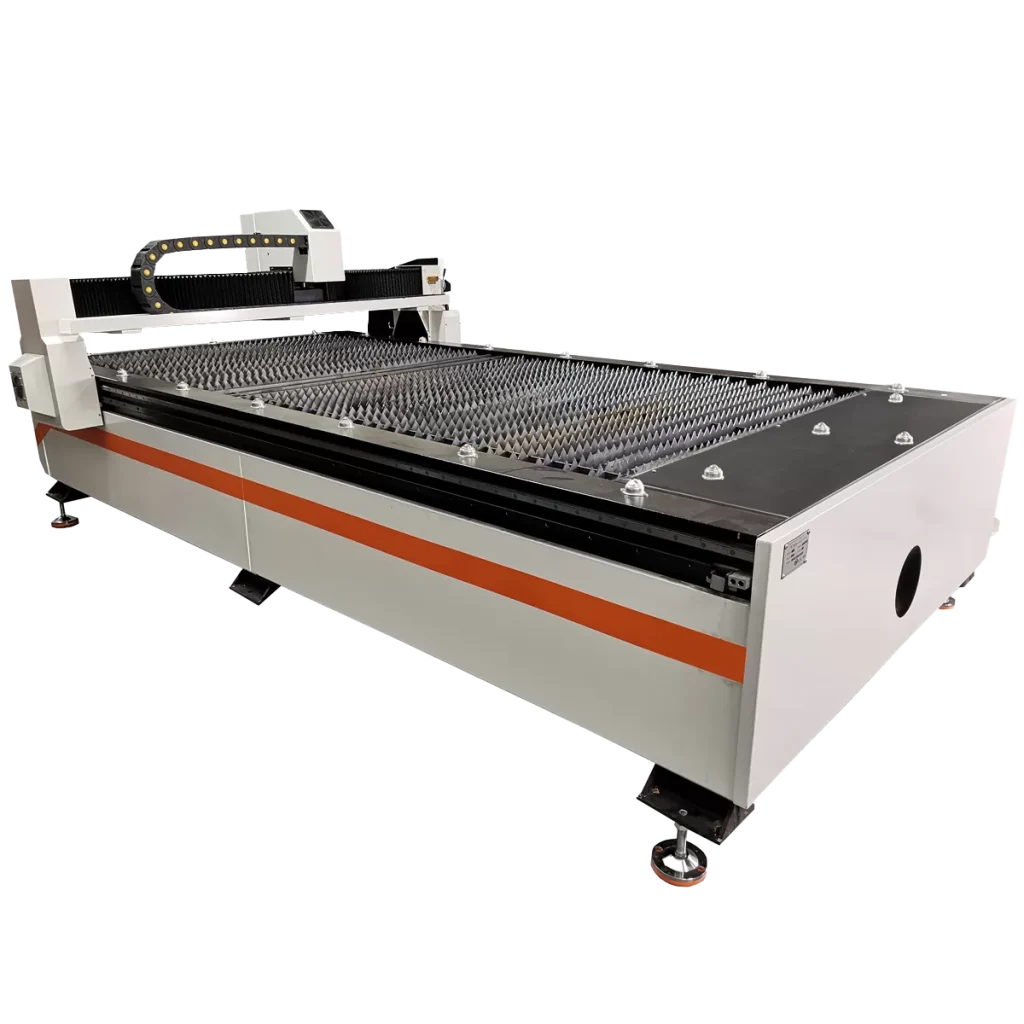
Plasma cutting is usually chosen because it's cheaper to purchase than laser cutting and can handle thicker steel. When asked what thickness plasma can cut, stores often answer with a single maximum number. This is a common source of disappointment: this number can be a separating thickness, leaving the edge suitable only for further processing.
This text explains what happens inside the torch, the difference between air plasma and high-precision plasma, and how to read the manufacturer's thickness chart: recommended, separating, and pierce. Edge quality, materials, common faults with symptoms, and health and safety information are also covered. The numbers are taken from Hypertherm data sheets and manuals, SSAB and The Fabricator publications, and the Central Institute for Labor Protection-National Research Institute (CIOP-PIB).
The physics are the same in a manual cutter and a CNC plotter, but they are two different devices. The selection of a manual inverter is described in the article "Plasma cutter: manual or CNC table ," and the construction of a portal machine is described in the text about what determines a CNC plasma cutter .
How Plasma Cutting Works: Arc, Gas, Nozzle, and Electrode
According to Przegląd Spawalnictwa, the arc burns between a non-consumable electrode (cathode) and the material being cut (anode). Plasma gas flows through the torch, ionizing the arc, and the plasma jet reaches 10,000–30,000 K and a speed close to the speed of sound. According to SSAB, steel is melted in this jet; in air and oxygen plasma, it is also oxidized and blown out of the gap. According to The Fabricator, the energy is concentrated by the small nozzle diameter combined with the gas swirl—this distinguishes plasma from a regular arc.
Hypertherm describes the torch as a set of consumable parts:
- the electrode supplies the current and is the starting point of the arc; its emission insert is made of a metal with a very high melting point, e.g. hafnium or tungsten;
- the swirl ring centers the arc and narrows it, resulting in faster cutting and greater thickness;
- the nozzle shapes, directs and narrows the arc;
- the cover protects the nozzle from splashes.
The material is part of the circuit, so plasma cuts only conductive metals. Consumption of these parts is the main component of the cost per meter of cut—we'll break down the calculation in the text about the cost of plasma cutting .
Air plasma and high-precision plasma
Powermax sources cut with compressed air: this is standard in workshops and on most CNC tables. High-precision systems operate on oxygen and other gases. According to The Fabricator, oxygen plasma produces a smaller bevel, less roughness, a thinner heat-affected zone, and a weld-friendly edge. Nitrogen from nitrogen and air plasma can cause weld porosity—we expand on this topic in the comparison of laser and plasma for steel cutting .
| Class | Example (Hypertherm) | Edge angle according to ISO 9013 | Edge for welding |
|---|---|---|---|
| Air plasma | Powermax45–125 | range 5 | "requires preparation" |
| Industrial plasma | MAXPRO200 | range 4 | "ready to weld" |
| High-precision plasma | HPR, XPR | Ranges 2–4; XPR300 Range 2 on thin steel | "ready to weld" |
The angle and weldability designations are from the Hypertherm guide (2012) and the XPR300 website. We've summarized the source prices for each class in the text about what determines the performance of a CNC plasma cutter . For metalworking, the choice usually comes down to air plasma, and the difference in edge length must then be factored into the pre-weld grinding time. The RBP 1530 PRO plasma cutter has a universal connector for Hypertherm and Spartus generators.
What thickness range does plasma cutting provide: table by current
Hypertherm provides four steel thickness values for each source. The recommended value is production thickness at 500 mm/min. The second value is cutting thickness at 250 mm/min. The severance value is the thickness that can be cut manually at 125 mm/min, leaving a workable edge. Pierce is the thickness that the source pierces manually or with automatic torch height control.
| Source | Current | Recommended (500 mm/min) | Cutting (250 mm/min) | Separating (125 mm/min) | Puncture |
|---|---|---|---|---|---|
| Powermax45 XP | 10-45 A | 16 mm | 22 mm | 29 mm | 12 mm |
| Powermax65 SYNC | 20–65 A | 20 mm | 25 mm | 32 mm | 16 mm |
| Powermax85 SYNC | 25–85 A | 25 mm | 32 mm | 38 mm | 20 mm |
| Powermax105 SYNC | 30–105 A | 32 mm | 38 mm | 50 mm | 22 mm |
| Powermax125 | 30–125 A | 38 mm (457 mm/min) | 44 mm | 57 mm | 25 mm |
How to use it: The power source is selected so that the most common thickness falls into the "recommended" column, not the "separation" column. Example from the table: for 20 mm sheet metal, the Powermax65 SYNC has a recommended thickness of 20 mm, but only pierces 16 mm. The outer contour can then be started from the edge of the sheet, but not the hole inside the part. Therefore, for holes in 20 mm sheet metal, a more powerful power source is required—the Powermax85 SYNC pierces 20 mm.
Store declarations should be read with the same caution. One domestic store lists a "max. cutting thickness of 55 mm" for the Spartus ProCUT 125CNC source without specifying which point; another store distinguishes between separating and quality cuts for manual inverters, e.g., the Ideal Tecno Plasma 45: 18 and 14 mm.
Industrial systems set the upper limit. ISO 9013:2017 covers plasma cutting in the range of 0.5–150 mm, while Hypertherm specifies stainless steel cutting up to 160 mm for the HPR800XD. Roboteus routers have a simple rule: "The maximum thickness is determined not by the router itself, but by the power of the plasma source selected for the order." The same frame, for example, the RBP 1530 plasma router with a 1500 x 3000 mm field, can work with different sources, and the price depends on the source—the RBP 1530 is priced according to the process. Full offer: Roboteus CNC plasma routers .
Piercing or starting from the edge
Piercing is the most critical moment for the torch. According to the Powermax45 manual, pierce height is typically 2.5 times the cut height; on the 45A card for steel, it's 1.5 mm (0.06 in) at cut height and 3.8 mm (1.5 in) at pierce. Pierce delay increases with thickness, from 0.0 s to 0.9 s at 9.5 mm (3.7 in), and from 15.9 mm (0.6 in), the manual recommends edge starting.
Piercing shortens the life of the part compared to starting from the edge (Powermax45 manual). We'll calculate how this translates to cost per meter in the text about the cost of plasma cutting .
The cutting height is maintained by THC, or torch height control, based on arc voltage (Powermax45 manual). The RBP 1515W and RBP 1530 routers have a built-in THC, and the RBP 1530 PRO has a PROMA 50:1 THC and a collision-free OHMIC torch system; we describe how to evaluate THC when purchasing in the text about CNC plasma cutting machines.
Plasma Edge: Angle, Dross, SWC and Gap
PN-EN ISO 9013 evaluates the edge, among other things, by perpendicularity or angle tolerance (u) and roughness Rz5; the lower the range, the smaller the cutting surface angle (Hypertherm).
The skew is a feature of the process, not a machine defect. The Powermax45 manual states clearly: the most perpendicular edge is on the right side relative to the torch's direction of travel, and the left side always has a skew. Therefore, the contour bypass direction is set in CAM so that the part lies on the side of the straighter edge.
The same instructions note that air plasma will always produce some dross. According to The Fabricator, high quality is ideally a bevel between 0 and 1°.
Speed affects the edge more severely than expected. In a study by Przegląd Spawalnictwa, 20 mm thick S355J2 samples cut with oxygen plasma had a roughness tolerance in the range of 1 and a perpendicularity tolerance in the range of 3. At a speed of 450 mm/min, perpendicularity dropped to the range of 4. This is the result of an industrial system using oxygen as the plasma gas; for air plasma, such as Powermax, Hypertherm reports an angle in the range of 5.
The heat-affected zone for plasma is 2–5 mm according to SSAB. The kerf is given in the Powermax125 manual for steel and the "Best Quality" setting:
| Current | Slot | Thickness range |
|---|---|---|
| 45 A | 1.3–1.6 mm | 0.5–6 mm |
| 65 A | 1.6–3.7 mm | 2–25 mm |
| 125 A | 2.2–4.1 mm | 6–40 mm |
The kerf is entered into the CAM as compensation; otherwise, the outer contour will be smaller and the holes will be larger by half its width on each side. For wear-resistant and high-strength steels, SSAB warns against delayed hydrogen cracks after thermal cutting, which can appear after several days; preheating prevents them.
What metals can and cannot be cut by plasma?
Plasma cuts mild steel, galvanized sheet metal, aluminum, and stainless steel; it won't cut plexiglass, plywood, rubber, or leather (Roboteus). For non-metallic materials, a CO2 laser cutter is used—we describe how to do this in the article about what a CO2 laser cutter is good for . According to Hypertherm, oxy-fuel cutting with a gas torch can't cut stainless steel or aluminum, while plasma can.
On stainless steel and aluminum, the penetration capacity is lower than on steel: Hypertherm claims the XPR300 penetrates 50 mm of steel (with the addition of argon), but 38 mm of stainless steel and aluminum. Hypertherm claims that the water table provides better edge metallurgy on stainless steel. The problem with galvanized steel is zinc oxide fumes, which, according to CIOP-PIB, cause metal fume.
Common Errors and Their Symptoms at the Edge
| Symptom | Probable cause | What to do | Source |
|---|---|---|---|
| Big slope, difficult slag at the bottom | too high speed | release | The Fabricator |
| Rounded top edge, wider SWC | too low speed | accelerate | The Fabricator |
| The gap is narrow at the bottom and wide at the top | too high arc voltage or too high speed | reduce the tension, slow down | SSAB |
| The gap is very wide at the bottom | too low voltage | raise the tension | SSAB |
| Negative or positive angle | burner too low or too high | adjust the cutting height | Powermax45 manual |
| Edge worse after a few hours | worn parts | slow down slightly; replace the copper electrode when the pit is 1 mm, the silver electrode when the pit is 2 mm | SSAB, Hypertherm |
| Rapid nozzle wear | piercing too thick sheet metal, wrong piercing height | start from the edge, pierce at a height of 2.5× the cutting height | Powermax45 manual |
Health and Safety: Filter, Hearing and Fumes
The plasma arc emits strong UV. CIOP-PIB, based on PN-EN 169 (currently replaced by PN-EN ISO 16321), specifies the following filters for plasma cutting: 60–150 A — grade 11, 150–250 A — 12, 250–400 A — 13. Plasma cutting is very loud and requires hearing protection.
Stainless steel smoke contains chromium VI compounds. Directive (EU) 2017/2398 sets a value of 0.005 mg/m³ for these compounds; until January 17, 2025, a temporary value of 0.025 mg/m³ was in effect for welding and plasma cutting. Hypertherm claims that a water table provides very good smoke control; the exhaust requirements for a ventilated table are discussed in the text about CNC plasma cutting.
Frequently asked questions
What is the maximum thickness that plasma cuts?
It depends on the source and what you mean by "cuts." Hypertherm says the Powermax45 XP has a recommended cut thickness of 16 mm (0.64 in) and a cut thickness of 29 mm (1.11 in), while the Powermax125 has 38 and 57 mm (1.59 in). The ISO 9013:2017 standard covers plasma cutting up to 150 mm (6.99 in), but such thicknesses require industrial systems.
Is plasma cutting suitable for stainless steel and aluminum?
Yes, because both metals conduct electricity. However, penetration is more difficult than on steel: Hypertherm claims the XPR300 can penetrate 50 mm of steel and 38 mm of stainless steel and aluminum. With stainless steel, the water table improves the edge metallurgy.
Why is the plasma edge beveled?
According to the Powermax45 manual, the most perpendicular edge is on the right side relative to the torch's direction of travel, and the left side always has some skew. The skew increases when the speed is too high or the torch height is incorrectly set. Air plasma is in the ISO 9013 range of 5, high-precision in the ranges of 2–4.
What gas is used in plasma cutting?
In workshops and on most CNC tables, compressed air is used. Industrial systems cut steel with oxygen, which, according to The Fabricator, produces a smaller bevel and a weld-friendly edge. Nitrogen and air plasmas risk nitrogen penetration into the edge and porosity in the weld.
What are the advantages and disadvantages of plasma cutting?
Advantages: lower machine price than laser, wide thickness range, cutting stainless steel and aluminum, tolerance for poorer sheet metal surfaces. Disadvantages: wider kerf and heat-affected zone than laser, beveled edges, slag, noise, UV and smoke, as well as consumables that wear out during arc hours.
Sources
- https://roboteus.com/pl/maszyny/plotery-plasma/
- https://roboteus.com/pl/maszyny/plotery-plazmowe/ploter-plazmowy-rbp-1530/
- https://roboteus.com/pl/maszyny/plotery-plazmowe/ploter-plazmowy-rbp-1515w/
- https://roboteus.com/pl/maszyny/plotery-plazmowe/ploter-plazmowy-rbp-1530-pro/
- https://pspaw.pl/pspaw/article/download/648/655/1288
- https://www.ssab.com/en/support/how-to-process/how-to-cut/20-questions-about-cutting
- https://www.thefabricator.com/thefabricator/article/plasmacutting/you-can-plasma-cut-it-but-can-you-weld-itr
- https://www.weldersupply.com/Content/files/ProductPDFs/Hypertherm/HyperthermConsumablecareg.pdf
- https://www.hypertherm.com/en-US/hypertherm/powermax/powermax45-xp/
- https://www.hypertherm.com/en-US/hypertherm/powermax/powermax65-sync/
- https://www.hypertherm.com/en-US/hypertherm/powermax/powermax85-sync/
- https://www.hypertherm.com/en-US/hypertherm/powermax/powermax105-sync/
- https://www.hypertherm.com/en-US/hypertherm/powermax/powermax125/
- https://www.hypertherm.com/hypertherm/xpr/xpr300
- https://www.weldersupply.com/Content/files/ProductPDFs/Powermax125CutSheets.pdf
- https://www.hypertherm.com/resources/more-resources/blogs/fume-control/
- https://www.evs.ee/en/iso-9013-2017
- https://www.ciop.pl/CIOPPortalWAR/file/91673/202102050613&BP_8_2020_Owczarek_Szkudlarek.pdf
- https://www.ciop.pl/CIOPPortalWAR/file/48100/2013031212041&14nr1r2009.pdf
- https://multimedia.3m.com/mws/media/2409178O/comparison-of-en-iso-16321-2022-standards-with-en-166-2001-and-other-related-standards.pdf
- https://eur-lex.europa.eu/legal-content/PL/TXT/HTML/?uri=CELEX:32017L2398
Editorial note
List prices for plasma cutting equipment referenced here are accurate as of October 2026 and are subject to change. Thicknesses, kerfs, and edge quality vary depending on the plasma source, torch, gas, condition of consumables, and material grade—these values represent manufacturer specifications for their equipment. This text does not replace manufacturer instructions or health and safety regulations for plasma cutting.