
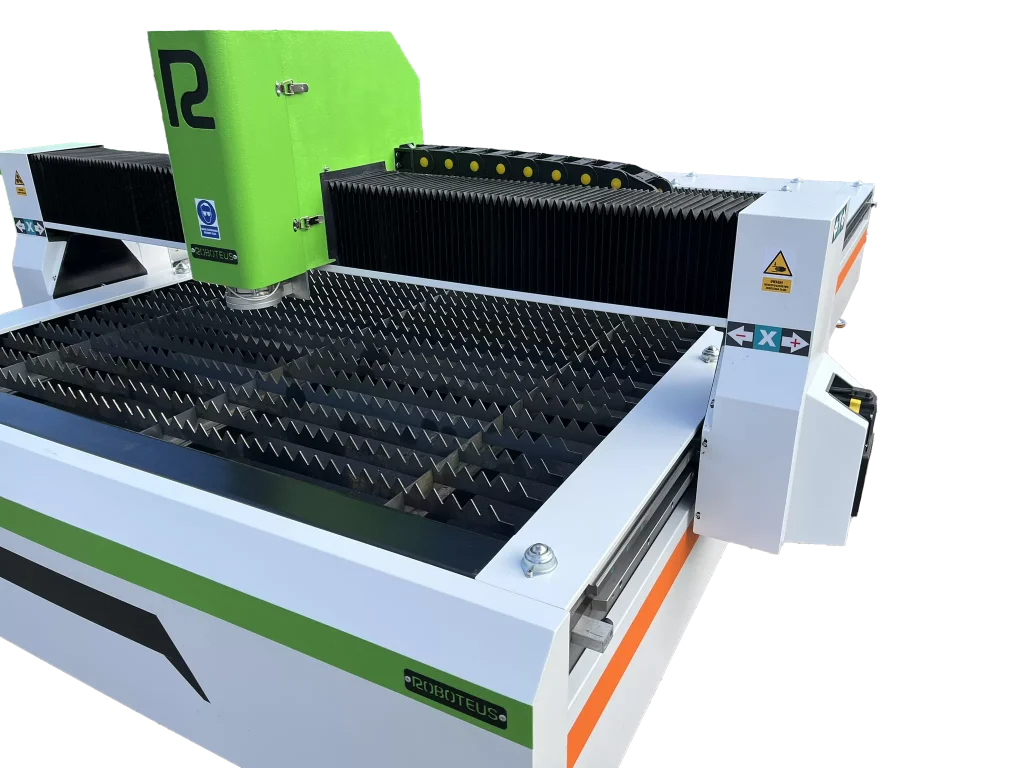
A CNC plasma cutter—also known as a plasma cutter, plasma plotter, or CNC plasma table—is a portal that guides a plasma torch along a program over a sheet of metal. This is different from a handheld cutter, where the torch is held by an operator. If you're still deciding between the two, start with the text " Plasma cutter—handheld or CNC table ."
Product sheets list the same items: source, table, THC, drives, controller, software—rarely explaining what this means for thickness, edge, and cost. This text goes through them sequentially, concluding with a pricing table and checklist.
The numbers come from Roboteus CNC plasma plotter data sheets, from the manufacturer Hypertherm's website, and from Polish stores, which we mark with the letters A–D (as of October 2026). The principle of the arc is described in the text on how plasma cutting works .
1. The plasma source determines the thickness, the frame determines the geometry
Roboteus puts it bluntly in the category description: "The maximum thickness is determined not by the plotter itself, but by the power of the plasma source selected for the order—the same frame can work with different sources." Therefore, the question "what thickness does this table cut?" has no answer without the name of the source. The frame and drives are responsible for ensuring the contour matches the drawing, while the source is responsible for the thickness and edge.
Hypertherm lists several different thicknesses for each source, which shops often reduce to a single number. Below is the carbon steel grade according to the manufacturer's website, with prices for sets from Polish shops:
| Source: Hypertherm | Current | Recommended (500 mm/min) | Puncture | Net price of the set (store A, as of October 2026) |
|---|---|---|---|---|
| Powermax45 XP | 10-45 A | 16 mm | 12 mm | 45 SYNC, CNC kit: PLN 13,399.19 |
| Powermax65 SYNC | 20–65 A | 20 mm | 16 mm | CNC kit: PLN 19,000 |
| Powermax85 SYNC | 25–85 A | 25 mm | 20 mm | CNC kit: PLN 28,373.98 |
| Powermax105 SYNC | 30–105 A | 32 mm | 22 mm | hand set: PLN 30,081.30 |
| Powermax125 | 30–125 A | 38 mm (at 457 mm/min) | 25 mm | 46,949.59 PLN |
The thicknesses in the first row are for the Powermax45 XP, and the price for the Powermax45 SYNC CNC kit; compare the datasheet for the specific model before purchasing. The full table in the text about how plasma cutting works shows the severing thickness and point at 250 mm/min.
For a CNC table, two columns are important: recommended and pierce. Pierce limits any contour started inside the sheet: the manual for the older Powermax45 model recommends starting from the edge for cuts from 15.9 mm, but holes cannot be started from the edge.
Besides Hypertherm, stores offer cheaper sources with CNC sockets: the Spartus ProCUT 125CNC (20-100 A) for PLN 10,500.00 net and the ProCUT 145CNC for PLN 14,100.00 net in store B, with maximum cutting thicknesses according to the store of 55 and 60 mm, and the Spartus EasyCUT 100CNC for PLN 4,799 net in store A (list prices, as of October 2026). Stores don't specify whether this is severing or production thickness—ask for both and about the pierce. At the other end of the spectrum is the MAXPRO200 (store A, PLN 105,165 net): virtually dross-free up to 20 mm, with a production pierce of 32 mm.
2. Water table or ventilated table
The table collects sparks, debris, and smoke, and each design does this differently. Hypertherm's blog lists the water table's excellent smoke control, reduced distortion in thin sheets, and improved edge metallurgy on stainless steel parts. Disadvantages include rust on the fins and machine, splatter that increases dross, slower cutting, difficult cleanup, and freezing in an unheated facility.
According to Hypertherm, a ventilated table (dry, with under-grate exhaust) provides better cut quality for steel, doesn't rust, and is easier to clean. Its cost is in the air: the exhaust draws heated or cooled air from the hall, and zoning and filtration increase the installation cost. According to Hypertherm, a 4×4-foot table with plasma up to 100 amps requires approximately 3200–3600 CFM of exhaust, or approximately 5400–6100 m³/h.
Roboteus plotters have different tables, according to the machine cards:
| Model | Table (according to the card) |
|---|---|
| RBP 1515W | saber with integrated water bath which, according to the card, reduces smoke, noise and deformation |
| RBP 1530 | saber with ventilated box, ducted exhaust fan included |
| RBP 1530 PRO | ventilated saber |
The choice depends on the facility, not just the machine. A water table makes sense where efficient exhaust under the grate is difficult to run and a lot of thin sheet metal is being cut. A water table reduces smoke but doesn't eliminate it, so hall ventilation is still necessary, especially with stainless steel and galvanized steel. Choose a ventilated table where the steel edge is important and there's room for a duct. Check whether a filter is included in the price or the buyer's responsibility.
3. THC: Why Burner Height Control?
THC (torch height control) maintains a constant distance between the nozzle and the sheet based on the arc voltage: the higher the torch, the higher the voltage, so the controller adjusts the Z-axis to maintain the voltage at the set level. According to SSAB, voltage changes the kerf shape—a kerf that's narrow at the bottom and wide at the top means the voltage needs to be lowered; too high a speed produces the same effect.
Height translates directly to edge. The Powermax45 manual states that too low a torch produces a negative cutting angle, while too high a torch produces a positive one. Without THC, a wavy sheet means a variable angle and faster nozzle wear.
What to look for in the offer:
- Start height measurement. Before piercing, the torch is lowered into contact with the sheet metal, and the controller establishes the zero point. Hypertherm's CommandTHC data sheet describes ohmic measurement and backup detection via Z-axis motor stall—for painted sheet metal or underwater cutting when electrical contact fails.
- Adjustments and lockouts. CommandTHC responds to arc voltage changes of less than 1V and allows you to disable adjustments in corners to prevent the torch from diving when slowing down. The RBP 1515W has a THC with adjustable sensitivity and delay, while the RBP 1530 PRO has a 50:1 PROMA THC interface.
- Collision-free holder. A cut part can lift and catch on the torch. The RBP 1515W and RBP 1530 feature a collision-free inductive holder and torch length sensor, while the RBP 1530 PRO features a collision-free OHMIC torch system that, according to the card, detects material and protects the head.
If you purchase the source separately, check that it has an arc voltage output compatible with the machine's THC interface.
4. Frame, Drives and Accuracy
RBP plotters feature a steel and aluminum frame, HIWIN HGR20 linear guides, and helical gear racks. They differ in their drive: the RBP 1515W and RBP 1530 use 8.5 Nm stepper motors with Leadshine MA860H controllers, while the RBP 1530 PRO uses 8.5 Nm stepper motors with endloop technology, i.e., encoders on the X and Y axes and HBS860H controllers.
A standard stepper motor operates in open loop: the controller sends pulses and assumes the axis has executed them. When the motor misses a step, the contour shifts, which is only visible when the workpiece is measured. An encoder closes the loop: the RBP 1530 PRO card describes it this way: motors with encoders "eliminate the risk of missing steps at higher operating speeds." Servo drives in more expensive tables follow the same principle.
Positioning accuracy according to Roboteus cards is < 0.08 mm / 300 mm (RBP 1515W and 1530) and < 0.1 mm / 300 mm (RBP 1530 PRO), working speed up to 10,000 mm/min (RBP 1515W and 1530) and up to 12,000 mm/min (PRO). When comparing offers, check the reference length: shop B states 1500 × 3000 mm +/- 0.1 mm/m for its portal.
Machine accuracy isn't the same as part accuracy: kerf, bevel, and thermal distortion also determine dimensions, and Hypertherm classifies air plasma edge angles as 5 according to PN-EN ISO 9013. High axis speed is important for thin sheet metal; for thicker ones, it's limited by the process—according to the Powermax45 manual, at 45 A (older model), 6.4 mm sheet metal is cut at 1500 mm/min, and 12.7 mm at 510 mm/min.
5. Control, CAM and Nesting
CAM converts the DXF drawing into paths with torch inputs, cutting order, and nesting (arrangement of parts on the sheet), and the controller executes the finished code. The RBP 1515W and RBP 1530 feature the Starfire SF2100C controller, MPG controller, and FASTCAM with a perpetual license and nesting; the RBP 1515W card describes the controller as offline, with .nc code uploaded via USB. The RBP 1530 PRO features the MyPlasM CNC control and MyMiniCam software from the Polish company Proma, designed specifically for plasma cutters.
The slogan "nesting included" isn't enough. Ask if the program:
- imports DXF without manually correcting contours and recognizes holes;
- cuts holes in front of the outer contour and positions the torch entry outside the workpiece line;
- supports common edge and bridges between details;
- allows you to disable THC in corners and small openings;
- has technology tables for your source (current, speed, heights, breakdown delay).
Each of these points affects consumable wear—the Powermax45 manual states that piercing reduces consumable life compared to edge-starting. To translate this into dollars, we'll calculate the cost of plasma cutting in the text about the cost of plasma cutting .
6. Field format and power supply
The RBP 1515W has a work area of 1500 × 1500 × 150 mm with dimensions of 236 × 222 × 140 cm; according to the data sheet, this is a format for half sheets and smaller details in a workshop with limited space. The RBP 1530 and RBP 1530 PRO have a work area of 1500 × 3000 mm, i.e. a whole standard sheet without trimming, with dimensions of 375 × 230 × 145 cm.
Power supply is planned separately for the machine and the source: RBP plotters operate on 230V single-phase, while larger plasma sources require a three-phase network. Power requirements and air consumption by model are summarized in the text "Plasma cutter: how to select the correct current for sheet metal ."
7. How much does a CNC plasma cutter cost: list prices
List prices net, as of October 2026. Note the "source in price" column.
| Model (shop) | Field | Table | Source included in the price | Net list price |
|---|---|---|---|---|
| RBP 1515W (Roboteus) | 1500 × 1500 mm | saber with a water bath | selected to order | from PLN 30,893.00 net (indicative price, configuration for the process) |
| RBP 1530 (Roboteus) | 1500 × 3000 mm | saber with ventilated box | selected to order | valuation for the process |
| RBP 1530 PRO (Roboteus) | 1500 × 3000 mm | ventilated saber | connector for Hypertherm / Spartus | valuation for the process |
| Plasma Table (Shop B) | 1500 × 3000 mm | aqueous | NO | 31,000.00 PLN |
| Same table + Spartus ProCUT 125CNC (shop B) | 1500 × 3000 mm | aqueous | Yes | 41,000.00 PLN |
| Plasma Table (Shop B) | 2000 × 4000 mm | aqueous | NO | 37,900.00 PLN |
| Plasma Portal (Shop B) | 1500 × 3000 mm | sold without a table | NO | 19,900.00 PLN |
| Plasma-Gas Portal (Shop B) | 1500 × 3000 mm | sold without a table | NO | 9,900.00 PLN |
| Plasma table with 160A source (shop C) | 1500 × 3000 mm | — | yes, 160 A | 55,000.00 PLN |
| 120A Plasma Table (Shop D) | 1500 × 3000 mm | tabletop with triangular knives | Huayuan 120 A | 69,900.00 PLN |
| 160A Plasma Table (Shop D) | 1500 × 3000 mm | tabletop with triangular knives | Huayuan 160 A | 79,900.00 PLN |
Two conclusions emerge directly from the table. The difference between Shop B's water table with and without Spartus is similar to the price of the ProCUT 125CNC source alone at that store. At Shop D, the higher current source alone (160 A instead of 120 A) increases the price by a similar amount. For RBP, the source is selected for the order, so it largely determines the cutting thickness and final price. When requesting a quote, please specify the thicknesses you cut most frequently and the thickest thickness you need to pierce.
8. Checklist: 10 questions to ask the seller
- What source is on offer (manufacturer, model, current) and what is the recommended thickness, separation and penetration according to the manufacturer?
- Does the source have a CNC port and arc voltage output compatible with the machine's THC interface?
- Water table or vented? If vented, are a fan, duct, and filter included?
- Does the THC have a takeoff height measurement, sensitivity adjustment, and corner lock?
- Is the torch holder collision-free?
- Open-loop stepper motors, with encoders or servo drives?
- What is the specified length of positioning accuracy and operating speed?
- What CAM software, is the license perpetual, in Polish and with automatic nesting?
- What power supply does the machine need and what source; what compressor and what dryer?
- What does delivery, installation, training and service include, and where can I get nozzles and electrodes?
Frequently asked questions
What is THC in a plasma cutter?
This is automatic torch height control based on arc voltage. The controller corrects the Z axis to maintain a constant nozzle-to-sheet distance, even on corrugated sheets. This height determines the edge angle and nozzle life.
Water table or extraction table – what to choose?
According to Hypertherm, a water table suppresses smoke better and reduces distortion on thin sheets, but it rusts. A ventilated table produces a better edge on steel but requires efficient extraction and filtration. Roboteus offers a water bath in the RBP 1515W, and a ventilated table in the RBP 1530 and RBP 1530 PRO.
What plasma source for a CNC table?
One whose recommended thickness and pierce thickness cover sheet metal cut daily. According to Hypertherm, the Powermax45 XP pierces 12 mm (0.5 in), the Powermax85 SYNC 20 mm (0.8 in), and the Powermax125 25 mm (0.1 in) of steel. Pierce thickness is not a good basis for selection for tabletop work.
How much does a 1500 × 3000 CNC plasma table cost?
In Polish store catalogs (net, as of October 2026), a complete table with a source costs from PLN 41,000.00 (a water table with a Spartus source in one domestic store) to PLN 79,900.00 with a 160 A source (in another store); the plasma-gas portal itself, without the table and source, costs PLN 9,900.00. The RBP 1530 and RBP 1530 PRO are priced for the process, because the source is selected for the order.
Sources
- https://roboteus.com/pl/maszyny/plotery-plazmowe/ — the principle of selecting the source for the order, category description
- https://roboteus.com/pl/maszyny/plotery-plazmowe/ploter-plazmowy-rbp-1515w/ — RBP 1515W parameters, approximate price
- https://roboteus.com/pl/maszyny/plotery-plazmowe/ploter-plazmowy-rbp-1530/ — RBP 1530 parameters, ventilated table
- https://roboteus.com/pl/maszyny/plotery-plazmowe/ploter-plazmowy-rbp-1530-pro/ — RBP 1530 PRO parameters, endloop, OHMIC, source connector
- https://www.hypertherm.com/en-US/hypertherm/powermax/powermax45-xp/ – Powermax45 XP thickness and penetration
- https://www.hypertherm.com/en-US/hypertherm/powermax/powermax65-sync/ – Powermax65 SYNC Thicknesses and Piercing
- https://www.hypertherm.com/en-US/hypertherm/powermax/powermax85-sync/ – Powermax85 SYNC Thicknesses and Piercing
- https://www.hypertherm.com/en-US/hypertherm/powermax/powermax105-sync/ – Powermax105 SYNC Thicknesses and Piercing
- https://www.hypertherm.com/en-US/hypertherm/powermax/powermax125/ – Powermax125 thickness and penetration
- https://www.hypertherm.com/resources/more-resources/blogs/fume-control/ — Water table vs. ventilated, exhaust required
- https://www.ssab.com/en/support/how-to-process/how-to-cut/20-questions-about-cutting — Arc voltage and kerf shape
Editorial note
List prices are from retailer websites as of October 2026 and are subject to change; some are promotional prices or items marked as unavailable. Cut and pierce thicknesses vary depending on the specific source, steel grade, consumables, and settings, and retailer declarations do not always distinguish between cut and production thicknesses. This text does not replace the machine and source manufacturer's instructions or health and safety regulations for plasma cutting.