
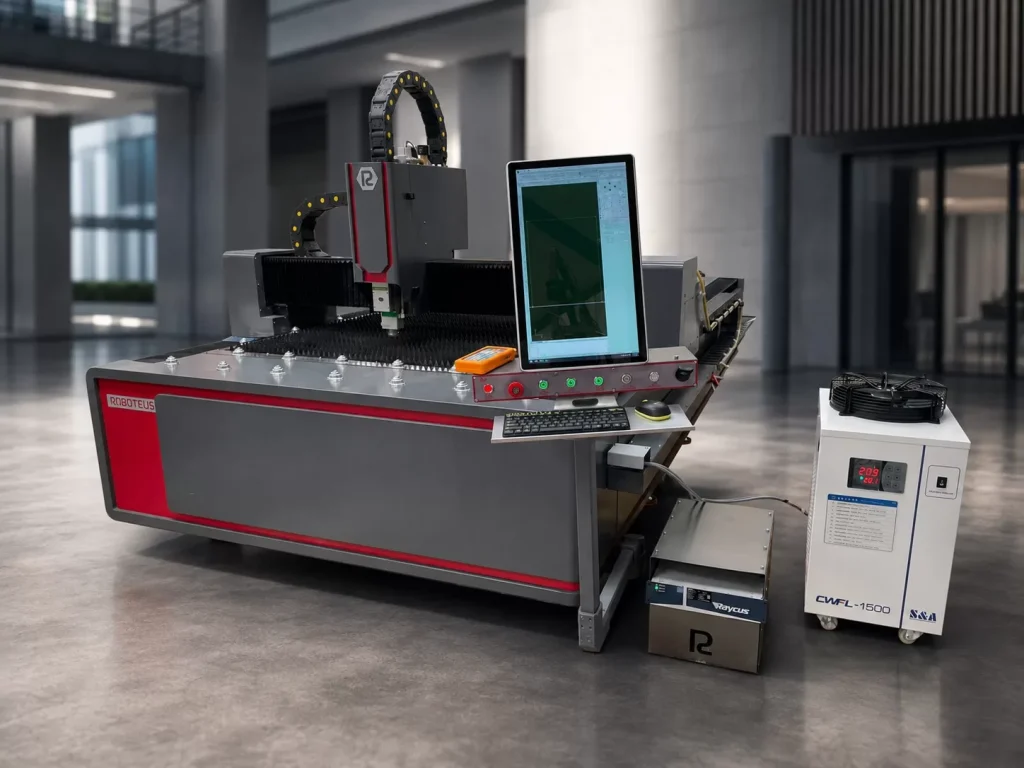
Laser cutting of sheet metal looks the same from the outside, regardless of the material: the same cutting head, the same DXF file, the same table. The differences are only visible at the edges. Black steel cut with oxygen has a dark oxide layer, stainless steel cut with nitrogen can turn out bright, and aluminum is problematic because it reflects the beam and dissipates heat quickly.
This text organizes laser cutting of metal by material: what gas is typical, what edge to expect, what limits thickness, how to prepare the file, and where typical defects come from. It applies to fiber lasers (the beam is created in an optical fiber); we discuss the source itself in the text " Fiber Laser in Plant Practice ."
We don't include costs here. The cost of the service and your own machine can be found in the article "Laser cutting: service price and your own cutting machine ."
What determines the edge: gas, material and focus
The accompanying gas blows the molten metal out of the kerf, and its type determines the chemistry of the edge. Oxygen adds heat to the reaction but leaves oxides and greater roughness (RP Photonics); nitrogen produces an oxide-free surface (Air Products), and compressed air compromises with slight oxidation (according to one laser cutting machine manufacturer). The mechanism of gases, nitrogen purity, pressures, and supply costs are compared in the text " Nitrogen vs. Oxygen: Laser Cutting, Edge, and Cost ."
On a dual-gas machine, switching from oxygen to nitrogen doesn't require switching the gas supply, and process parameters are set according to the control technology table. The RBFIB 1530 fiber laser plotter has two automatic gas valves (oxygen and nitrogen/air) and a Raytools BM110 autofocus head that adjusts the focus to the material thickness.
Laser cutting of sheet metal by material: table
| Material | Typical gas | Edge | What to watch out for | 1500 W, approximately according to the store |
|---|---|---|---|---|
| Black steel (unalloyed, e.g. S235) | oxygen or air | oxides in oxygen, slight oxidation in air | rust, paint, scale on sheet (SSAB) | 10–12 mm |
| Stainless steel (e.g. 1.4301) | azote | no oxides; bright with N2 purity of 99.995% (Air Products) | sheets with foil: risk of reflections damaging the laser (cutting machine manufacturer); fumes containing chromium VI | 2–3 mm |
| Aluminum (e.g. 5754) | air or nitrogen | slight oxidation in air | strongly reflects the beam, quickly dissipates heat (manufacturers of fiber cutters) | 1–2 mm |
| Brass, copper | nitrogen for brass (fiber cutter manufacturers) | no oxides | strong reflections, risk of damaging the source (cutter manufacturer) | — (see below the table) |
| Galvanized sheet metal | confirm the selection with a test | depending on the gas | reflections (cutting machine manufacturer), zinc oxide fumes | no declaration |
The thicknesses in the last column are a declaration from one local store for its 1500W cutting machine; the store states: "Cutting thicknesses are approximate. The range depends on the metal type and process configuration." Roboteus confirms the thickness range for the RBFIB 1530 for a specific material type before quoting. We describe how source power translates to thickness in our guide on how to select laser cutting power for metal .
The RBFIB 1530 specification lists steel, aluminum, and stainless steel. Only cut brass and copper after confirming with the machine and source manufacturer, as reflected beams can damage the laser.
Laser cutting of steel: sheet metal condition, oxides and cracks
Carbon steel is the only material for which oxygen is the gas of choice. Air Products explicitly states that oxygen laser cutting is only suitable for mild and low-alloy steel. The heat of reaction aids in thicker sheets, hence the declared thicknesses for steel are significantly greater than for other metals.
The downside is the edge. The oxide layer can interfere with welding and coating (RP Photonics), so when working on parts for powder coating or weld seams, you have to choose between cleaning the edge after cutting or cutting without oxygen. We've discussed which gas is best for which part purpose in the text on gas selection.
SSAB pays attention to the condition of the sheet metal: a clean surface, free of paint and rust, and the material temperature are important. For high-hardness and high-strength steels (Hardox, Strenx), SSAB warns against delayed hydrogen cracking after thermal cutting, which may not appear until several days later.
Laser Cutting of Stainless Steel: Edge, Foil and Fumes
Laser cutting of stainless steel is performed with nitrogen when the edge must be free of oxides before welding or polishing (according to fiber cutter manufacturers). The nitrogen purity threshold for a bright edge is given in the table above.
With thicker stainless steel, fiber cutter manufacturers write that the result is primarily determined by the gas pressure, not the focal point. One fiber cutter manufacturer lists sheets with protective foil among the materials whose reflections can damage the laser, so discuss the cutting method for such sheets with the machine supplier or contractor.
An oxide-free edge is a good starting point for the weld; we cover the welding itself in the article "Laser welding of stainless steel ." Also, remember about fumes: chromium VI compounds have an EU limit of 0.005 mg/m³ (Directive (EU) 2017/2398), so exhaust ventilation at the table is not an option.
Aluminum Laser Cutting and Reflective Metals
Aluminum, brass, copper, and zinc are highly reflective. According to Laser Focus World, reflected light can return to the fiber and damage it, and one cutter manufacturer lists reflections from copper, brass, galvanized sheet metal, and stainless steel with foil as dangerous. However, this is a separate issue from the cutting thickness. The lower thicknesses for aluminum, copper, and brass result from their high reflectivity and rapid heat dissipation (according to fiber cutter manufacturers) and the lack of reaction heat, which is added by oxygen in steel (RP Photonics).
For aluminum, high-pressure compressed air is the standard (according to one fiber cutter manufacturer); another fiber cutter manufacturer also recommends air as a better choice for most aluminum, subject to slight oxidation. The former recommends negative focus for thin and medium-sized sheets. It's a good idea to specify the allowable burr on the lower edge explicitly in the order.
Galvanized sheet metal also reflects the beam (according to the cutting machine manufacturer), and zinc evaporates. According to the Central Institute for Labor Protection-National Research Institute (CIOP-PIB), zinc oxide fumes cause what's known as metal fume fever: transient, but with coughing, shortness of breath, and fever. Extraction and filtration are essential here.
Edge quality: burr, oxides, perpendicularity and ISO 9013
The laser edge is assessed using the same criteria as other thermal cutting methods. The PN-EN ISO 9013 standard classifies the cut surface according to perpendicularity or angle tolerance (u) and roughness Rz5; Kjellberg also lists groove delay, top edge melting, and dross. The lower the range, the smaller the angle on the cut surface.
The laser's heat-affected zone (HAZ) is the smallest among thermal methods: SSAB quotes 0.2–2 mm, compared to 2–5 mm for plasma and 4–10 mm for oxy-fuel cutting (a different process than laser cutting with oxygen). According to RP Photonics, the cutting kerf is close to the beam diameter, and for thick plates, it is typically around 2 mm.
In the order, describe the edge so that it can be checked: whether burr is acceptable, whether the edge should be oxide-free, whether the customer requires a specific range according to PN-EN ISO 9013. The phrase "nice edge" is not an acceptance criterion.
Preparing the DXF file and nesting
- Geometry. 1:1 scale, millimeters, closed contours, no duplicate lines or loose segments. A double line indicates a second pass of the head over the same spot.
- Holes and bridges. The thicker the sheet metal, the larger the smallest hole and the narrowest bridge of material must be. Discuss the limits for grade and thickness with the contractor or verify with a test.
- Micro-joints. Small details are held in place in the sheet by micro-joints to prevent them from falling into the grate or catching on the head. They leave a mark that requires cleaning, so mark where they cannot fall out.
- Nesting. Spacing between details, common edge for simple shapes, cutting sequence (holes in front of the outer contour), grinding direction for polished stainless steel.
- Description. Engraving and markings on a separate layer; each file includes the grade, thickness, quantity, and edge requirements.
What to decide before placing an order or before cutting at home
- Grade and thickness. Not "3 mm steel," but the specific grade, as this determines the thickness range and gas selection.
- The intended use of the edges. For welding, for powder coating, for display, or for further processing. This determines whether oxygen, nitrogen, or air are used.
- Burr and discoloration are acceptable. Recorded directly, preferably with a reference sample.
- Foil and surface condition. Whether the sheet has a foil, is it sanded, and may have rust or scale.
- Tolerances and range according to PN-EN ISO 9013 , if required by the drawing or the customer.
- Microjoints and markings. Where they can be and where they can't be, and whether details should be marked.
Common errors and their causes
The Raycus guide to dross-free cutting attributes most defects to several causes: focal point, gas pressure and purity, nozzle condition, and beam alignment. Below is a summary of the symptoms most commonly seen in workpieces.
| Symptom | Common causes | What to check |
|---|---|---|
| Burr on the bottom edge | focus too low or too high, pressure too low, speed too high or too low (Raycus) | correction of focus and pressure in small steps |
| Discoloration on stainless steel | too low nitrogen purity, oxygen or air in the line (Raycus) | gas purity, tightness, system blow-through |
| Uneven cut, one side worse | nozzle clogged or oval, beam center shifted (Raycus) | nozzle condition, alignment |
| Burns in corners and small holes | local overheating (Raycus) | cutting order, corner parameters |
| Rough edge on steel | rust, paint, scale | sheet condition (SSAB) |
| Decrease in quality without changing parameters | dirty protective glass | glass condition; one of the cutting machine manufacturers installs a glass condition sensor in the head |
The principle is simple: change one parameter at a time and record the result. The head's autofocus eliminates the need for the operator to manually adjust the lens, but it doesn't replace nozzle and protective glass control.
Safety: Laser Class and Smoke
According to the Central Institute for Labor Protection and National Research Institute (CIOP-PIB), a cutting laser is a Class 4 device, while a completely enclosed device can be classified as Class 1. Workplace requirements, including eye protection for open-plan machines, are described in the article on fiber lasers. Fumes from stainless steel and galvanized steel are discussed above—both require exhaust ventilation. Machine configurations can be found in the Roboteus fiber laser plotter catalog.
Frequently asked questions
Why does stainless steel become discolored after laser cutting?
According to the Raycus guide, this is most often due to low purity of nitrogen, oxygen, or air in the gas line. Check the gas purity and tightness of the installation, and purge the line before cutting. Nitrogen purity requirements are described in the text on gas selection.
Will a 1500W laser cut aluminum?
Yes, but to a lesser extent than steel: one domestic store declares approximately 1–2 mm of aluminum versus 10–12 mm of steel for its 1500W cutter. For the RBFIB 1530, Roboteus confirms the range for a specific grade before quoting. Aluminum strongly reflects the beam and dissipates heat quickly, so sellers declare lower thicknesses for it than for steel.
Why is the edge of lasered steel dark?
This is the oxide layer left behind by laser cutting with oxygen, a reaction that creates additional heat. If it interferes with painting or welding, cut with nitrogen, or if light oxidation is acceptable, with air (according to one cutting machine manufacturer), or clean the edge after cutting.
Is it necessary to deburr sheet metal after laser cutting?
Not always, but burr-free performance is not guaranteed. It depends on the material, gas, focus setting, and nozzle condition. Please specify the acceptable burr level in your order.
How to prepare a DXF file for laser cutting?
A 1:1 scale drawing in millimeters, with closed contours and no duplicate lines, and engraving on a separate layer. Include the grade, thickness, quantity, and edge requirements. Minimum holes for a given thickness should be agreed with the contractor.
Sources
- https://www.rp-photonics.com/laser_cutting.html
- https://en.raycuslaser.com/view/2156.html
- https://www.airproducts.ca/-/media/files/en/330/330-18-003-us-optimizing-gas-supply-for-industrial-lasers.pdf
- https://www.ssab.com/en/support/how-to-process/how-to-cut/20-questions-about-cutting
- https://www.laserfocusworld.com/industrial-laser-solutions/article/14218987/laser-processing-reflective-materials
- https://www.kjellberg.de/quality-parameters.html
- https://www.evs.ee/en/iso-9013-2017
- https://www.ciop.pl/CIOPPortalWAR/file/99433/Ochrona_przed_promieniowaniem_laserowym_MatInf_M.Okrasa_I.PN.06.pdf
- https://www.ciop.pl/CIOPPortalWAR/file/48100/2013031212041&14nr1r2009.pdf
- https://eur-lex.europa.eu/legal-content/PL/TXT/HTML/?uri=CELEX:32017L2398
- https://roboteus.com/pl/maszyny/plotery-laserowe-fiber/ploter-laserowy-fiber-rbfib-1530/
- https://roboteus.com/pl/maszyny/laser-plotery-fiber/
Editorial note
The thicknesses and specifications stated in the text are manufacturer and vendor declarations as of October 2026; actual results vary depending on the machine, material type, gas, and settings. This text does not replace the machine manufacturer's instructions or occupational health and safety regulations for Class 4 laser devices and fume protection.