The fiber laser, also known as a fiber laser (from the English word for fiber), is today the primary source of cutting tools for sheet metal, handheld welding machines, and metal marking machines. However, in machine descriptions, "fiber" often remains a mere name, accompanied by the same slogans: high efficiency, long life, low cost.
This text explains the concept behind this term: where the beam originates, why metal absorbs it, how much energy is converted into light, and what this means for cooling, consumables, power supply, and health and safety. The numbers are provided by source manufacturers and technical publications, always with attribution.
We won't repeat the power selection for sheet metal thickness here. See the guide for a metal laser cutter—how to select the right power .
1. How a fiber laser works: the fiber is the medium, not the cable
According to RP Photonics, a fiber laser is a laser whose active medium is an optical fiber doped with rare-earth ions, most commonly ytterbium in industrial sources. The fiber is pumped by laser diodes. At high power levels, the pump light is introduced into the cladding of the double-clad fiber. The word "fiber optic" therefore describes the location where the beam is formed, not just the cable through which it runs.
One manufacturer of IPG YLS laser cutting systems describes the same design: active fibers and semiconductor diodes, without laser gas. The finished beam runs to the head via a flexible, armored cable. IPG emphasizes modular design: multiple modules are combined into a single output fiber, so, according to the manufacturer, the laser continues to operate even if a single module fails.
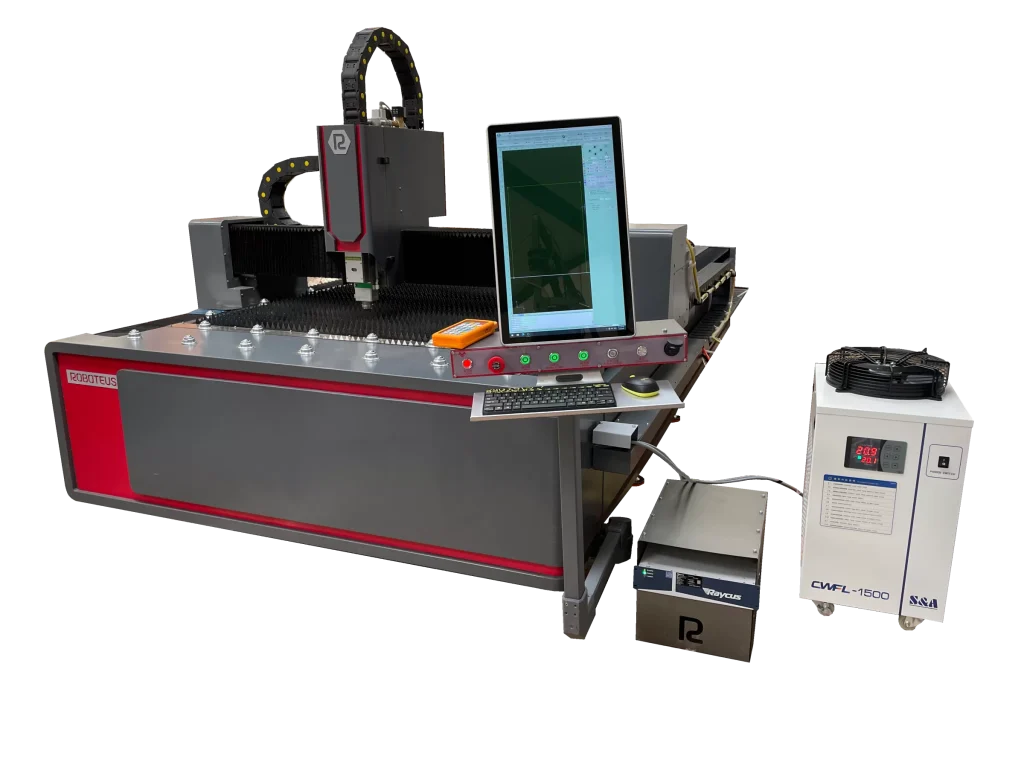
The end of this cable is a connector that plugs into the head. Raycus's RFL-C6000S-CE source card specifies a QBH connector and an output fiber core diameter of 50–75 µm. In the RBFIB 1530 fiber laser plotter, the source is a 1500 W Raycus RFLC020, and the beam is guided by a Raytools BM110 autofocus head.
2. Wavelength approx. 1.07–1.08 µm and why fiber cuts metal
Fiber sources operate in the near infrared. IPG specifies a 1070 nm center wavelength for its YLS lasers, Raycus specifies a 1080 ± 5 nm center wavelength for its RFL-C6000S-CE, and one domestic distributor specifies a 1070 ± 10 nm center wavelength in its plotter description. In practice, this is approximately 1.07–1.08 µm.
Some store descriptions use values specific to a classic Nd:YAG laser, a different type of source. For fiber lasers, stick to the source manufacturer's datasheet.
A CO2 laser typically emits a wavelength of 10.6 µm (RP Photonics), which is approximately ten times longer. Roboteus explains in the category description that metals absorb light of approximately one micrometer much better than CO2 wavelengths. This explains the division of roles within Roboteus's offering: a fiber laser plotter cuts metals and is not suitable for Plexiglas, wood, or leather, while a CO2 laser plotter of the same class as the one offered (an 80W tube) cuts and engraves non-metals but does not cut metal. More about this machine in the article "CO2 laser plotter — what is it suitable for ?"
This is the limit of the class of equipment, not the technology itself. High-power industrial CO2 lasers cut sheet metal, but according to RP Photonics, they are increasingly being replaced in cutting by diode-pumped solid-state lasers, including fiber lasers, especially for thinner sheets.
3. Efficiency: how much current is converted into a beam
This is the most frequently cited benefit of fiber, rarely quantified. Summary with attribution:
- CO2 laser: efficiency approx. 10–20% (RP Photonics).
- Typical industrial high-power ytterbium lasers: over 30% wall-plug efficiency (Laser Focus World, J. Hecht, 2016).
- Best commercial fiber sources: over 50% (Laser Focus World, IPG ECO series), because the pump diodes operate at the point of highest efficiency, not highest power.
- IPG claims ">40%" energy efficiency for its high-power lasers. The aforementioned cutting system manufacturer claims that fiber is three times more efficient than CO2. These are marketing claims.
- In its source materials, Raycus only writes about high conversion efficiency, without any numbers.
What does this mean in a plant? Even with the best efficiency, a significant portion of the consumed energy is converted into heat, which must be removed, hence the need for a chiller at each source. The source isn't the only consumer of electricity either: drives, a chiller, control, and exhaust are all in operation. One laser cutting manufacturer reports an average power consumption of 11 kW for a 6 kW laser and 16 kW for a 12 kW laser for the entire machine. According to RP Photonics, energy and gas per meter of cut constitute a significant portion of laser costs, dependent on the source's efficiency.
4. Reflections: copper, brass, aluminum and galvanized
Metals that reflect light well pose a risk to the fiber source. According to one laser cutting machine manufacturer, reflections when cutting non-ferrous metals (copper, brass), galvanized sheet metal, and stainless steel with foil can damage the laser. The same manufacturer states that its lasers are designed for this purpose, and the head has a sensor to monitor the condition of the protective glass.
Laser Focus World (2012, JK Lasers) states that aluminum reflects about 92% of visible light and up to 98% of mid- and far-infrared light. Fiber operates in the near-infrared, so the 98% figure applies to longer wavelengths, such as the 10.6 µm CO2 laser.
Reflected light can return to the feed fiber and damage it. Two solutions are used: tilting the head, which results in an elliptical spot and a wider aperture, or reflection capture with monitoring and automatic shutdown. IPG claims improved protection against back reflections in its datasheets.
Source protection is a separate issue from cutting thickness. Regardless, aluminum, copper, and brass are more difficult to cut than steel: they are highly reflective and dissipate heat quickly (according to fiber cutter manufacturers), but lack the heat of reaction with oxygen, which aids cutting in steel (RP Photonics). Therefore, manufacturers specify lower thicknesses for them, with the lowest for copper and brass—a list is available in the power selection guide. The RBFIB 1530 specification lists steel, aluminum, and stainless steel. If you plan on using copper or brass, ask the machine and source manufacturer before purchasing if these materials are acceptable.
5. One source, three machines: cutting, welding, marking
The same source technology is used in Roboteus' offer in three types of machines, differing in power and beam guidance method.
- Cutting. Roboteus fiber laser cutters are the RBFIB 1530: a 1500 W source, a 1500 × 3000 mm field, an autofocus head, and a bypass gas that blows molten metal from the kerf.
- Welding. The RBW 1500 laser welder guides the fiber beam to a handheld gun, not to a head on the gantry. Other models are in the Roboteus laser welders category.
- Marking. The RBZ 2020 fiber marker has a pulsed source with a power many times lower than a cutting machine, and the beam is guided across the field by galvo head mirrors. It is used for permanent marking of metals and plastics. The entire group is classified as laser markers .
The term "fiber laser" therefore covers three different devices. A fiber laser marker won't cut sheet metal, and a cutting machine won't replace a marking machine for small codes.
6. Cooling, wear parts and source life
Chiller. The source and head require liquid cooling. The RBFIB 1530 includes an S&A CWFL-1500 dual-circuit chiller: one circuit cools the Raycus source, the other the head. One domestic store describes this model as a cooler for lasers up to 1500 W with two cooling systems and sells it separately for PLN 9,500.00 net (as of October 2026). If the machine listing does not include a chiller, this item must be added.
Consumable parts of the head. Nozzles, protective glass, and ceramic ring are replaced during operation. List prices in the same store for Raytools heads (net, as of October 2026):
| Hi | Net price |
|---|---|
| Single nozzle D1.2 M11 H15 | 40.00 PLN |
| Double nozzle D1.2 M11 H15 | 42.00 PLN |
| Bottom protective glass 27.9 × 4.1 | 40.00 PLN |
| Bottom protective glass 37 × 7 | 80.00 PLN |
| Collimator protective glass 37 × 1.6 | 90.00 PLN |
| Ceramic ring D32 mm M14 | 163.00 PLN |
Protective glass shields the optics from the material side and absorbs splinters. Therefore, manufacturers of cutting machines and heads (including Precitec) equip their heads with glass condition sensors. Manufacturers don't provide a numerical replacement interval, as it depends on the material, gas, and operator discipline.
Source lifespan. One domestic distributor lists their plotter as "Laser lifespan: 100,000 hours." This is a seller's declaration, not a warranty. When purchasing, the warranty period and scope for the source itself, as well as service availability, are key considerations.
7. Power supply, laser class and cabin
Power Supply. The fiber cutter is a three-phase machine: the RBFIB 1530 requires a 380V (3-phase) power supply. It is recommended to prepare the connection before delivery.
Laser Class. According to the Central Institute for Labor Protection (CIOP-PIB), based on PN-EN 60825-1:2014-11, industrial lasers for cutting and welding are classified as Class 4. Direct viewing into the beam, skin exposure, and even diffuse reflections are hazardous, often resulting in a fire hazard. CIOP-PIB points out that an intense laser can damage the eye before the aversion reflex, which lasts 0.25 seconds, is triggered. The fiber beam lies outside the visible spectrum, so its reflections are invisible.
Cabin. High-power lasers that are completely enclosed may also be classified as Class 1. CIOP-PIB states that exposure measurements are not required if collective protective measures allow the device to be classified as Class 1. Class 4 devices should not be used without a risk assessment that takes into account reflections.
CIOP-PIB recommends first technical and organizational measures: guards and screens, marked restricted access areas, and training. For open machines, safety glasses with filters adapted to the laser wavelength are also recommended (CIOP-PIB). The EN ISO 11553-1:2020 standard also addresses the safety of laser processing machines.
8. Fiber, CO2, and Plasma – A Quick Overview
| Characteristic | Fiber laser | CO2 laser | CNC plasma |
|---|---|---|---|
| Center of a beam or arc | doped fiber, diode-pumped | laser gas | electric arc in ionized gas |
| Wavelength | approx. 1.07–1.08 µm | 10.6 µm | not applicable |
| Electrical efficiency | typically over 30% (LFW) | approx. 10–20% (RP Photonics) | we don't compare |
| Metals | yes; reflectors require caution | 80W class CO2 plotter (Roboteus offer) — no; high-power industrial CO2 — yes, increasingly replaced by fiber (RP Photonics) | only conductive |
| Non-metals | NO | Yes | NO |
| Heat affected zone (SSAB, no distinction between laser types) | 0.2–2 mm | 0.2–2 mm | 2–5 mm |
| Slot | close to the beam diameter, with thick plates of approx. 2 mm (RP Photonics) | as above | example Powermax125, 65 A: 1.6–3.7 mm on steel (Hypertherm) |
The table shows the differences in technology, not the machine selection. When a facility is better served by laser, and when by plasma, we'll discuss the laser vs. plasma comparison for steel cutting .
Frequently asked questions
What is a fiber laser?
This laser uses a diode-pumped optical fiber doped with rare-earth ions, most commonly ytterbium. It operates in the near-infrared region, approximately 1.07–1.08 µm, making it suitable for metals. The terms "fiber" and "fiber optic" are synonymous.
What is the difference between a fiber laser and a CO2 laser?
Wavelength and efficiency: CO2 typically emits 10.6 µm with an efficiency of approximately 10–20% (RP Photonics), while typical fiber sources exceed 30% (Laser Focus World). A CO2 plotter of the class offered by Roboteus (80 W tube) cuts and engraves non-metals, but not metals; sheet metal is cut by high-power industrial CO2 lasers, which are currently inferior to fiber in cutting metal, especially in thin sheets (RP Photonics). Roboteus offers two separate machines for two applications.
How many hours does the fiber laser source operate?
Sellers claim "100,000 hours," but that's not a guarantee. Compare the warranty period and scope of the source itself, as well as who services it and how quickly.
Does a fiber laser cut aluminum and copper?
Aluminum, yes, but at lower thicknesses than steel. Copper and brass require a source with back-reflection protection, as the reflected beam can damage the laser (cutting machine manufacturers, Laser Focus World). Before purchasing, ask if the manufacturer allows these materials in your machine.
Can a fiber marker be used to cut sheet metal?
No. A marking machine has a pulsed source with a power many times lower than a cutting machine and is used to permanently mark surfaces. Cutting sheet metal requires a cutting machine with a cutting head and accompanying gas.
Sources
- https://roboteus.com/pl/maszyny/plotery-laserowe-fiber/ploter-laserowy-fiber-rbfib-1530/ — RBFIB 1530 specifications: source, head, chiller, materials, power supply
- https://roboteus.com/pl/maszyny/plotery-laserowe-fiber/ — wavelength of fiber and CO2, fiber and non-metals, CO2 laser and metal
- https://www.rp-photonics.com/fiber_lasers.html — construction of a fiber laser
- https://www.rp-photonics.com/co2_lasers.html — CO2 laser wavelength and efficiency
- https://www.rp-photonics.com/laser_cutting.html — CO2 vs. diode-pumped lasers, heat of reaction with oxygen, gap, energy costs
- https://en.raycuslaser.com/view/2116.html — Raycus RFL-C6000S-CE: Wavelength, Fiber Core, QBH Connector
- https://en.raycuslaser.com/products/Global-Version-cw-fiber-lasers.html — Raycus: Performance description without numbers
- https://www.laserfocusworld.com/lasers-sources/article/16547048/photonic-frontiers-high-efficiency-optical-pumping-going-green-cranks-up-the-laser-power — Ytterbium laser efficiency
- https://www.laserfocusworld.com/industrial-laser-solutions/article/14218987/laser-processing-reflective-materials — Aluminum Reflection, Fiber Protection
- https://www.ciop.pl/CIOPPortalWAR/file/99433/Ochrona_przed_promieniowaniem_laserowym_MatInf_M.Okrasa_I.PN.06.pdf — laser classes according to PN-EN 60825-1:2014-11, class 1 for closed devices, eye protection equipment and sequence of protective equipment
- https://www.ciop.pl/CIOPPortalWAR/file/99714/I_PN_06_Referat_Narazenia_na_promieniowanie_laserowe_2024.pdf — threats, aversion reflex
- https://bip.ciop.pl/CIOPPortalWAR/file/71538/rozdz_3_poradnik_pr_optyczne_ocena_ryz.pdf — risk assessment for classes 3B and 4
- https://evs.ee/en/evs-en-iso-11553-1-2020 — EN ISO 11553-1:2020
- https://www.ssab.com/en/support/how-to-process/how-to-cut/20-questions-about-cutting — Heat Affected Zone, Plasma
- https://www.weldersupply.com/Content/files/ProductPDFs/Powermax125CutSheets.pdf – Powermax125 Plasma Cut Sheet
Editorial note
List prices are from retailer websites as of October 2026 and are subject to change. Efficiency, service life, and reflection resistance of the source depend on the specific source model, machine, and material, and manufacturer data may be marketing claims. This text does not replace the manufacturer's instructions or occupational health and safety regulations for working with Class 4 lasers.