
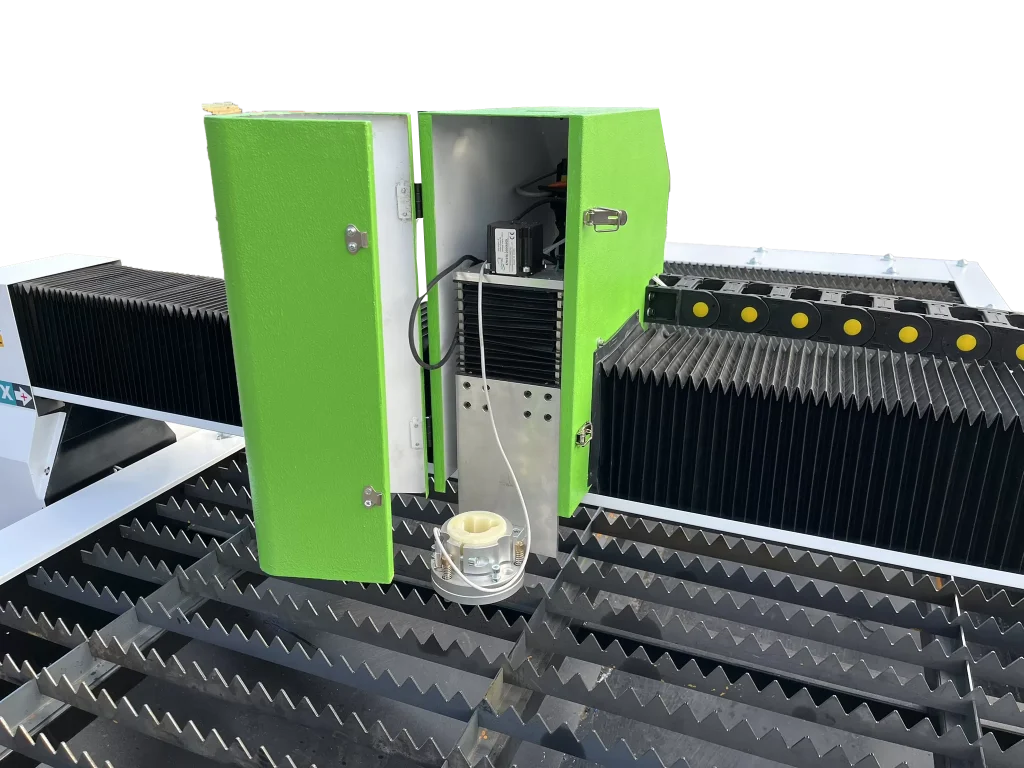
The cost of plasma cutting from a subcontractor is easy to check: price lists quote zlotys per linear meter or per machine hour. It's more difficult to calculate the same meter on your own table. A typical plasma cost calculator has fields for nozzles, electrodes, electricity, air, and operator, but you have to enter the values yourself. This entry populates them with an example, where each number is either manufacturer or store data or an explicitly stated assumption.
This refers to a CNC plasma cutter, which is a table with a gantry, a machine torch, and a torch height control (THC). A handheld plasma cutter is a different device and has a different operation. The differences between the two types of devices are described in the text " handheld plasma cutter vs. CNC table ."
1. What does a cutting meter consist of?
The cost of one meter of cutting on your own machine consists of seven items:
- burner consumables: nozzle, electrode, and less frequently swirl ring, cap and shield,
- electrical energy consumed by the plasma source, drives and controls,
- compressed air, i.e. compressor, drying and filters,
- operator time,
- table and source depreciation,
- replacements and downtime,
- post-cutting processing and scrap.
In its article on the true cost of cutting, Hypertherm proposes a simple formula: Material cost is the price of a set times the number of sets used per month. Replacement cost is the number of replacements times the replacement time times the labor rate with overhead. The cost of lost production is the hours of downtime times the production value per hour. Scrap and rework resulting from a poorer edge are also included.
The Kinetic calculator calculates two quantities: "cost per start" and "cost per hour," and the average number of starts is based on experience. We calculate the cost per arc hour and divide it by the number of meters the torch will cut in that hour. With plasma, this denominator determines the result more often than the nozzle price.
2. Plasma nozzles and electrodes – prices and service life
List prices in one of the domestic stores (hereinafter: store A), as of October 2026, net:
| Position | Packaging | Net price |
|---|---|---|
| Böhler Welding cutting nozzle 1.10 mm, 50–70 A (SP 70 holder) | 10 pcs. | 161.25 PLN |
| Böhler Welding electrode (SP 70 holder) | 5 pcs. | 141.90 PLN |
| Spartus CUT BOX for SP125HY handle (105 A nozzle) | set | 550.13 PLN |
| Spartus CUT BOX for SP100 / PT100 handle (80–120 A nozzle) | set | 780.40 PLN |
CUT BOX kits are sets of parts for specific torches and don't offer a direct unit conversion. The Böhler parts fit the SP 70 torch, not the Hypertherm torch; we haven't found genuine Hypertherm parts priced in Polish zlotys in Polish stores.
The Powermax45 manual specifies the life of the kit, which is based on genuine Hypertherm parts: approximately 3–5 hours of arc time for machine cutting. The manual also lists the factors that determine this life: sheet metal thickness, average cut length, pierce or edge start, pierce height, and air quality (oil, moisture). On a machine, the electrode wears out first, while in hand cutting, the nozzle wears out first.
The Hypertherm consumables guide shows when to replace the electrode. Copper electrodes are replaced at 1 mm of pitting, silver at 2 mm. We don't provide the number of pierces per set because we couldn't find any confirmation of this for mechanized systems in the manufacturer's data. The best source for this number is the replacement log from your own machine.
3. How much does a puncture cost: wear and tear and the life of the set
The Powermax45 manual explicitly states that piercing shortens material life compared to edge-starting. The data sheet for 45A and steel with 9.5mm plate shows a pierce delay of 0.9 seconds. For thicker plates, the manual recommends edge-starting.
For calculation purposes, this means that a part with multiple holes costs more than a part with the same circumference and a single contour. Each start causes additional wear on the nozzle and electrode, as well as several moments without feed. Therefore, Kinetic calculates the cost per start separately, not just per meter.
The THC maintains the torch height based on arc voltage, and striking the nozzle against sheet metal or a raised part usually results in premature replacement of the set. Roboteus plasma cutters feature a THC and a collision-free torch holder—more on how to choose a table, THC, and source in the text.
4. Current: how much power does the plasma source draw?
Power consumption depends on the plasma source, not the table itself. Examples from the cards:
- Hypertherm Powermax45 XP: with an output power of 6.5 kW, draws 33 A from a 230 V single-phase network or 10 A from a 400 V three-phase network; efficiency 88% (manufacturer's data sheet),
- Hypertherm Powermax105: input current 28 A at 400 V and output power 16.8 kW (card in another store, hereinafter: store B).
The power in kilowatts on the cards is the arc power. The power drawn from the grid is increased by the source losses, which is approximately the output power divided by the efficiency.
The table also draws electricity, but not much compared to the source; the RBP 1515W, RBP 1530, and RBP 1530 PRO are powered from a 230V mains. The plasma source is selected for the order and determines the cutting thickness, the price of the kit, and whether a 400V connection is required.
The formula is simple: power drawn from the grid during an arc, times the arc hours, times the invoice rate. The data on the card refers to the full current, so at lower currents, it provides a reasonable estimate.
5. Compressed air – quantity and quality
Air plasma uses a lot of air. According to the manual, the older Powermax45 requires 151 l/min with the arc lit, while larger sources require significantly more. A list for several models is provided in the text on selecting a plasma cutter .
The compressor is selected with a margin for the flow and pressure specified in the source card. Air quality is also important. The Powermax45 manual lists oil and moisture as factors that shorten consumable life. The dryer and filters are charged once, while wet air is charged with each electrode replacement.
The energy consumption of the compressor during the arc is included in the calculation. A ventilated table also includes an exhaust fan. The RBP 1530 has a ventilated box with a fan included, while the RBP 1515W has a water bath.
6. Operator, Depreciation and Downtime
With plasma, the biggest item is usually human time, not nozzle time. The operator is paid for the entire shift, and the arc only burns for part of it.
The rest is sheet metal loading, part removal, travel, piercing, material changes, and programming. The proportion of arc time in the machine's operating time is the most important assumption in the calculation.
Depreciation is calculated based on the price of the machine with the source. The RBP 1515W plasma cutter has a guide price of PLN 30,893.00 net (configuration for the process). The RBP 1530 and RBP 1530 PRO are priced for the process. For scale: Store A has a Hypertherm Powermax45 SYNC CNC kit in its catalog for PLN 13,399.19 net, and Store B has a Spartus ProCUT 125CNC source for PLN 10,500.00 net (as of October 2026).
Downtime is calculated using the Hypertherm method from point 1: material replacement time times rate plus production that was not occurring during that time.
7. Plasma cutting cost step by step – example with assumptions
Below is a calculation example. The "From" column shows which values come from the manufacturer's or store's data sheets, and which we assume are just for demonstration purposes.
| Parameter | Value | From where |
|---|---|---|
| Source and material | 45A, 6.4mm black steel | we accept |
| Cutting speed | 1500 mm/min, i.e. 90 m per arc hour | cutting card from the Powermax45 manual (previous generation; assumed for 45 XP) |
| Nozzle and electrode set | 44.51 PLN net | estimate from Böhler prices for SP 70 torch (50-70 A nozzle) in shop A, parts of other torch than Hypertherm: PLN 161.25 / 10 + PLN 141.90 / 5 |
| Lifespan of the set | 3 hours of arc | we assume the lower limit of the Hypertherm fork for original parts |
| Power consumption from the network during the arc | estimated 7.4 kW | let's assume: output power 6.5 kW / efficiency 88% (Powermax45 XP card) |
| Compressor and table | 1.5 kW + 0.5 kW | we accept |
| Energy price | PLN 1.00 net per kWh | we accept |
| Operator | 50 PLN/hour | we accept |
| Arc share in machine operation | 50% | we accept |
| Table with a source | 45,000 PLN net | we accept |
| Amortization period | we assume 5 years after 1,600 hours of operation, i.e. 4,000 hours of arc | assumption, with a 50% arc share |
| Component | Calculation | PLN per arc hour |
|---|---|---|
| Nozzle and electrode | 44.51 PLN / 3 h, estimate | 14.84 |
| Energy | estimated 9.4 kWh × 1.00 PLN | 9.40 |
| Operator | 50 PLN / 0.5 | 100.00 |
| Depreciation | 45,000 PLN / 4,000 h, estimate | 11.25 |
| Together (respect) | 135.49 |
Assuming 90 meters of cutting per arc hour, we divide PLN 135.49 by 90 meters, which gives us an estimated net cost of PLN 1.51 per meter. The nozzles and electrodes alone are an estimated PLN 0.16 per meter, and the bill without the operator is an estimated PLN 0.39.
A 3-hour lifespan is the lower end of Hypertherm's range for original parts; for replacements, measure it in your replacement log. For parts with multiple pierces, the part's cost share increases.
How the result reacts to changing one assumption (the rest remains unchanged):
| Variant | PLN per arc hour | PLN per meter | Character |
|---|---|---|---|
| Base: 6.4 mm, 3 h set, 50% arc | 135.49 | 1.51 | respect |
| 5 h set (fewer punctures, worn from the edges) | 129.55 | 1.44 | respect |
| 9.5 mm sheet metal, 810 mm/min according to the instructions, i.e. 48.6 m/h | 135.49 | 2.79 | respect |
| Arc only 30% of operating time (operator and depreciation for fewer arc hours) | 209.66 | 2.33 | respect |
The table shows that a longer set lifespan changes the result by a few cents. The thickness of the sheet metal, and therefore the speed and organization of work at the table, changes it by several dozen cents to over a złoty per meter.
What is missing in the example: hall, heating, programming and nesting, deburring, scrap or profit margin.
The Powermax45 manual notes that air plasma always leaves some dross, and Hypertherm states that the edge "requires preparation" before welding—grinding is a separate item in the part cost. More about the edge in the text about how plasma cutting works .
8. Own machine and service price list
Price lists for plasma cutting services, as of October 2026:
| Business | Rate | Comments |
|---|---|---|
| AluPro | PLN 150.00 net per hour for the machine with an operator | minimum PLN 150, placing the sheet on the table PLN 25, plasma up to 110 A, max. S235 steel 15 mm |
| BSG | approximately 8–15 PLN/m | straight edge in 10 mm sheet metal |
| kb.pl (aggregator, illustrative; updated 07/01/2026) | 6 mm steel PLN 6.50–11.00/m; 10 mm PLN 11.50–13.80/m | "the price list is indicative" |
Don't compare these rates directly with the example. The service price includes the facility, programming, order processing, internal transport, risk of shortages, and profit—everything missing from the example. The comparison only makes sense once you add these items and the actual number of meters per month to your own bill.
Machine utilization is crucial. A table that cuts for a few hours a month has a high depreciation cost per meter, and it's usually cheaper to outsource the cutting. A table that runs daily spreads its fixed costs over so many meters that the operator and speed are the primary factors.
We discuss the same threshold logic for lasers in the article "Laser Cutting – Service Price vs. Your Own Cutting Machine ." The purchase can be spread over time: see Machine Leasing and Financing .
9. How to reduce the cost of the subway
Several practices reduce cost without changing the machine:
- Start from the edge where possible. Piercing shortens the life of the set, so starting from the edge of the sheet saves the nozzles.
- Correct current. A nozzle matched to the cutting current will last longer, while too low a current on thick sheet metal results in low speed and high cost per meter.
- Efficient THC and proper breakout height. Fewer collisions mean fewer early replacements and a more consistent edge angle.
- Dry and clean air. A dehumidifier and filters upstream are cheaper than electrodes worn out by moisture.
- Nesting with a common edge. Rectangular parts cut with a common cut result in fewer meters and fewer starts per sheet.
- Replacement log. Recording arc hours and number of starts with each replacement after a few weeks gives you your own set's lifespan.
If you'd like to calculate this bill for a specific part and source, please prepare a DXF file, sheet metal grade and thickness, and annual unit count, and then request a quote . A machine overview is available on the CNC plasma routers page.
Frequently asked questions
How much does a meter of plasma cutting cost?
For subcontractors, kb.pl (updated January 7, 2026) gives an approximate price of PLN 6.50–11.00/m for 6 mm steel and PLN 11.50–13.80/m for 10 mm, while BSG (as of October 2026) gives an approximate price of PLN 8–15/m for a straight edge in 10 mm sheet metal. In our example, using our own machine and assuming the assumed costs, we came to an estimated PLN 1.51 net per meter for 6.4 mm, excluding the hall, programming, and overhead costs.
How often should plasma nozzles and electrodes be replaced?
The Hypertherm Powermax45 manual specifies approximately 3–5 hours of arc time per set for machine cutting and 1–2 hours for hand cutting; factors include piercing, pierce height, and air quality. Copper electrodes should be replaced when 1 mm of pitting is present, and silver electrodes when 2 mm. On a CNC table, the electrode is usually the first to wear out.
How many punctures can an electrode withstand in plasma?
We're not providing a figure because we haven't found confirmed manufacturer data for mechanized systems; we only know that piercing reduces service life compared to starting from the edge. The replacement log will provide the most reliable figure.
How much electricity and air does plasma use?
It depends on the source. The Powermax45 XP at 6.5 kW output draws 33 A from 230 V (88% efficiency), while the Powermax105, according to a data sheet at one domestic store, draws 28 A at 400 V and 16.8 kW output; the line draw is higher than the arc power. The Powermax105 requires 217 l/min of air at 5.9 bar (76 psi), while the Spartus ProCUT 125CNC requires 250 l/min (75 psi) at 5.5 bar (76 psi).
How much does a plasma nozzle cost?
In one domestic store (net, as of October 2026), Böhler Welding nozzles for the SP 70 torch cost PLN 161.25 for 10 pcs, and electrodes PLN 141.90 for 5 pcs; the Spartus CUT BOX set for the SP125HY torch costs PLN 550.13. The nozzle is selected for the torch and cutting current, and it is included in the cost per meter along with the electrode.
Sources
- https://www.weldersupply.com/Content/files/ProductPDFs/Hypertherm/HyperthermConsumablecareg.pdf
- https://web.archive.org/web/20220929213535/https://www.hypertherm.com/en-US/learn/articles/true-cost-of-cutting-metal/
- https://kineticusa.com/PrimecutHelp/plasma_calculator.html
- https://alupro.pl/products-page/uslugi-slusarskie/ciecie-plazmowe-cnc/
- https://bsg.pl/ciecie-plazma-szybkie-ciecie-stali/
- https://kb.pl/cenniki/uslugi/cennik-plazmowego-ciecia-stali/
- https://roboteus.com/pl/maszyny/plotery-plazmowe/ploter-plazmowy-rbp-1515w/
- https://roboteus.com/pl/maszyny/plotery-plasma/
Editorial note
List prices and service price lists are current as of October 2026 and are subject to change. The numbers in the calculation example are illustrative, and material life, speed, and energy consumption depend on the specific plasma source, torch, material, and settings. This text does not replace the manufacturer's instructions or health and safety regulations for plasma cutting (eye, hearing, and respiratory protection).