
A plasma cutter in Polish stores is almost always a handheld inverter: a power source with a torch controlled by the operator. In one Polish store (hereinafter referred to as Store A; as of October 2026), reviewed 40-100A models cost from PLN 966.67 net (Magnum CUT 40) to several thousand PLN net. This tool is used for cutting sheet metal, profiles, and scrap metal in workshops, on construction sites, and in service centers.
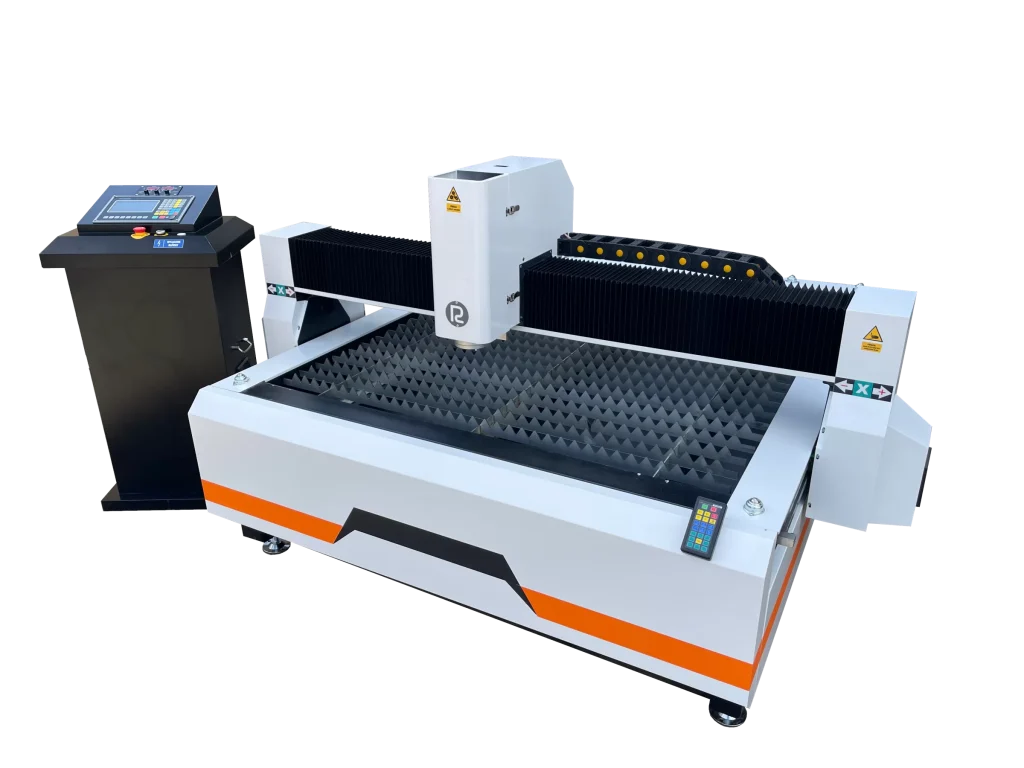
A CNC plasma table, also called a plasma cutter, is a different device: the gantry guides the torch through the program, and the plasma source is just one component. It's purchased for different reasons and at different prices.
This article first helps you choose a manual cutting machine: how to read the thickness charts, how to select the correct current for the sheet metal, and what power and air are needed. It then explains when manual cutting is no longer sufficient and the benefits of switching to a CNC table. We describe the principle of the arc separately, in the article on how plasma cutting works and the thicknesses you can realistically achieve .
1. "Quality" and "Separation" Thickness: How to Read a Card
Cutting machine data sheets typically feature two numbers. The separation thickness is the plate that can be cut—slowly, with dross and a workable edge. The quality thickness is the plate that can be cut at a reasonable rate, with a usable edge after minor machining; with air plasma, some dross always remains (Powermax45 manual). The ratio between the two numbers is not constant: in Store A's declarations, the separation thickness is several millimeters greater than the quality thickness, while in Hypertherm's data, it is from one and a half to almost two times greater (table below).
Hypertherm describes this more precisely by specifying speeds: recommended thickness is plate cut at 500 mm/min, and slitting (manual) at 125 mm/min. Pierce thickness and edge start are discussed in the text on how plasma cutting works .
Therefore, when purchasing, consider the quality (recommended) thickness for sheets cut weekly, and treat the separating thickness as a reserve for exceptions. If the description provides a different number in the header than in the technical data, trust the technical data and ask the seller which thickness type they're referring to.
2. How to choose the current for the sheet metal: table
Below are the steel thicknesses as declared by Shop A (for manual inverters) and by Hypertherm (for the Powermax series). The definitions of "quality" in shops and "recommended" from Hypertherm are not standardized, so compare primarily within a single data source.
| Device | Current | Quality / recommended | Separating | Power supply | Net list price (as of October 2026) |
|---|---|---|---|---|---|
| Magnum CUT 40 | 15–40 A | 8 mm | 10 mm | — | 966.67 PLN (shop A) |
| Spartus EasyCUT 40sL | 20–40 A | — | — | — | PLN 1,279 (shop A); the shop states "max. cutting thickness 16mm" without specifying the thickness |
| Ideal Tecno Plasma 45 LED | 20–45 A | 14 mm | 18 mm | 230V | 1,499.19 PLN (store A) |
| Hypertherm Powermax45 XP | 10-45 A | 16 mm | 29 mm | 230V or 400V | — |
| Hypertherm Powermax65 SYNC | 20–65 A | 20 mm | 32 mm | 380–400 V | — |
| Ideal Expert Plasma 80 HF | up to 80 A | 35 mm | 40 mm | 3 × 400 V | 3,899.19 PLN (store A) |
| Hypertherm Powermax85 SYNC | 25–85 A | 25 mm | 38 mm | 380–400 V | — |
| Magnum Cut 100 | 30–100 A | 25 mm | 30 mm | 400V | 3,813.01 PLN (store A) |
| Hypertherm Powermax105 SYNC | 30–105 A | 32 mm | 50 mm | 400 V (according to the card in another store, hereinafter: store B) | PLN 30,081.30, hand set (shop A) |
| Hypertherm Powermax125 | 30–125 A | 38 mm | 57 mm | 400V | 46,949.59 PLN (store A) |
We did not find the manual versions of Powermax45, 65 and 85 with a price in Polish stores; Store A provides prices for these models in CNC sets, which we summarize in the text about what to check in a CNC plasma cutter .
How to use the table: find the sheet metal you cut most often in the quality or recommended column, and the thickest plate encountered in practice in the separation column. For example, let's assume a shop that primarily cuts 8 mm steel, occasionally 20 mm. According to Store A's declarations, the Magnum CUT 40 cuts 8 mm for quality and 10 mm for separation, so there's no margin. The Ideal Tecno Plasma 45 cuts 8 mm with a margin, but 20 mm exceeds its separation thickness. Among inverters with Store A's declarations, an 80 A class is required. In the Hypertherm series, 20 mm falls within the separation thickness of the Powermax45 XP, but only the Powermax65 SYNC cuts it with a margin and at a production rate (20 mm recommended).
3. Power supply: 230 V or 400 V
Small 40-45A inverters typically operate on 230V—as is the case with the Ideal Tecno Plasma 45 LED. The Hypertherm Powermax45 XP accepts 400V three-phase (10A) or 230V single-phase (33A) with an output of 6.5 kW. Single-phase draw of several dozen amps requires a dedicated circuit and proper protection, so check your installation with an electrician before purchasing.
At 230V, the highest rated devices in the table are 45A: the Powermax45 XP has a recommended thickness of 16mm, while the Ideal Tecno Plasma 45 LED, according to Store A, cuts 14mm with good quality. Treat higher 230V claims with caution and ask what thickness rating you're referring to.
From the 65-80 A class and up, cutters typically require three-phase power: the Powermax65 and 85 SYNC CE versions (380-400 V), the Ideal Expert Plasma 80 HF (3 x 400 V), and the Magnum Cut 100 (400 V). Shop B lists the Powermax105 as having an input current of 28 A at 400 V (at a 16.8 kW rating). If your shop has only single phase, the thickness range will be determined by the installation, not the budget.
4. Compressor and air
An air cutter requires compressed air: dry, clean, and in the amount the source consumes throughout the arc's life. Moisture and oil in the air shorten the life of the nozzle and electrode, so a filter and dryer are standard, not an optional extra.
Consumption by manufacturers and stores:
- older Hypertherm Powermax45 (manual): 151 l/min with the arc on ("hot") and 165.2 l/min without the arc ("cold");
- Spartus ProCUT 125CNC (shop B): 250 l/min at 5.5 bar;
- Hypertherm Powermax105 (shop B): 217 l/min at 5.9 bar;
- Hypertherm Powermax125 (Shop B): 260 l/min at 5.9 bar.
The pressure and flow from your source's data sheet are crucial: for the Powermax105 and 125, Store B lists 5.9 bar, and for the Spartus ProCUT 125CNC, 5.5 bar. Select a compressor for flow at this pressure, with room for losses in the lines and other tools in the workshop. Cutters with a built-in compressor are convenient in the field, but their range depends on a small compressor housed in a housing.
5. Duty Cycle, Ignition and Consumables
Duty cycle tells you how much of the cutting cycle a cutter can operate at a given current without overheating. Shop B lists "80% at 105 A" and "100% at 94 A" for the Hypertherm Powermax105, and "100% at 94 A" for the Spartus ProCUT 125CNC, with no current indicated. When comparing, ask about the duty cycle at the current you'll be cutting. If you're cutting long distances, the duty cycle at your current is more important than the maximum current.
Ignition can be high-voltage (HF) or contact (blowback—the electrode moves away from the nozzle under air pressure). For a cutting machine that will later be operated with CNC control, ask the seller how to ignite the arc; for example, Shop B specifies "contactless arc ignition without HF" for the Spartus ProCUT 125CNC.
Consumables wear out faster when used manually: according to the Powermax45 manual, a complete set lasts about 1–2 hours of arc time when cutting by hand and about 3–5 hours when using a machine. We've summarized nozzle and electrode prices and replacement criteria in the article about how much plasma cutting costs .
6. When a handheld plasma cutter is no longer enough
A handheld cutter wins where mobility and one-off cuts are key: disassembly, rework during assembly, profiles, and scrap. The problem begins when the same parts are returned in batches. Below are signs that a workshop has matured with a CNC table:
| Criterion | Handheld cutter | CNC plasma table |
|---|---|---|
| Repeatability | depends on the operator's hand and the template | the program repeats the contour |
| Holes and contours | difficult, usually needs to be corrected | cut out together with the detail |
| Burner height | the operator leads | THC corrects it from the arc voltage |
| Using the sheet | manual routing | nesting in software |
| Consumables | set of approx. 1–2 hours of arc (Powermax45) | approx. 3–5 hours on the machine (Powermax45) |
| Smoke and sparks | sawing on trestles, local extraction | water or ventilated table |
| Entry cost | from PLN 966.67 net (Magnum CUT 40, store A) | from PLN 30,893.00 net (RBP 1515W, approximate price, configuration for the process; plasma source selected for the order) |
Height also matters for edges: according to the Powermax45 manual, too low a torch produces a negative cutting angle and too high a positive one. It's difficult to manually maintain a consistent cutting angle across the entire contour, and any angle change requires grinding before welding. If the operator spends more time scribing and rework than cutting, the cost of the table begins to be higher.
There's also a middle ground: outsourcing CNC plasma cutting. We compare the service rates per machine hour and per meter with the cost of your own table in the aforementioned text on cutting costs; for rare runs, this is often more reasonable than purchasing.
7. Switching to a CNC Table: What to Bring and What to Buy Again
Will a power source from a handheld cutting machine work on a tabletop? Only if it has a CNC control port and an arc voltage output for the THC, plus a machine torch instead of a handheld one. That's why manufacturers sell separate versions: the Hypertherm Powermax45 SYNC at Store A as a CNC kit with a machine torch and a CPC port, the Spartus EasyCUT 100CNC, or the ProCUT 125CNC.
Roboteus offers the RBP 1515W plasma cutter with a 1500 x 1500 mm cutting area, a reciprocating table with a water bath, THC, and a 230 V power supply; the guide price starts at PLN 30,893.00 net (process-specific configuration). The RBP 1530 and RBP 1530 PRO (1500 x 3000 mm cutting area) are priced for the process. In all three, the plasma source is selected for the order, which determines the cutting thickness and price; the RBP 1530 PRO has a universal connector for Hypertherm and Spartus generators. A full list of machines can be found in the CNC plasma cutters category.
What to check in the table itself – table type, THC, drives, control, nesting, prices of CNC sources and tables with and without a source – we describe in the text about what to check in a CNC plasma cutting machine .
8. Occupational health and safety when using a hand-held cutter: filter, hearing, extraction
A plasma arc glows like a welding arc: CIOP-PIB, based on PN-EN 169 (now replaced by PN-EN ISO 16321), specifies filter 11 for currents of 60–150 A. Plasma is very loud, so the operator requires hearing protection, and for stainless steel and galvanized steel, local exhaust ventilation. A complete table of filters and permissible values for fumes is provided in the text on plasma cutting .
The Powermax45 manual also reminds you of the hazards inherent in manual work. Sparks can cause fires or explosions, so do not cut near flammable materials, and do not use a drum or other closed container as a table. The circuit contains hazardous voltages: work with dry, undamaged insulating gloves, insulated from the workpiece and ground.
Frequently asked questions
Which plasma cutter is best for 10mm sheet metal?
One whose quality or recommended thickness includes 10 mm plus a margin. According to Hypertherm, the Powermax45 XP has a recommended thickness of 16 mm, and according to one local store, the Ideal Tecno Plasma 45 LED cuts 14 mm with a quality thickness of 14 mm. The Magnum CUT 40, with a quality thickness of 8 mm, will only cut 10 mm with a separating cut.
Does a plasma cutter need a compressor?
An air cutter works like this: it requires compressed, dry air in the amount specified by the manufacturer, e.g., 217 l/min at 5.9 bar for the Powermax105 (according to the data sheet at one local store). Some models have a built-in compressor, but then have a smaller range.
Is a 230V plasma cutter enough for a workshop?
For thin and medium sheet metal, the Ideal Tecno Plasma 45 LED, operating at 230V, cuts 14mm at a quality level, according to the store. Thicker sheet metal requires a class of 65A or higher in production, which typically operates at 400V.
Can I cut plastic or wood with a plasma cutter?
No. Plasma only cuts conductive metals because the arc must be closed through the material. A CO2 laser is used for cutting plastics and wood—we describe this in the article about what a CO2 laser cutter is good for .
Can a handheld plasma cutter be connected to a CNC table?
Only if it has a CNC port, an arc voltage output for the THC, and can be connected to a machine torch. Most cheap inverters don't have this feature, so CNC versions of the sources are purchased for tables.
Sources
- https://roboteus.com/pl/maszyny/plotery-plazmowe/ — plasma cuts only conductive metals, selection of source for order
- https://roboteus.com/pl/maszyny/plotery-plazmowe/ploter-plazmowy-rbp-1515w/ — RBP 1515W parameters, approximate price
- https://roboteus.com/pl/maszyny/plotery-plazmowe/ploter-plazmowy-rbp-1530/ — RBP 1530 table
- https://roboteus.com/pl/maszyny/plotery-plazmowe/ploter-plazmowy-rbp-1530-pro/ — RBP 1530 PRO table and source connector
- https://www.hypertherm.com/en-US/hypertherm/powermax/powermax45-xp/ — Powermax45 XP thicknesses
- https://www.hypertherm.com/en-US/hypertherm/powermax/powermax65-sync/ – Powermax65 SYNC thicknesses and power supply
- https://www.hypertherm.com/en-US/hypertherm/powermax/powermax85-sync/ – Powermax85 SYNC thicknesses and power supply
- https://www.hypertherm.com/en-US/hypertherm/powermax/powermax105-sync/ – Powermax105 SYNC Thicknesses
- https://www.hypertherm.com/en-US/hypertherm/powermax/powermax125/ – Powermax125 thicknesses and power supply
- https://www.ciop.pl/CIOPPortalWAR/file/91673/202102050613&BP_8_2020_Owczarek_Szkudlarek.pdf — welding filters for plasma cutting
- https://multimedia.3m.com/mws/media/2409178O/comparison-of-en-iso-16321-2022-standards-with-en-166-2001-and-other-related-standards.pdf — Replacement of EN 169 by EN ISO 16321
Editorial note
List prices are from retailer and service provider websites as of October 2026 and are subject to change. Cutting thicknesses are declared by retailers and manufacturers, who do not use a single definition of quality and cut thickness; actual results vary depending on the source, steel grade, consumables, and operator. This text does not replace the manufacturer's instructions or occupational health and safety regulations for plasma cutting, including workplace risk assessments.