
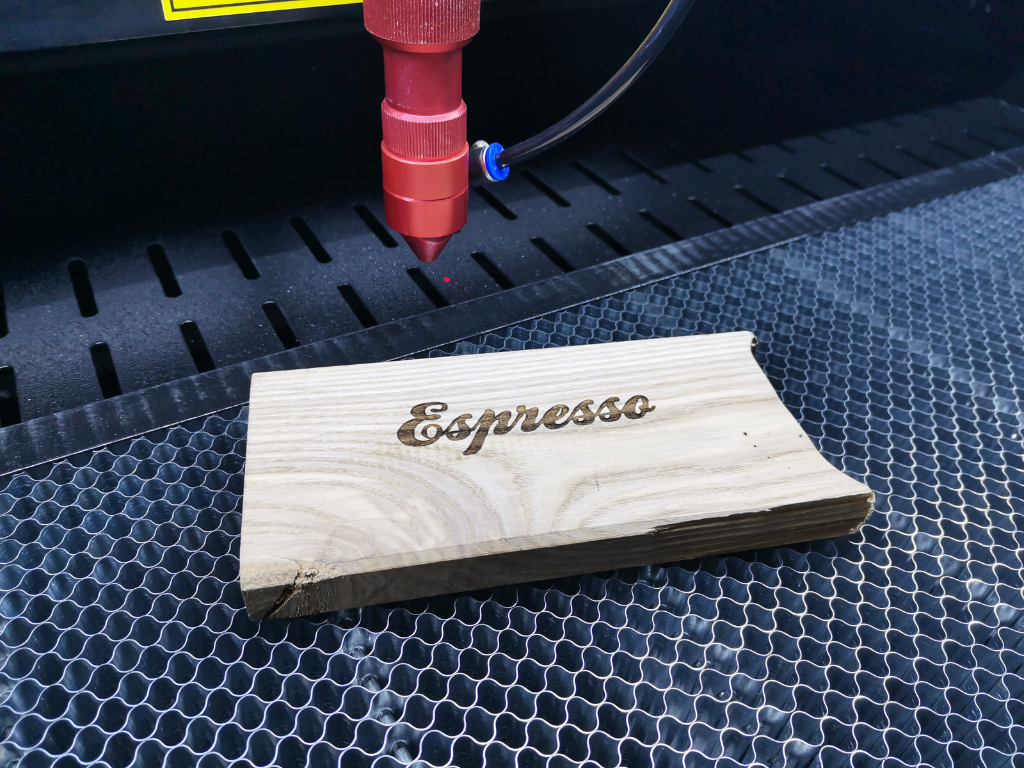
A CO2 laser cutter is a gas-tube machine that emits an invisible infrared beam with a wavelength of 10.6 µm. Mirrors guide it to a head that moves above the table in the X and Y axes. With a slow vector traverse and high energy per millimeter, the beam cuts through the sheet; with a fast raster traverse, it vaporizes a thin layer of the surface, i.e., engraves. This is the most common laser machine in advertising agencies, packaging workshops, and the furniture industry, as it processes almost anything organic.
The word "almost" is important here. A CO2 laser cutter doesn't cut metal, and several common materials are harmful to the machine and the operator's health. The table below shows what it cuts, what it only engraves, and what shouldn't be placed in the chamber. Next: tube power, glass tube and RF, chiller, air assist, exhaust, and working area.
The numbers come from Roboteus cards (RBL series), price lists of five Polish stores (A–E; as of October 2026) and manufacturer publications.
Why does a CO2 laser cutter cut plywood but not steel?
Absorption determines what can be processed. According to the marking machine manufacturer, a CO2 laser is effective on paper, resin, wood, rubber, and transparent materials like glass or PET, while marking metal with a CO2 beam is "almost impossible" because metal doesn't absorb this wavelength. The laser plotter manufacturer describes the process as follows: CO2 works by vaporizing the material, and bare metal reacts only when coated with a preparation.
Metal, on the other hand, absorbs the 1064 nm beam from a fiber laser, which, according to the plotter manufacturer, has an intensity up to a hundred times higher at the same average power due to its smaller spot size. Therefore, different machines are used for steel and aluminum: for markingRoboteus laser markersfor cutting sheet metalfiber laser plotters.
What does a CO2 laser cutter cut and engrave – material table
The table summarizes material from RBL cards and manufacturer notes. "Engraving only" means that cutting makes no technical or economic sense.
| Material | Cutting | Engraving | Notes |
|---|---|---|---|
| Plywood | Yes | Yes | The type of glue is important, especially when cutting; light glue gives cleaner edges |
| MDF, HDF | Yes | Yes | easy to process, but the cut edges become very dark |
| Solid wood | yes, thinner boards | Yes | hard species give a dark engraving, soft ones a lighter one; coniferous ones with resin unevenly |
| Acrylic (PMMA, plexiglass) | Yes | Yes | smooth, shiny cutting edge (cast acrylic; extruded acrylic behaves differently – test), matte engraving |
| Natural leather | Yes | Yes | synthetic leather can be made of PVC – see the "no" section |
| Fabrics, felt | Yes | limited | synthetics have a welded edge that doesn't fray |
| Cardboard, corrugated cardboard, paper | Yes | Yes | packaging, mock-ups; at very low power, only color change |
| Rubber for stamps | Yes | Yes | rubber intended for laser; intense odor requires efficient extraction |
| Engraving laminates | Yes | Yes | the engraver removes the top layer and reveals the color underneath |
| Glass | No | only engraving | white matte has minor surface cracks; glasses require a turntable |
| Stone, ceramics, granite | No | only engraving | tiles, light mark on dark stone |
| Anodized aluminum, painted metals | No | removal of the coating | CO2 removes the colored layer and reveals the clear substrate |
| Bare metal: steel, aluminum, brass | No | only with the preparation | reflected beam; the mark is made of a sintered preparation, not of metal |
Roboteus specifies for RBL plotters cutting „up to a dozen or so millimeters” without breaking it down by materials, because the same 80 W tube will cut a different thickness of plywood than acrylic in a single pass.
What a CO2 laser cutter is not suitable for
This list is not a matter of parameters, but of physics and chemistry: some materials damage the machine, some pose a threat to the operator.
- Metal without a preparation.The 10.6 µm beam reflects off steel, aluminum, and brass. A ceramic preparation produces a black mark on the surface, but this is marking, not engraving, and the process is more expensive: engravers charge more for marking metal with CO2 preparation than with fiber; the mechanism and cost are described in the text aboutlaser engraving on metal.
- PVC and other chlorinated materials — vinyl, PVC self-adhesive foils, PVC-based artificial leather, PVB. According to the marking system manufacturer’s application note, the laser releases chlorine vapor from PVC, which, combined with air humidity, creates hydrochloric acid that degrades metals and materials in the workstation area. The manufacturer calls exhaust ventilation „a fundamental requirement,” and PVC filters must be replaced „monthly or quarterly.” Laser Focus World adds that sticky PVC particles clog standard filters within minutes. Do not cut unmarked foil.
- Polycarbonate (PC). In practice, engraving under a CO2 beam yellows and chars, with a brown cut edge. Transparent PC looks like acrylic, so check the plate’s markings.
- Teflon (PTFE) and fluorinated plastics. They decompose into toxic fluorine compounds. An electronics store's guide lists Teflon among prohibited materials, alongside PVC, PVB, carbon fiber, epoxy and phenolic resins, and chrome-tanned leather.
- Chrome-tanned and synthetic leather. CO2 laser vendors warn against chromium salts and PVC in these materials. Vegetable-tanned leather is a safe choice.
- Materials of unknown composition. No material card means no processing until composition is confirmed.
Tube power and cutting thickness and speed
RBL plotters come standard with an 80W EFR glass tube; the RBL 9060 Roboteus offers the option of a 130W tube. Power translates primarily into cutting speed at a given thickness, and only secondarily into maximum thickness.
This is shown by the approximate values that shop A publishes for the 1610 plotter:
| Material | 40W tube | 60W tube | 80W tube | 130 W tube |
|---|---|---|---|---|
| Acrylic 5 mm | 5 mm/s | 9 mm/s | 10 mm/s | 15 mm/s |
| 4.5 mm plywood | 11 mm/s | 15 mm/s | 30 mm/s | 40 mm/s |
Same thickness, several times different performance. Maximum thickness declarations ("up to 20 mm" in store C for 130 W, "30 mm max" in store B) refer to the best materials and are silent on the quality of the edges.
When engraving, the relationship reverses: excess power causes burns and discoloration, not better results. Plotter manufacturers recommend 1.5″ or 2.0″ lenses (smaller spot) for engraving, and 2.5″ lenses for cutting thicker materials—the standard RBL 9060 has this. When a more powerful tube helps and when it only increases the price is explained in the text whether higher CO2 laser power always means better cutting.
Glass or RF tube – service life and replacement cost
A glass tube (DC) is a water-cooled, high-voltage gas-mixture tube. An RF tube is a metal, sealed resonator excited by radio waves. Glass tubes deliver more watts per zloty and are standard in cutting plotters; RF tubes, according to vendors, have a more stable, round spot and an advantage for fine engraving.
Stores declare the lifespan of glass tubes differently: store C „up to 4,500 hours” with a 6-month tube warranty; store A for EFR 60 W „up to 6,000 hours”; store B for EFR 100 W „over 6,000 hours”; store D for RECI W1 and W2 „approx. 12,000 operating hours.” The spread reflects differences between tube classes and calculation methods—these are vendors’ declarations.
When writing about sealed RF tubes, the plotter manufacturer states that the tube loses several percent of its power annually even when idle, and that every 10°C increase in semiconductor temperature halves their lifespan; the laser’s total lifespan is described as „approximately 10 years.” The marking system manufacturer states that the tube should be replaced „usually every 7–10 years.” Comparisons of glass versus RF in hours are published only by vendors and are inconsistent with each other.
Replacement cost in Polish stores, as of October 2026, net: 60 W EFR tube PLN 975.61, 80 W EFR F2 PLN 1,350.41, RECI W1 80 W PLN 1,202.44, 100 W EFR F4 PLN 1,788.62; plus power supply PLN 528.46–1,382.11. None of the reviewed stores list the price of the RF tube itself as a spare part. The difference is evident in finished machines: store E prices a plotter with a 30 W RF tube and a 90 W glass tube identically at PLN 23,000 net; in store A, a plotter with a 30 W RF tube costs PLN 49,000 net, while a plotter of the same brand with a 100 W glass tube costs PLN 35,000 net.
Chiller, air assist and exhaust – equipment without which there is no result
The chiller maintains the temperature of the water cooling the glass tube; the plotter manufacturer requires operating water-cooled tubes below 30°C, starting them only above 15°C water temperature, and strictly preventing condensation. RBL plotters include the CW5200 chiller as standard; it may also be sold separately in stores.
Air assist is a jet of compressed air directed by a nozzle into the cutting gap. According to the plotter manufacturer, it is „highly recommended” for wood cutting: it exhausts smoke, reduces burn marks, and protects the lens from residue. A dirty lens, as the manufacturer states, absorbs more power, heats up, and can crack.
Extraction is, as the plotter manufacturer states, „essential”: wood and plastics generate large quantities of gases and dust. Roboteus recommends planning the extraction system together with the machine, not after it has been started. Filtration has three stages—pre-filter, HEPA, and chemical section; the marking system manufacturer specifies HEPA efficiency of 99.997% at 0.3 µm and flow rates from 180 m³/h to 850 m³/h depending on the model, with a separate variant for PVC. List prices for filters, as of October 2026, net: BOFA in shop B PLN 4,878–7,724, in shop E PLN 3,000 and PLN 4,500. An alternative is to exhaust outside the building—but not for chlorinated plastics, which must not be processed without chemical filtration (marking system manufacturer).
Working area and through-feed table in RBL plotters
The working area is selected based on the sheet size, not the workpiece. Roboteus offers three formats on a common Ruida control system.
RBL 9060 CO2 laser cutterhas a 900 × 600 mm working area, an 80 W EFR tube, a honeycomb table, a through-feed table, a CW5200 chiller, a 2.5″ lens, a speed of 0–450 mm/s, an accuracy of 0.2 mm, and a minimum mark of 0.5 mm; it is powered by 230 V and weighs 250 kg. It is a workshop format for short runs and engraving.
RBL 1390 CO2 laser cutterwith a 1300 × 900 mm working area accepts a typical advertising sheet; it has the same tube, chiller, and Ruida with RDWorks v8 in Polish; it weighs 350 kg.RBL 1610 CO2 laser cutterwith a 1600 × 1000 mm working area processes sheets that do not need to be divided; it has a saber (knife) through-feed table with electric height adjustment, USB and Ethernet; it weighs 360 kg.
The through-feed table allows material longer than the working area to be fed through the machine and cut in sections. The honeycomb table supports small cut-outs; the knife table has fewer contact points, leaving fewer marks on the underside of thicker sheets. Roboteus provides indicative prices (as of October 2026): RBL 9060 from PLN 15,854.00 net and RBL 1610 from PLN 27,561.00 net, both as indicative prices, configured for the process; RBL 1390 is priced per process. The configuration (tube, table, extraction, turntable) is selected based on the order, so start with the CO2 laser cutters category or request a quote.
How much does a CO2 laser cutter cost – list prices in stores
As of October 2026, net: shop A—plotter 3040 (field 30 × 40 cm, 40 W tube) PLN 4,300 and plotter 6040 (60 × 40 cm, 40 W) PLN 5,000, plotter 1610 on Ruida from PLN 18,116.34 with tube of your choice; shop B—plotter 1300×900 with 80 W, 100 W or 130 W tube PLN 27,642.28; shop C—plotter 1390, 130 W PLN 28,447.15; shop D—plotter 1390, 130 W PLN 24,300; shop E—plotter 1390, 120 W PLN 29,000; shop A—100 W plotter PLN 35,000.
The price variation within the same field class depends on what is included: tube class, chiller, compressor, table type, extraction system, software, and tube warranty. Compare specifications, not offer headlines. Whether you need CO2, diode, or fiber lasers is determined by the text about the laser engraver—diode, CO2, or fiber.
Typical industries and what this means for your choice
Advertising and signage: Plexiglas letters, laminate signs, plaques—acrylic edge quality and large working area are key. Packaging: cardboard, foams—speed and a through-feed table are key. Furniture and interiors: plywood, MDF, engraved fronts—cutting power and engraving cleanliness are key; the recipe for a clean edge is described in the text about laser engraving on wood . Glasses and statuettes: turntable; the recipe for a matte white finish is described in the text about laser engraving on glass . A common denominator: a CO2 laser cutter is a machine for non-metallic materials; if metal is to be the primary material, add a fiber laser marker or fiber plotter to the calculation.
Frequently asked questions
Does a CO2 laser cutter cut metal?
In the power class of engraving plotters (40–130 W), no. The 10.6 µm beam is largely reflected by bare metal, so a CO2 laser cutter in this class cannot cut sheet metal or engrave steel. Sheet metal is cut by high-powered industrial CO2 lasers—a different class of machines, displaced in thin sheet metal by fiber lasers (RP Photonics). It is possible to create a mark on the surface using a ceramic preparation, but this is marking, not material loss. Fiber plotters are used for cutting sheet metal, and fiber laser markers for marking.
Can a CO2 laser cutter cut PVC or vinyl?
No. According to the marking system manufacturer, the laser releases chlorine from PVC, which, when combined with moisture, creates hydrochloric acid, which is destructive to the machine and harmful to humans. The same applies to vinyl films and PVC faux leather. Choose chlorine-free materials and check the labels.
What tube power is enough for plywood and plexiglass?
For engraving and thin sheets, the basic power is sufficient; a more powerful tube primarily speeds up cutting of the same thickness, as shown in the table above. The RBL 9060 comes standard with 80 W, and 130 W is optional.
How long does a CO2 tube last and how much does replacement cost?
Stores declare lifespans for glass tubes from „up to 4,500 h” to „approx. 12,000 h” (RECI). An 80 W tube as a component costs, as of October 2026, from PLN 1,202.44 net (RECI W1) to PLN 1,350.41 net (EFR F2), plus power supply.
Does a CO2 laser cutter require exhaust?
Yes. The plotter manufacturer calls exhaust essential, and Roboteus recommends planning an exhaust system with the machine. The choice is between a stationary filter (pre-filter, HEPA, chemical section) or an external discharge; for plastics, chemical filtration is mandatory.
Sources
- https://roboteus.com/pl/maszyny/plotery-laserowe-co2/ — Roboteus CO2 laser cutters category, materials, FAQ about ventilation and tube power, approximate prices of RBL 9060 and RBL 1610
- https://roboteus.com/pl/maszyny/plotery-laserowe-co2/ploter-laserowy-co2-rbl-9060/ – RBL 9060 parameters
- https://roboteus.com/pl/maszyny/plotery-laserowe-co2/ploter-laserowy-co2-rbl-1390/ – RBL 1390 parameters
- https://roboteus.com/pl/maszyny/plotery-laserowe-co2/ploter-laserowy-co2-rbl-1610/ – RBL 1610 parameters
- https://www.laserfocusworld.com/optics/article/16558543/fume-extraction-for-laser-marking-of-plastics — Hydrogen chloride and benzene from PVC/PET, sticky particles
- https://www.rp-photonics.com/laser_cutting.html
Editorial note
List prices vary and are for specific configurations as of October 2026; please verify with the source before making a decision. Speeds, thicknesses, and service life are manufacturer and vendor claims, depending on the machine, tube, lens, and material—confirmed by testing on your own sheets. This text does not replace manufacturer instructions, material safety data sheets, or laser health and safety regulations.