
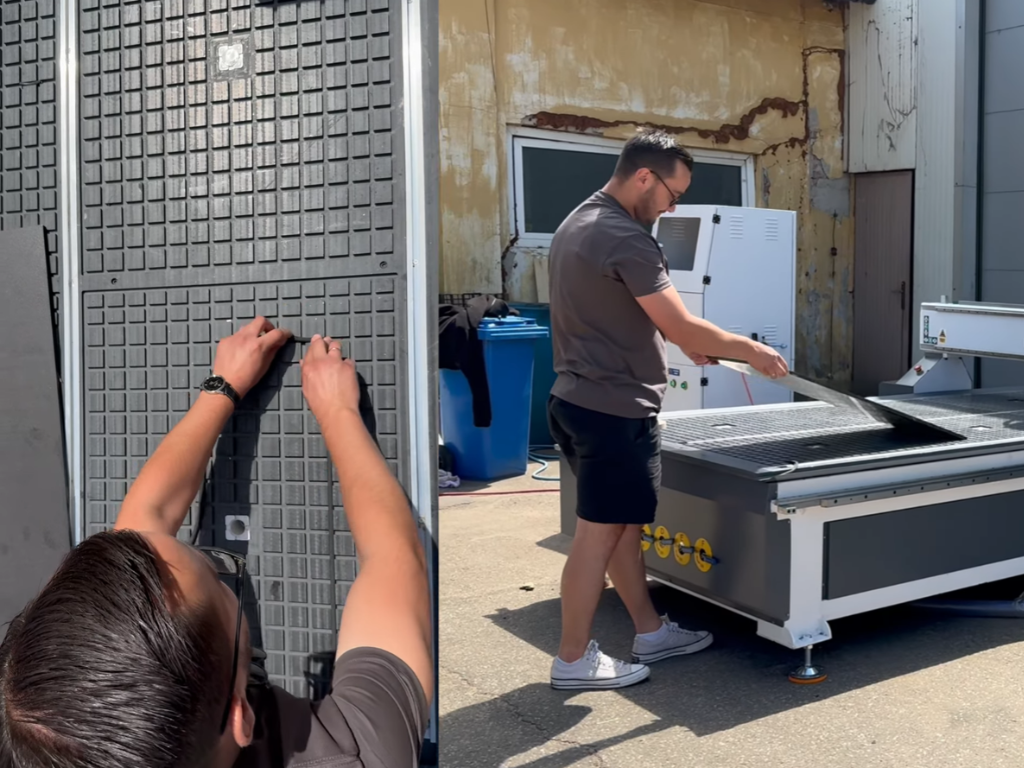
A CNC vacuum table, also known as a vacuum hold-down table, holds a sheet through a pressure difference. A pump removes air from beneath the sheet, while atmospheric pressure presses it against the bed. There are no clamps or screws on the sheet, giving the cutter access to the entire surface without the operator stopping the program to reposition a clamp. The tables fitted to individual models are shown on the Roboteus CNC routers.
Not every router needs one, and not every part can be held this way. Below we explain holding force, grid tables versus spoilboards, zones, pumps, small parts and T-slot tables. A selection table follows at the end.
Machine specifications come from RBF router datasheets; pump prices are Polish retailers’ catalogue prices as of October 2026. If you are still choosing a machine, the complete decision process is covered in how to choose a CNC router for wood.
1. How a CNC vacuum table holds a sheet
Hold-down force equals the pressure difference multiplied by the area over which it acts: F = Δp × A. Δp is the difference between the pressure above and below the sheet; A is the part’s area exposed to the vacuum. The pump does not “pull” the part. It creates a vacuum beneath it, and the air above presses it down.
Three practical conclusions follow:
- A large panel is held firmly even at moderate vacuum because it has a large surface area.
- A small part has a small A, so holding force falls with its area. The force the cutter applies does not decrease at the same rate, which is why small parts come loose first.
- Any leak reduces Δp beneath all the parts at once, not just at the leak. An uncovered area of the table, porous material or a through-cut all create leakage.
For example, assume a pressure difference of 0.2 bar, or 20,000 Pa (an assumption, not a machine specification), a panel measuring 0.5 × 0.5 m (0.25 m²) and a part measuring 0.1 × 0.1 m (0.01 m²). The force on the panel is then F = 20,000 × 0.25 = 5000 N (example), roughly the weight of half a tonne; on the small part it is 200 N (example), twenty-five times less.
This force presses the part against the table. The cutter mainly pushes it sideways, and only friction between the part and the bed or spoilboard prevents movement: substantially less than F. The real margin against cutting forces is therefore smaller than the calculation alone suggests. Moreover, the maximum vacuum in a pump datasheet is measured at its inlet; leakage losses mean less vacuum beneath the part.
If vacuum falls during the program, the part may move and be torn free by the cutter. Ask the supplier whether the machine monitors vacuum and stops the program when it drops. Do not stand in a part’s potential ejection path during through-cutting.
2. Grid table or MDF spoilboard
In its CNC routing guide, ACRYLITE (Röhm) states that material is most commonly held by vacuum on an MDF spoilboard. It describes two options:
- Conventional spoilboard. Used with a high-vacuum, low-flow pump. Channels are routed in the board to bring vacuum beneath a specific part, and a gasket is placed just inside its outline. According to ACRYLITE, this fixture provides the greatest holding force, but each shape requires its own fixture.
- Universal spoilboard. Used with a low-vacuum, high-flow pump. Air is drawn through the porous structure of the entire MDF board, without channels or gaskets, so one board accommodates many parts. ACRYLITE does not recommend it for small parts or parts with rough surfaces.
A grid table is an aluminium bed with a network of channels connected to vacuum zones. Material can be placed directly on the grid or on a spoilboard that distributes vacuum. The latter is necessary for through-cutting: the tool must enter the spoilboard, not the aluminium. In industrial nesting centres, one woodworking machinery manufacturer uses a table with a 30 × 30 mm channel grid and automatic vacuum-field selection.
The spoilboard wears with every through-cut and therefore needs periodic surfacing. Tool manufacturers offer dedicated cutters, such as Amana Tool PCD spoilboard surfacing tools. How to machine the MDF board itself without burning is covered in routing MDF without burning the edges.
3. Zones: six, nine or twelve
A zone is an area of the table that can be activated or isolated with a valve. The RBF 1325V datasheet explains this directly: zoning concentrates suction only where the material lies, which is useful for smaller panels. The number of zones increases with the working area. According to the datasheets, every model with a vacuum table includes a pump.
| Zones | Working area | Models and pump (according to datasheets) |
|---|---|---|
| 6 | 1300 × 2500 mm | RBF 1325V; RBF 1325 ATC with a 5.5 kW side-channel pump |
| 9 + 4 T-slot rails | 2000 × 3000 mm | RBF 2030V and RBF 2030 ATC, 7.5 kW pump |
| 12 + 4 T-slot rails | 2000 × 4000 mm | RBF 2040V, 7.5 kW side-channel pump |
RBF 9060 and RBF 1212 have a T-slot table without a pump.
For comparison, two Polish router distributors’ catalogues, as of October 2026, show the following: retailer A’s 1300 × 2500 mm ATC router has a vacuum table with 4 zones and a T-slot table; its 2000 × 4000 mm ATC version has 4 independent zones. Retailer B describes its 1300 × 2500 mm router’s table as hybrid (“vacuum + mechanical rails”), also with 4 zones.
The operating rule is simple: activate only the zones covered by material. If a sheet does not cover an entire zone, cover the exposed area with a panel offcut; otherwise the pump draws air from the workshop. LEUCO gives similar advice for machining PMMA on pod-and-rail tables: use as many vacuum cups as possible and minimise unsupported overhang.
4. CNC vacuum pumps: side-channel, rotary vane and claw
ACRYLITE’s distinction shows that pump selection follows the workholding method. A universal spoilboard needs high flow because air continuously leaks through the MDF. A gasketed fixture with channels needs a deep vacuum because leakage is low.
Retailers describe pumps by their construction. Retailer B sells the Becker SV 500/1 as a “side-channel compressor”, Becker VT 4.25 as an “oil-free rotary vane” pump and Busch MINK MV 0312 B as a “dry claw” pump. The nesting-centre manufacturer mentioned earlier uses claw or dry rotary vane pumps and describes them as quiet and low-maintenance. According to the datasheets, RBF ATC routers and the RBF 2040V use a side-channel pump.
Pump type is not the whole story. Compare two datasheet values: flow in m³/h and maximum vacuum in mbar, preferably together with a flow curve at different vacuum levels. Retailer A specifies its 5.5 kW pump at 320 m³/h flow and vacuum down to −440 mbar. If an offer omits these figures, ask for them directly.
Pump catalogue prices excluding VAT, as of October 2026:
| Retailer | Pump | Specifications stated by retailer | Price excluding VAT |
|---|---|---|---|
| retailer A | 5.5 kW vacuum pump | 320 m³/h, down to −440 mbar | 5,500.00 PLN (promotional price) |
| retailer A | 7.5 kW vacuum pump | — | 5,601.63 PLN |
| retailer A | Becker VTLF 2.250 | — | 14,900.00 PLN |
| retailer B | Becker VT 4.25, oil-free rotary vane | — | 8,500.00 PLN |
| retailer B | Becker SV 500/1, side-channel, with filter and non-return valve | 7.5 kW, 510 m³ (from the product name) | 20,900.00 PLN |
| retailer B | Busch MINK MM 1252 AV | 5.5 kW, 250 m³/h (from the product name) | 41,800.00 PLN |
| retailer B | Busch MINK MV 0312 B, dry claw | — | 43,700.00 PLN |
The pump’s cost is also visible in machine prices. In retailer B’s catalogue, a 2000–2100 × 4000 mm router with a 6 kW spindle costs 79,000 PLN excluding VAT, or 87,000 PLN with a pump. According to the datasheets, the RBF 1325V, RBF 1325 ATC, RBF 2030V, RBF 2030 ATC and RBF 2040V include a pump.
5. What a vacuum table cannot hold without help
Large MDF, plywood, chipboard and laminated panels are the easiest case. Difficulties arise with small parts, porous materials and through-cutting when the part separates from the sheet. There are four ways to address them.
- Two passes (onion skin). LEUCO describes a two-stage method for nesting PMMA: a roughing pass slightly shallower than the sheet thickness, followed by a finishing pass slightly deeper, cutting into the spoilboard. The thin remaining layer maintains the seal until the final pass.
- Tabs. CAM leaves short, thin connections between the part and the sheet along the outline; these are removed after the sheet comes off the table. They require manual finishing, but prevent the part from coming loose at the last moment.
- Cutting order and tool choice. Holes and small parts are cut first, with large external contours last while the sheet still seals the table. A down-cut tool that presses the part down helps; an up-cut tool that lifts it does not. Tool selection and entry rules are explained in CNC router bit types.
- Dedicated fixture. For a batch of small, repeatable parts, a conventional spoilboard with channels and a gasket matching the shape becomes worthwhile.
For plastics, MCG recommends vacuum plates with additional perimeter support and avoiding excessive material removal from one side of a sheet. Röhm recommends leaving the protective film on PLEXIGLAS until machining is complete. Warped solid wood will not seal against the bed, so mechanical clamping is preferable.
6. T-slot and combination tables
The RBF 9060 and RBF 1212 have aluminium T-slot tables with PVC inserts. Material is secured with clamps and screws in the slots. ACRYLITE also lists other workholding methods: screws, eccentric clamps and a vice. This table needs no pump or separate pump supply. Both machines operate on 230 V, while vacuum-table models use 380 V.
Clamps occupy working space and need repositioning, which means stopping the program. A T-slot table suits one-off parts, solid wood, fixtures and small formats.
A combination table provides both options on one machine. The RBF 2030V, RBF 2030 ATC and RBF 2040V have a vacuum grid with 4 T-slot rails. Vacuum holds sheets, while worktops, beams and fixtures are bolted to the rails. According to its machine datasheet, the RBF 1325 ATC also combines 6 vacuum zones with T-slot rails. The RBF 1325V datasheet allows “conventional clamping”; ask an adviser which clamps to use and where they attach.
7. Energy, noise and pump exhaust
The pump runs whenever material is held on the table, not only during cutting. On the RBF 2030V, the spindle is 3.2 kW and the pump 7.5 kW. On the RBF 1325 ATC, the spindle is 6 kW and the pump 5.5 kW. The pump is therefore one of the workstation’s largest electrical loads and must be included when planning the 380 V supply.
Reduce energy use by switching off unused zones and stopping the pump between sheets. According to one nesting-centre manufacturer’s documentation, additional pumps switch on automatically in large installations, while variable-speed pumps adjust vacuum to demand.
Pump noise adds to spindle and extraction noise. Directive 2003/10/EC provides a reference for workers’ daily noise exposure: the lower exposure action value is 80 dB, the upper is 85 dB, and the exposure limit, accounting for hearing protection, is 87 dB. HSE estimates that most woodworking employees are likely to exceed 85 dB. It therefore makes sense to position the pump away from the operator, for example behind a wall, using a short, airtight pipe.
The pump draws MDF dust through the porous spoilboard, so the inlet filter needs regular inspection. Retailer B supplies its side-channel pump with a filter and non-return valve. Direct the exhaust away from the operator and stored material.
8. Selection table: which table for which production
| Production profile | Solution | Example from Roboteus |
|---|---|---|
| One-off parts, solid wood, fixtures, small workshop | T-slot table, clamps and screws | RBF 9060, RBF 1212 |
| Full-sheet cutting, 1300 × 2500 mm, cabinet fronts, nesting | 6-zone vacuum table + MDF spoilboard | RBF 1325V, RBF 1325 ATC |
| Large sheets and solid components on one machine | 9-zone grid + 4 T-slot rails, 7.5 kW pump | RBF 2030V, RBF 2030 ATC |
| 2000 × 4000 mm sheets without trimming | 12-zone grid + 4 T-slot rails, 7.5 kW pump | RBF 2040V |
| Batch of small sheet-cut parts | vacuum + two passes or tabs; a channelled, gasketed fixture for large batches | any model with a vacuum table |
Indicative prices and model configurations are compared in how to choose a CNC router for wood.
For through-cutting, the Z-axis zero is usually set on the table or spoilboard surface rather than the top of the material. We cover homing and the tool-length sensor in CNC router programming and control.
Frequently asked questions
Does a CNC router need a vacuum table?
Not always. For full-sheet cutting and nesting, a vacuum table saves time because clamps do not need repositioning. For one-off parts, solid wood and small formats, a T-slot table such as those on the RBF 9060 and RBF 1212 is sufficient.
Which vacuum pump should I use for a CNC table?
One whose flow and vacuum match the workholding method. A universal MDF spoilboard needs high flow; a gasketed fixture needs deep vacuum. According to its datasheet, the RBF 1325 ATC has a 5.5 kW side-channel pump, while the RBF 2030V, RBF 2030 ATC and RBF 2040V have a 7.5 kW pump.
Why will a vacuum table not hold small parts?
Hold-down force is the pressure difference multiplied by area, so a small part has little holding force. The cutter also pushes sideways, resisted only by friction. Helpful measures include two passes leaving a thin layer until the end, tabs, a down-cut bit and cutting small parts before large outlines.
How much does a CNC vacuum pump cost?
Polish retailers’ catalogues (excluding VAT, as of October 2026) range from 5,500.00 PLN for a 5.5 kW pump at one retailer (promotional price) to 43,700.00 PLN for a Busch MINK MV 0312 B dry claw pump at another. At the latter retailer, the Becker SV 500/1 side-channel pump rated at 7.5 kW costs 20,900.00 PLN.
Sources
- https://roboteus.com/pl/maszyny/frezarki-cnc/ — vacuum table description, zones by model
- https://roboteus.com/pl/maszyny/frezarki-cnc/frezarka-cnc-rbf-9060/ — T-slot table, specifications
- https://roboteus.com/pl/maszyny/frezarki-cnc/frezarka-cnc-rbf-1212/ — T-slot table, indicative price
- https://roboteus.com/pl/maszyny/frezarki-cnc/frezarka-cnc-rbf-1325v/ — 6 zones, pump included, conventional clamping
- https://roboteus.com/pl/maszyny/frezarki-cnc/frezarka-cnc-rbf-1325-atc/ — 5.5 kW side-channel pump, 6 kW spindle, T-slot rails in the datasheet description
- https://roboteus.com/pl/maszyny/frezarki-cnc/frezarka-cnc-rbf-2030v/ — 9-zone grid + T-slot rails, 7.5 kW pump included
- https://roboteus.com/pl/maszyny/frezarki-cnc/frezarka-cnc-rbf-2030atc/ — 9-zone grid, 7.5 kW side-channel pump
- https://roboteus.com/pl/maszyny/frezarki-cnc/frezarka-cnc-rbf-2040v/ — 12-zone grid + T-slot rails, 7.5 kW pump
- https://www.acrylite.co/resources/fabrication-manuals/routing-premium-acrylite-acrylic-sheet — conventional and universal spoilboards, pump types, other workholding methods
- https://www.leuco.com/EN/AU/media/DOK_MBR_LEUCO-Kunststoffbearbeitung_DL.pdf — two-pass nesting, vacuum cups
- https://www.mcam.com/mam/41701/MCG-Machinist-Toolkit-A4-EU-metric.pdf — holding plastic sheets on vacuum plates
- https://www.zenit.cz/public/media/Plasty/Zenit_Montaz_Plasty_Plexiglas_Zpracovani2_AJ.pdf — PLEXIGLAS protective film during machining
- https://www.amanatool.com/pub/media/productattachments/PCD-Spoilboard-Speed-Chart-v3.pdf — PCD spoilboard surfacing tools
- https://eur-lex.europa.eu/legal-content/PL/TXT/HTML/?uri=CELEX:32003L0010 — noise exposure action values
- https://www.hse.gov.uk/woodworking/noise.htm — woodworking noise
Editorial note
Catalogue prices come from retailer websites as of October 2026 and may change; some are promotional. Holding force depends on the specific machine, pump, spoilboard, material and sealing, so the calculation illustrates only an order of magnitude. This article does not replace the machine and pump manufacturers’ instructions or workplace safety rules for machinery, noise and wood dust.