
The same router and program can produce a clean edge or tear-out, chips or melted plastic; the cutter itself often makes the difference. CNC router bits differ in spiral direction, cutting-edge count, end geometry and cutting material. Each feature addresses a different problem: lifting the part, chipping laminate, chips sticking to the tool or rapid edge wear.
We organise tool types in one table and explain cutting materials (HSS, VHM, PCD), workholding and catalogue prices from Polish retailers, using Vortex, Amana, LEUCO and Leitz datasheets and European Panel Federation (EPF) and Röhm guidance. Speed and feed formulas are covered in CNC milling parameters.
1. CNC router bit types in one table
| Tool type | Applications | Result and precautions |
|---|---|---|
| Straight (brazed carbide, two-flute) | MDF, panels, wood | According to EPF, the most commonly used type in MDF; spiral tools run more quietly and productively but cost more |
| Spiral up-cut | slots, pockets, plunging | Chips move upwards, smooth bottom edge, possible top-edge fuzzing; may lift the part |
| Spiral down-cut | sheet cutting, top veneer surface | Presses the part down, smooth top edge, possible bottom-edge fuzzing; may clog in blind slots |
| Compression | double-sided laminated panels (melamine, HPL, painted panels) | Upward and downward spirals “compress” the material, preventing chipping on both sides |
| Roughing | rapid stock removal in hardwood and plywood | Serrated edge; a finishing pass is required |
| Single-flute | lower feed rates, plastics, aluminium | An open flute evacuates chips and limits heating |
| Three-flute | finishing | Better finish than a two-flute tool at the same feed rate |
| O-flute | soft and hard plastics | Curled chips that do not weld back onto the plastic |
| Polished single-flute for aluminium | aluminium sheets, blocks and profiles | Sharp, polished edges limit built-up edge |
| Multi-flute polishing | finishing PMMA edges | LEUCO recommends a Z = 5 polishing cutter for the final finish |
| Ball-nose | 3D work, carving, curved surfaces | Amana provides a separate parameter sheet for the Spektra series |
| V-bit (tapered engraving) | lettering, chamfers, engraving | Line width increases with depth (cone geometry) |
| Surfacing | surfacing the table spoilboard | Amana requires ramp entry for its PCD spoilboard surfacing cutter |
Descriptions of spiral and roughing tools and cutting-edge counts come from the Vortex catalogue; O-flute profiles from Vortex and ACRYLITE; aluminium tools from Vortex and Sandvik. The table does not replace a specific tool’s datasheet: the same type from two manufacturers may have different geometries and recommendations.
2. Spiral direction: up-cut, down-cut and compression
According to the Vortex catalogue, an up-cut tool has a right-hand spiral with right-hand cutting rotation and carries chips upwards. It suits slots and pockets because it ejects chips from the cutting zone and plunges well. The trade-off is a force lifting the part and a frayed top edge, so thin sheets on a vacuum table need stronger workholding or staged cutting.
A down-cut tool has a left-hand spiral with right-hand cutting rotation, pushing chips down and pressing the material against the bed. It produces a smooth top surface and clean veneer, although the bottom may fuzz. Vortex warns that a down-cut bit must not plunge vertically into wood: it must enter on a ramp. In nesting, chips left in the cut help maintain vacuum. Polish retailers sometimes call this tool “left-hand spiral” or “negative”. Before buying, check that the datasheet means spiral direction with right-hand cutting rotation: a left-hand cutting tool will not work in a spindle rotating clockwise (M3).
A compression bit combines both directions: the lower cutting section works as an up-cut, the upper as a down-cut. Vortex mainly specifies it for double-sided laminated panels; Polish retailers sometimes describe it as having a “positive-negative arrangement of inclined cutting edges” (cnc-sklep.pl). For both sections to work, the pass must reach the down-cut section. Panel and cabinet-front machining is covered in routing MDF without burning.
3. Cutting-edge count: single-, two- and three-flute tools
More edges mean more cuts per revolution: at the same feed rate, each edge removes a thinner chip. A single-flute tool therefore suits routers with a limited working feed rate, maintaining a thicker chip at lower feed. Vortex recommends it where the application requires lower feed rates.
Two-flute tools are the most common choice for wood and panels. According to Vortex, a three-flute tool produces a better finish at the same feed rate but requires a machine capable of maintaining a higher feed.
4. Tools for plastics and aluminium: O-flute and polished flutes
“O-flute” is a term from American catalogues describing flute geometry, not cutting-edge count: an O-profile chip flute has a rounded, usually polished shape that curls the chip. These tools most often have one cutting edge, although ACRYLITE lists versions with 1–3. According to Vortex, they curl chips into a regular spiral, allowing soft plastics to be cut without chip welding. A straight version introduces neither upward nor downward forces and therefore suits parts weakly held by vacuum. ACRYLITE (Röhm) states that solid-carbide up-cut tools of this type with 1, 2 or 3 edges produce the best PMMA results and recommends starting with 1–2 edges.
Polish retailers generally list these as single-flute acrylic cutters with a polished flute. cnc-sklep.pl describes the “Ultra Low Helix High Performance” series as “single-flute” tools with a polished cutting edge and chip flute. For final PMMA finishing, LEUCO recommends a single-flute solid-carbide tool with a polished flute or a Z = 5 polishing cutter. Selection for PMMA, PC and POM is developed in CNC routing plastics.
With aluminium, the problem is built-up edge. Sandvik Coromant recommends sharp, polished edges; Vortex describes its 5600A series as single-flute up-cut O-flute tools for most sheet, block and extrusion grades of aluminium. Polish retailers list them as “single-flute aluminium cutters” or “polished” tools. Leitz notes that wrought alloys can also be machined with tools similar to woodworking cutters, but a typical wood bit with a narrow, unpolished flute clogs more easily with aluminium. An aluminium-specific cutter is therefore a better starting choice. Strategies and cooling are covered in routing aluminium on a gantry machine.
5. Tool material: HSS, VHM and PCD
The Leitz Lexicon classifies cutting materials as follows:
- HSS (high-speed steel, HS in Leitz terminology) — for solid wood, mainly softwood;
- carbide (HW) — the “universal cutting material for wood”; VHM tools are solid carbide, whereas TCT tools have carbide tips brazed to the body;
- coated carbide (HC) — for solid wood, thermoplastics and non-ferrous metals; according to Leitz, coatings extend operating life up to 5× and remain effective after sharpening;
- polycrystalline diamond (DP, sold as PCD) — from solid wood and panels to highly abrasive materials such as laminates, fibre-cement boards and composites; Leitz recommends it for dry machining of non-ferrous metals;
- monocrystalline diamond (DM) — for high-gloss surfaces on plastics and non-ferrous metals.
According to EPF, PCD tools last 30–50× longer than carbide tools when profiling MDF with controlled feed. However, they are less resistant to abrasive inclusions than TCT and work best in MDF with low sand content. According to Leitz, glue joints are the main source of edge wear in panels, while sand is a major factor in chipboard.
For a small joinery shop, the conclusion is: solid carbide for most work, HSS at most for softwood and trials, and PCD for large panel batches where tool changes and downtime matter. Coating and polishing are two routes towards the same goal: Vortex uses polished flutes, while GARANT specifies a substantially higher aluminium cutting speed for its DLC-coated cutter than its uncoated version.
6. Tool clamping: runout, cutting length and ISO30 holders
A cutter is only as accurate as its clamping. REGO-FIX writes that “precision is a function of the complete system: holder, collet and nut”, and runout affects tool life, finish and spindle wear. According to REGO-FIX, DIN 6499 / ISO 15488 allows up to 0.015 mm runout for 1–10 mm shanks, while REGO-FIX ER collets have up to 10 µm.
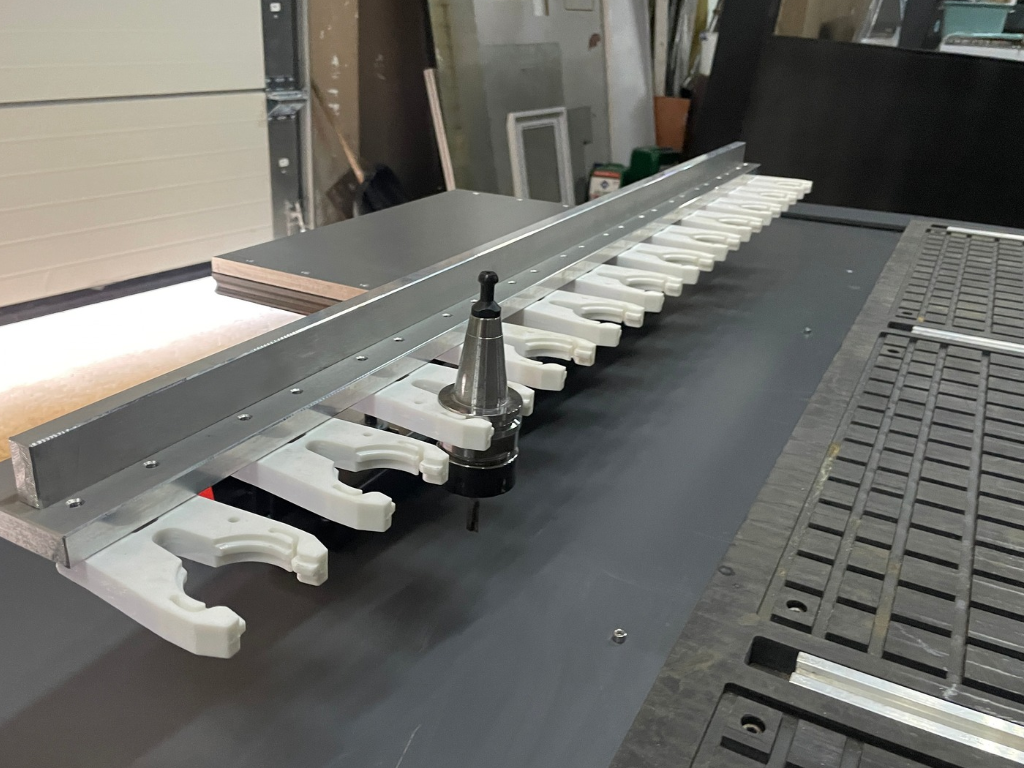
According to Roboteus machine datasheets, models without ATC have ER20 collets (RBF 9060, 1212, 1325V, 2030V) or ER25 (RBF 2040V); collet ranges are discussed in which spindle to choose for a CNC router. The RBF 2030 ATC has a linear magazine for 12 tools in ISO30holders, and the RBF 1325 ATC has the same magazine, also for ISO30 holders according to the machine datasheet.
With ATC, each tool in the magazine needs its own holder and collet, so the set’s cost increases with tool count. For comparison, as of October 2026, cncprofi.com sells a set of 9 ER20 collets for 165.00 PLN excluding VAT (202.95 PLN including VAT) and 10 ER25 collets for 175.00 PLN excluding VAT (215.25 PLN including VAT); a Polish router distributor sells an ISO30 taper holder for ER32 collets for 373.17 PLN excluding VAT (catalogue prices). When a magazine pays off is covered in CNC router or machining centre.
Two rules concern the cutter itself. ACRYLITE recommends a shank at least as large as the cutting diameter and a cutting length no greater than 3× diameter for HSS and brazed carbide, or up to 4.5:1 for solid carbide. For MDF, EPF states that cutting diameter should not exceed 2× shank diameter. Röhm adds that the shank should be inserted deeply into the collet.
7. CNC cutter prices from Polish retailers
Example catalogue prices, as of October 2026:
| Cutter | Retailer | Excluding VAT | Including VAT |
|---|---|---|---|
| Compression BF 1F 6x22x6x65 Z1+1 (wood, MDF, plywood) | cnc-sklep.pl | 118.70 PLN | 146.00 PLN |
| Straight BF 2F 4x18x6x60 | cnc-sklep.pl | 83.74 PLN | 103.00 PLN |
| VHM two-flute fi 7.96x30x12.7 for wood | cncprofi.com | 14.95 PLN | 18.39 PLN |
| HSSCo two-flute fi 12 mm | cncprofi.com | 19.60 PLN | 24.11 PLN |
| CMT spiral finishing down-cut 10x32x10 | narzedziacnc.pl | 240.56 PLN | 295.89 PLN |
| CMT spiral down-cut 16x55x16 | narzedziacnc.pl | 769.15 PLN | 946.05 PLN |
| CMT diamond nesting cutter 12x24x12 | narzedziacnc.pl | 1,309.28 PLN | 1,610.41 PLN |
| BF 1F 3x12x6x50 AL, polished, for aluminium | cnc-sklep.pl | 102.44 PLN | 126.00 PLN |
| INTEGRA VHM 1-flute for aluminium 10 mm / 12 mm | narzedziacnc.pl | 136.98 / 178.56 PLN | 168.49 / 219.63 PLN |
| DARMET VHM 3-flute 10 mm | narzedziacnc.pl | 125.68 PLN | 154.59 PLN |
| CE 1F 3x12x6x60 Low Helix, for acrylic | cnc-sklep.pl | 109.76 PLN | 135.00 PLN |
| Amana Spektra 6 mm, 3 cutting edges | router distributor | — | 247.25 PLN |
The range is wide: a wood cutter of about 8 mm diameter starts in the teens of PLN excluding VAT, while a branded 10 mm spiral cutter costs over two hundred (CMT 192.100.11: 240.56 PLN excluding VAT). For the first purchase, compare two cutters of the same type on a sample.
8. Tool life, sharpening and replacement
A blunt cutter causes the same symptoms as poor settings: burning, tear-out and melting. According to ACRYLITE, a blunt edge in PMMA causes chipping or overheating and stress. It also recommends replacing the tool when runout exceeds 0.001–0.002″.
EPF gives two assessment methods: edge inspection or motor-current measurement. Sharpen when current rises to 110–120% of the value with a new tool. Carbide edges are rough-ground with a 100-grit diamond wheel and polished with 400–600 grit, limiting resin build-up. In aluminium, Sandvik identifies burrs and surface quality as the end-of-life criteria.
Small solid-carbide cutters are generally replaced; calculate the economics of sharpening larger tools with a tool-grinding service.
9. A starter set for a new router
For a workshop starting with panels and wood, occasionally cutting acrylic and thin aluminium:
- Compression bit for laminated panels and plywood, such as the BF 1F 6×22 Z1+1 from cnc-sklep.pl (118.70 PLN excluding VAT).
- Straight or up-cut bit for slots and pockets, such as the BF 2F 4×18 from cnc-sklep.pl (83.74 PLN excluding VAT).
- Down-cut for a clean top edge, such as the CMT spiral down-cut 10x32x10 from narzedziacnc.pl (240.56 PLN excluding VAT).
- Single-flute acrylic cutter with a polished flute, such as the CE 1F 3×12 Low Helix from cnc-sklep.pl (109.76 PLN excluding VAT).
- Polished single-flute aluminium cutter, such as the BF 1F 3×12 AL from cnc-sklep.pl (102.44 PLN excluding VAT).
These five items cost approximately 655 PLN excluding VAT at catalogue prices (editorial calculation), as of October 2026. Add a ball-nose cutter for 3D work, a V-bit for engraving and a spoilboard surfacing tool. Selection for solid wood is covered in CNC wood routing; machines with ER collets and ATC magazines can be found among Roboteus CNC routers.
Frequently asked questions
How much does a CNC router bit cost?
In Polish retailers’ catalogues (excluding VAT, as of October 2026), a straight solid-carbide wood cutter starts at 14.95 PLN at cncprofi.com, a BF 1F 6×22 compression bit costs 118.70 PLN at cnc-sklep.pl and a CMT diamond nesting cutter costs 1,309.28 PLN at narzedziacnc.pl. Polished-flute aluminium and acrylic cutters usually cost around 100–180 PLN excluding VAT.
What is a compression bit and when should I use one?
It has two spiral sections: the lower cuts upwards and the upper downwards. Both “compress” the material towards the centre, leaving both edges clean. It is mainly used for melamine, HPL and painted panels, with a pass deep enough to reach the down-cut section.
How does a VHM cutter differ from TCT?
A VHM tool is solid carbide, whereas TCT has carbide tips brazed to the body. EPF notes that straight brazed tools are still common in MDF; solid-carbide spiral tools run more quietly and productively but cost more. Small solid-carbide cutters are usually replaced, while larger tools can be worth sharpening.
Up-cut or down-cut: which should I choose?
Up-cut evacuates chips upwards and works well in slots and pockets, but can lift the part and fray its top edge. Down-cut presses material down and gives a clean top edge, but must enter on a ramp rather than plunge vertically. When both edges of a laminated panel matter, choose a compression bit.
Can I use an HSS bit in a CNC router?
For softwood, yes: Leitz specifies HSS for solid wood, mainly softwood. MDF, panels and laminates are better served by carbide (VHM or TCT) or PCD because resin binders and sand rapidly dull the edge.
Sources
- https://www.vortextool.com/media/assets/Vortex_Catalog.pdf
- https://www.acrylite.co/resources/fabrication-manuals/routing-premium-acrylite-acrylic-sheet
- https://www.leuco.com/EN/AU/media/DOK_MBR_LEUCO-Kunststoffbearbeitung_DL.pdf
- https://www.hoechsmann.com/cz/lexikon/pdf/lei_lexikon_edition6_2011_en.pdf
- https://mdf-info.eu/using-mdf/processing/routing
- https://mdf-info.eu/using-mdf/processing/profilage-du-mdf
- https://www.sandvik.coromant.com/en-gb/knowledge/milling/milling-different-materials
- https://www.amanatool.com/pub/media/productattachments/Spektra-Spiral-Ball-Nose-Speed-Chart-v11.pdf
- https://www.amanatool.com/pub/media/productattachments/PCD-Spoilboard-Speed-Chart-v3.pdf
- https://cdn.hoffmann-group.com/dsh/de-DE/dsh_de-de_99645.pdf
- https://www.productivity.com/wp-content/uploads/2020/04/Rego-Fix-_ER_System-3-25-20-Interactive.pdf
- https://cnc-sklep.pl/pl/c/Frezy-VHM-do-drewna%2C-sklejki%2C-MDF-oraz-plyty-wiorowej/44
- https://cnc-sklep.pl/pl/p/Frez-BF-1F-6x22x6x65-Z1-1-GL/681
- https://cnc-sklep.pl/frezy-do-aluminium
- https://cnc-sklep.pl/pl/p/Frez-BF-1F-3x12x6x50-AL/454
- https://cnc-sklep.pl/pl/c/Frezy-VHM-do-plexi-tworzyw-sztucznych/1
- https://cnc-sklep.pl/pl/p/Frez-CE-1F-3x12x6x60-LH-HP/612
- https://www.narzedziacnc.pl/pl/searchquery/negatyw
- https://www.narzedziacnc.pl/frezy-do-aluminium
- https://cncprofi.com/category/frezy-z-weglika-vhm-2p
- https://cncprofi.com/category/frezy-hss
- https://cncprofi.com/category/zestawy-tulejek-er
- https://roboteus.com/pl/maszyny/frezarki-cnc/
- https://roboteus.com/pl/maszyny/frezarki-cnc/frezarka-cnc-rbf-1325-atc/
Editorial note
Retailers’ catalogue prices change; the figures are from October 2026 and are provided only as a reference. Tool selection depends on the machine, material and batch, so test each new cutter on a sample. This article does not replace the tool and machine manufacturers’ instructions or workplace safety rules for machinery and wood dust.