
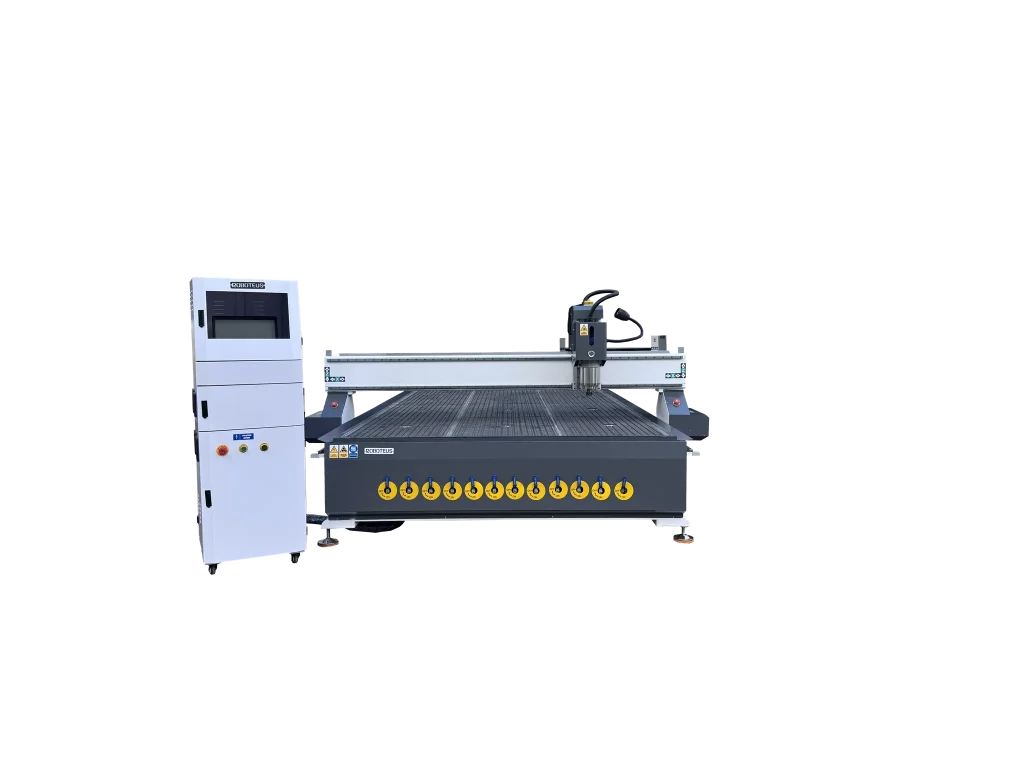
Routing MDF is considered easy: the board is uniform, with no grain or knots, and the routed edge looks ready for paint. Problems appear in production. Edges turn brown, the cutter starts squealing after a few sheets, fine dust replaces chips, and every tool mark becomes visible after a cabinet front is painted.
The cause is almost always the same: the cutting edge rubs instead of shearing. Below is a six-step process, followed by cabinet fronts, HDF, dust and formaldehyde, and a table of common defects.
Speed and feed formulas are in CNC milling parameters. Here we give only fibreboard values from tool manufacturers’ datasheets, always with the diameter and cutting-edge count to which they apply.
Why routing MDF burns edges and dulls cutters
The European Panel Federation (EPF), a panel manufacturers’ organisation, writes that MDF is “slightly more abrasive than commonly used hardwood”. Its high density and resin binder are the reason, not sand, which is present only in small quantities in the raw material. Leitz adds that glue joints cause most cutting-edge abrasion in wood-based materials. MDF contains glue throughout its volume, so the cutter encounters it along its full cutting length.
Density determines resistance. Leitz gives a typical MDF density of 600–1000 kg/m³, while DIN EN 316 defines HDF as at least 800 kg/m³. There is also the burning mechanism EPF describes in edge machining: at insufficient feed rates, edges “compress and abrade” the MDF edge. Friction raises temperature and shortens tool life between sharpenings. According to EPF, routing wear rises rapidly as feed per tooth decreases.
The conclusion is counterintuitive. Feeding more slowly “to be safe” at full spindle speed burns MDF more, not less.
1. MDF chip thickness: chips, not dust
Feed per tooth (fz) is the advance per cutting edge in one tool revolution; it determines the chip thickness removed by each edge. According to EPF, 0.15–0.25 mm per tooth produces a satisfactory edge with minimal wear. For sawing, EPF adds a practical test: fine dust is a “sure sign” of insufficient feed, while a ragged cut means excessive feed. The same observation is useful in routing.
Tool manufacturers give diameter-dependent values:
| Source | Cutter | Feed per tooth | Datasheet notes |
|---|---|---|---|
| Onsrud, series 48-700 | Ø 1/2″ (12.7 mm), 2 cutting edges | 0.006–0.008″ (converted: 0.15–0.20 mm) | 18,000 rpm; 5.5–7.3 m/min |
| Amana, DLC-coated solid-carbide spiral | Ø 1/4″, 2 cutting edges | 0.006–0.008″ | max. 24,000 rpm; Ø 3/8″ max. 18,000; Ø 1/2″ max. 15,000 |
| LEUCO for EGGER panels | Ø 3–10 mm | 0.03–0.10 mm | chipboard and MDF, CNC routing |
| LEUCO for EGGER panels | Ø 10–16 mm | 0.10–0.20 mm | as above |
| LEUCO for EGGER panels | Ø 16–25 mm | 0.20–0.30 mm | as above |
| EPF | diameter not specified | 0.15–0.25 mm | depth no greater than diameter |
The sources differ. EPF gives a range without diameter, whereas LEUCO gives values several times smaller for Ø 3–10 mm tools. Onsrud’s Ø 12.7 mm values fall within LEUCO’s Ø 10–16 mm range. The LEUCO datasheet applies to EGGER PerfectSense painted panels. With a thin cutter and coated panel, start in the upper part of LEUCO’s range and test for edge browning; with raw MDF and a Ø 12 mm cutter, start from Onsrud or EPF.
On a gantry router, the datasheet range must fit the machine’s working speed: up to 7000 mm/min on the RBF 1212, 10,000 mm/min on the RBF 2030V and 14,000 mm/min on the RBF 1325 ATC. Onsrud’s 5.5–7.3 m/min range fits the latter two without compromise.
2. Spindle speed: matched to feed, not set to maximum
The RBF’s 3.2 kW and 5.5 kW spindles reach up to 24,000 rpm (the HQD 6 kW ATC datasheets do not state speed), but maximum is not a default setting. Onsrud recommends running its tools at 18,000 rpm and permits adjustment “to suit the machine”. Amana limits larger MDF cutters: Ø 3/8″ to 18,000 and Ø 1/2″ to 15,000 rpm. Leitz gives a cutting speed of 10–40 m/s for shank cutters.
The MDF rule is: when the machine cannot feed faster, lower spindle speed to maintain the datasheet chip thickness. An electric spindle produces less power at lower speeds, so check its datasheet for a deep pass and reduce depth if necessary. The opposite approach, full speed with reduced feed, is the shortest route to burning.
3. Cutter: compression, down-cut or straight
The choice depends on the panel surface. According to the Vortex catalogue:
- raw MDF for painting: a spiral up-cut evacuates chips well from a slot but may fuzz the top edge; a down-cut gives a smooth top and presses the part down;
- double-sided laminated or foil-faced MDF: a compression cutter’s up-cut and down-cut sections compress the material, preventing chipping on either side;
- nesting on a vacuum table: a down-cut leaves chips in the slot, which Vortex says helps maintain vacuum.
A down-cut tool enters the panel on a ramp, not vertically. For EGGER panels, LEUCO recommends the largest practical diameter (less vibration), a tool with a large cutting-edge inclination angle, precision hydraulic or shrink-fit clamping, and an end-cutting tool for pockets.
Cutting material: EPF states that two- and three-flute spiral tools run more quietly and productively than straight tools but cost more. PCD tools are less resistant to abrasive inclusions than carbide but perform very well in low-sand MDF. According to EPF, in profiling with controlled feed they last 30–50 times longer than equivalent carbide tools. Cutter types, prices and manufacturers’ warnings are compared in CNC router bit types.
4. Depth, passes and corners
EPF recommends pass depth no greater than cutter diameter. Onsrud reduces chip load by 25% at 2 × D depth and by 50% at 3 × D. It is therefore better to cut a thick board in two passes than in one deep pass with an excessively thin chip.
Leave visible edges for a final light, full-depth finishing pass with a small width of cut. At small cutting widths, the chip is thinner than the set fz (chip thinning), which Sandvik describes for milling at low ae. Do not reduce finishing feed: maintain chip thickness; if the edge browns, increase feed instead. A very slow “clean-up” pass burns just like any other.
Brown marks often appear at corners and tool entry points. The machine slows when changing direction while the cutter continues at full speed, briefly rubbing in place. Rounding corners to a radius slightly larger than the cutter, using tangential rather than vertical entry and avoiding dwelling in the material can help.
5. Sharp tooling and wear checks
According to EPF, cutters need sharpening at appropriate intervals to leave a clean edge without “glazing” or torn fibres. Edge inspection can indicate when, but motor-current measurement is more reliable. Set the new-tool current as 100% and schedule sharpening when it rises to 110–120%.
For painted panels, LEUCO recommends new or freshly sharpened tools for the best edge. In practice, keep the cabinet-front cutter separate and do not use it for spoilboards or utility blanks.
6. Workholding: vacuum table and MDF spoilboard
On a universal table, vacuum passes through a porous MDF spoilboard that is periodically surfaced with a cutter. Table and board types are explained in CNC vacuum tables. For its PCD spoilboard surfacing cutters, Amana applies an MDF chip-load correction factor of 0.8.
RBF 1325 ATC has a 1300 × 2500 mm working area, a 6-zone vacuum table and a 5.5 kW side-channel pump included. RBF 2030V has a 9-zone grid table with 4 T-slot rails and a 7.5 kW pump (quoted for the process). The same article explains zones and pump selection.
Routing MDF cabinet fronts: patterns and paint-ready edges
A cabinet front is one part but involves several tools: a contour cutter, a profile cutter or V-bit for the pattern, sometimes a ball-nose cutter for recessed panels. According to the FAQ on the Roboteus CNC routers category page, automatic tool changing pays off when a part needs more than one tool and is made in batches. The RBF 1325 ATC has a 12-tool linear magazine and an HQD 6 kW spindle (from 79,675.00 PLN excluding VAT, indicative price, configured for the process).
EPF addresses paint-ready edges: sharp edges should be slightly rounded because paint or lacquer covers them better and the finish is more impact-resistant. Simple profiles with curves are also easier to sand before painting. Design the pattern so each tool’s final pass is continuous. Every stop and re-entry leaves a mark visible through the paint.
Routing HDF: a thinner, harder board
According to DIN EN 316, HDF has a density of at least 800 kg/m³, so it resists cutting more than standard MDF. In thin HDF, a small part can easily lose vacuum on the final pass. Tabs, covering unused table zones and a freshly surfaced spoilboard help. Laminated HDF follows the same rule as MDF: a compression tool works only when the pass is deep enough for its down-cut section to cut the top edge. For a shallow pass, a ramp-entered down-cut is better.
MDF dust and formaldehyde
OSHA states that routers are among the machines generating the most dust. EPF adds that MDF machining dust is finer and disperses more easily in air than solid-wood or chipboard dust, requiring more effective extraction. According to EPF, MDF dust needs a capture velocity of 20–30 m/s at source (versus 10–20 m/s for ordinary wood dust) and 15–20 m/s in ducts to prevent settling and fire hazards. Poland’s NDS limit of 2 mg/m³ applies to all wood dust, and work involving it is listed as a carcinogenic process. The full safety section, including dust explosion hazards, zones, the machinery standard and extraction selection, is in CNC wood routing.
Formaldehyde concerns the product, not just the workshop. Commission Regulation (EU) 2023/1464 amending REACH prohibits, from 6.08.2026, placing furniture and wood-based articles on the market if chamber-tested formaldehyde emissions exceed 0.062 mg/m³; the limit for other articles is 0.080 mg/m³. Exemptions include articles exclusively for industrial or professional use. For comparison, E1 under EN 13986 is 0.124 mg/m³ (0.1 ppm), while the German E05 class is 0.062 mg/m³ (0.05 ppm). E1 and E05 are tested under EN 717-1, whereas the REACH limit uses the regulation’s conditions, so matching numbers do not directly imply comparable results. Cabinet-front manufacturers should ask panel suppliers for declared emissions against the REACH limit, not only an E1 classification.
Common defects and their causes
| Defect | Likely cause | What to change | Source |
|---|---|---|---|
| Brown, burnt edge | chip load too low at high spindle speed | increase feed or reduce spindle speed to datasheet values | EPF |
| Fine dust instead of chips | feed too low | as above | EPF |
| “Glazed” edge or torn fibres | blunt edge | sharpen when current reaches 110–120% | EPF |
| Marks in corners and at entry | tool dwelling in the material | tangential entry, rounded corners | — |
| Chipped top laminate | up-cut tool | down-cut or compression tool | Vortex |
| Chipped bottom laminate | down-cut in a double-sided panel | compression tool | Vortex |
| Smoke or broken tool at entry | vertical plunge with a down-cut tool | ramp entry | Vortex |
| Vibration, wavy edge | diameter too small, poor tool clamping | larger diameter, precision holder | LEUCO |
| Part moves at the end | insufficient area on a universal table | tabs, zones, surfaced spoilboard | ACRYLITE |
| Fuzzy pocket floor | blunt edge, insufficient feed | sharpening, datasheet feed | EPF |
| Uneven pocket depth | unsurfaced spoilboard | surface the board, set Z zero as programmed | ACRYLITE |
Frequently asked questions
Why does MDF burn when routed?
Usually because chip load is too low at high spindle speed: the edge compresses and abrades rather than cuts, and friction raises temperature. EPF describes this exact mechanism. A blunt cutter is the second cause; dwelling in corners is the third.
What chip load should I use for MDF?
EPF gives 0.15–0.25 mm; for a two-flute Ø 1/2″ cutter, Onsrud specifies 0.15–0.20 mm. LEUCO’s EGGER-panel values depend on diameter: from 0.03–0.10 mm for Ø 3–10 mm to 0.20–0.30 mm for Ø 16–25 mm. Start with your tool’s datasheet and adjust on a sample.
Which cutter should I use for MDF cabinet fronts?
For raw MDF to be painted: spiral down-cut or up-cut, depending on whether a smooth top or chip evacuation matters most. For double-sided laminated panels: compression. For patterns: profile cutters or V-bits, preferably on a machine with automatic tool changing.
How much does routing MDF cabinet fronts cost?
Service price lists as of October 2026 quote MDF 18/19 mm fronts at 80 PLN/m² at STEC (Lublin, excluding VAT), from 200 PLN/m² excluding VAT with material at WoodX, and 120–170 PLN/m² using supplied material at CNC Warszawa (VAT not specified). Compare quotations for the same front.
What formaldehyde emission limit applies to MDF fronts from 2026?
From 6.08.2026, Regulation (EU) 2023/1464 permits furniture and wood-based articles to emit up to 0.062 mg/m³ in chamber testing. Exemptions include articles exclusively for industrial or professional use. Ask the panel supplier for declared emissions.
Sources
- https://mdf-info.eu/using-mdf/processing/routing — EPF: MDF routing, 0.15–0.25 mm chip load, wear at low feed, spiral and PCD tools
- https://mdf-info.eu/using-mdf/processing/profilage-du-mdf — EPF: edge compression and abrasion at low feed, sharpening and current measurement, PCD life, rounding edges for painting
- https://mdf-info.eu/using-mdf/processing/sawing — EPF: MDF abrasiveness, fine dust as a sign of insufficient feed
- https://www.hoechsmann.com/cz/lexikon/pdf/lei_lexikon_edition6_2011_en.pdf — Leitz Lexicon: glue joints, MDF and HDF density, shank-cutter cutting speed
- https://www.woodweb.com/knowledge_base_images/zp/Chipload_MDF.pdf — Onsrud MDF datasheet
- https://www.amanatool.com/pub/media/productattachments/Solid-Carbide-Spiral-Plunge-Solid-Wood-DLC-Coated-Speed-Chart.pdf — Amana, solid-carbide DLC tools, diameter-dependent maximum speeds
- https://www.amanatool.com/pub/media/productattachments/PCD-Spoilboard-Speed-Chart-v3.pdf — Amana, spoilboard surfacing
- https://www.leuco.com/EN/AU/media/DOK_MBR_Verarbeitungshinweis-EGGER-PerfectSense_DL.pdf — LEUCO for EGGER panels: diameter-dependent chip load, clamping and tool geometry
- https://www.vortextool.com/media/assets/Vortex_Catalog.pdf — Vortex: up-cut, down-cut, compression tools, down-cut entry
- https://www.acrylite.co/resources/fabrication-manuals/routing-premium-acrylite-acrylic-sheet — ACRYLITE: universal table and spoilboard
- https://www.osha.gov/etools/woodworking/health-hazards/wood-dust — OSHA, dust at routers
- https://mdf-info.eu/using-mdf/handling-and-storing/dust-control — EPF: MDF dust, capture and duct velocities
- https://www.sandvik.coromant.com/en-us/knowledge/milling/milling-holes-cavities-pockets/slicing-trochoidal-milling — Sandvik: thin chips at small cutting widths
- https://www.gov.pl/attachment/6efaf7dd-ddfd-4d25-8a24-5fde675302f9 — IMP: wood-dust NDS limits, carcinogenic processes
- https://eur-lex.europa.eu/legal-content/PL/TXT/HTML/?uri=CELEX:32023R1464 — Regulation (EU) 2023/1464, formaldehyde
- https://www.frischeis.at/pim/06%20Sperrholz/Datenblaetter/Nadelholz/TheBault/Zertifikate/THEBAULT_Attestation-E1_D.pdf — E1 and E05 emission classes
- https://steccnc.pl/cennik/ — MDF cabinet-front price list
- https://woodx.pl/cennik/ — cabinet-front price list
- https://www.cncwarszawa.pl/cennik — cabinet-front price list
- https://roboteus.com/pl/maszyny/frezarki-cnc/ — Roboteus CNC router category, ATC FAQ
- https://roboteus.com/pl/maszyny/frezarki-cnc/frezarka-cnc-rbf-1325-atc/ — RBF 1325 ATC datasheet
- https://roboteus.com/pl/maszyny/frezarki-cnc/frezarka-cnc-rbf-2030v/ — RBF 2030V datasheet
Editorial note
Catalogue and service prices are quoted as of October 2026 and may change. Manufacturers’ values apply to specific series, diameters and cutting-edge counts; results depend on the machine, panel and coating, so test on an offcut before production. This article does not replace the machine and tool manufacturers’ instructions or workplace safety rules for woodworking machinery and wood dust.