
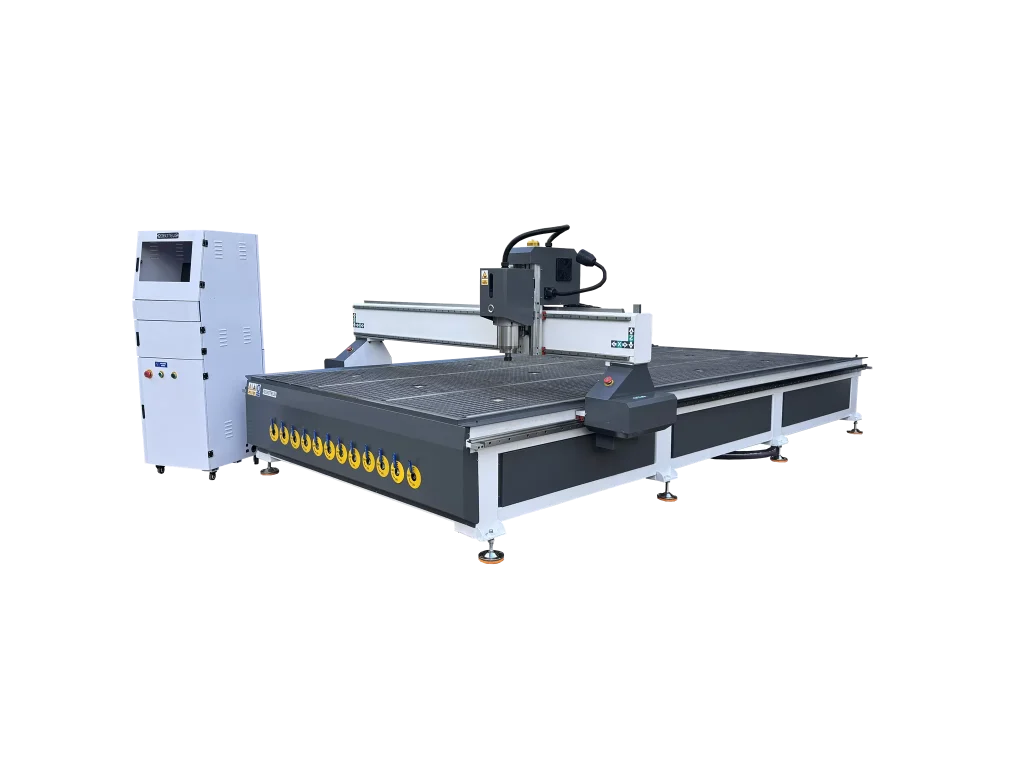
A CNC wood milling machine looks similar in every seller’s catalog: a gantry over the table, a spindle 24 000 rpm, working area in millimeters. The differences that determine work in a carpentry shop lie in the details: which panels fit without trimming, how the material is held, what tool the spindle will accept and whether the machine changes tools automatically.
This guide organizes the decision in the order you should make it: material, field, table, spindle, drives, ATC, control, power and extraction. We do not repeat the list of machines here, because the full range of types with prices is available on the website Roboteus CNC wood milling machines. RBF specifications come from the product data sheets, prices of other sellers according to stores, as of October 2026.
If you are still deciding whether to buy, start with the cost comparison CNC machining: service or your own milling machine.
1. The material and formats of the boards determine the rest
Take orders from the last year and break them down by material (plywood, MDF, furniture board, solid wood, plexiglass, PVC, aluminum), thickness and dimensions of the sheets you buy from the supplier. This list determines the table format, mounting method and spindle power. The general principle of selecting a machine for the material is described in the entry how to choose a CNC machine for the material.
All RBF milling machines process the same groups of materials according to cards: wood, plastics, composites and soft metals. So they differ not in what they cut, but in the format, mounting, spindle and drives. If steel appears on your list, some of the orders stay with a subcontractor or go to another technology, because a portal milling machine of this class will not process it.
2. Working area: full sheet or forms
The first question is: do you buy full sheets and want to cut them as a whole, or do you work with formats, remnants and small details? The answer depends on whether someone has to split the board on a saw before milling, which is an additional operation and an additional dimension risk.
You work on forms and signs: all you need is a smaller field that will fit in the workshop and does not require a three-phase power supply. You cut sheets whole: the field must be at least as large as the sheet from your supplier, and commercial formats vary between board manufacturers, so check before ordering.
The RBF series includes 900 × 600 mm fields (RBF 9060), 1200 × 1200 mm (RBF 1212), 1300 × 2500 mm (RBF 1325V, RBF 1325 ATC), 2000 × 3000 mm (RBF 2030V, RBF 2030 ATC) and 2000 × 4000 mm (RBF 2040V).
The Z axis travel is 200 mm in all models. The actual height of the detail is smaller by the length of the tool, the sacrificial plate and the safe travel height, which is enough for slabs and low blocks for 3D sculpture, but not for tall blocks.
3. Table: T-slot or vacuum table
T-slot table (RBF 9060, RBF 1212: aluminum with PVC spacers) holds the material with clamps. It is simple and does not require a pump, but the clamp takes up space on the sheet, and in the case of large formats the operator has to move it.
Vacuum table saves on changing the pressure on full sheets because it holds the material with a pressure difference over the entire surface. How many sections and which pump depends on the format, and the large RBF models combine a vacuum raster with T-slot rails. Details, including the sacrificial plate and what the vacuum cannot hold, are described in the text by Fr vacuum table (in Polish).
4. Spindle: power, cooling and tool holder
There are three classes of spindles in the RBF series:
- 3,2 kW liquid cooled, 0–24 000 rpm, ER sleeve20 (RBF 9060, 1212, 1325V, 2030V);
- 5,5 kW liquid cooled, 24 000 rpm, ER25 (RBF 2040V);
- HQD 6 kW in ATC versions; in RBF 2030 ATC with ISO30 mounts, and the RBF 1325 ATC card description also mentions an ISO30 mount.
The sleeve system limits the cutter shank diameter and is determined by the spindle seat: you cannot insert an ER25 sleeve into an ER20 spindle. Within one system, you only select a sleeve from the range provided by the manufacturer (e.g. REGO-FIX). If you plan cutters with a thicker shank, you will need a different spindle, for example ER25 as in RBF 2040V.
Liquid and air cooling, power and speed, and the material describes the entry what spindle for a CNC milling machine.
5. Drives: stepper or servo, screw or strip
Engines. In RBF, non-ATC versions have 8.5 Nm stepper motors and ATC versions have 1000 W AC servo with encoder; how it differs at work, explains the text about programming and control of the milling machine (in Polish).
Power transmission. According to Design World, a bolt’s critical speed increases with diameter and decreases with the square of the unsupported length, so long axles require thick bolts. The rack is connected in sections with virtually no length limits. RBF 9060 and RBF 1212 have 2010 ball screws. RBF 2030V, RBF 2040V and ATC versions have helical racks in the X and Y axes and a 2010 ball screw in the Z axis, and the RBF 1325V card lists „ball screws / helical racks” without axes.
Speed and accuracy from cards. The operating speed is up to 7000 mm/min (9060, 1212), to 10 000 mm/min (1325V, 2030V, 2040V) and to 14 000 mm/min (ATC versions). Positioning accuracy: less than 0.03 mm at 300 mm on most models, less than 0.08 mm on the RBF 2030V and less than 0.09 mm on the RBF 2040V. This is a parameter of the movement of the axis without load, not the tolerance of the finished part. When comparing offers, ask how the seller measures accuracy, because stores provide it differently.
6. ATC: when the tool magazine returns
According to the FAQ category, Roboteus ATC pays off when a detail requires more than one tool and you make it in series.
A typical example is a furniture front: milling the pattern, beveling the edges and finally cutting out the form are three tools. Without a magazine, the operator stops the program three times, changes the cutter and measures its length. In the RBF 1325 ATC and RBF 2030 ATC, the linear magazine holds 12 tools. The difference between an ATC plotter and a machining center is described in the text milling plotter or machining center.
7. Control: Mach3 or PikoCNC
Versions without ATC work on Mach3 via USB, and the impulses for the drives are generated by an external motion controller (in some models HXC Motion Control 2 MHz); The program runs Mach3 on the computer. ATC versions have PikoCNC Ethernet, in which, according to the manufacturer, the PLC program is executed in the controller, independently of the PC, so the movement of the axis is less dependent on what the computer is doing. Details and license prices are described in the text about CNC milling machine control (in Polish).
8. Power supply, space and extraction
RBF 9060 and RBF 1212 operate on 230 V and weigh 250-350 kg. Models from 1300 × 2500 mm require 380 V and weigh from approx. 1000 to 1500 kg; exact dimensions are provided on machine cards. To the dimensions, add the sheet loading zone, pump, extraction and trolley access.
Plan the extraction together with the machine and check its power supply, because an industrial extraction may require a three-phase connection even with a 230 V machine. According to EPF, CNC machines generate large amounts of dust and typically operate with a brush head and high-efficiency extraction. NDS, regulations and selection of extraction are described in the text about milling wood on CNC (in Polish).
9. Which configuration for which plant
| Plant profile | RBF configuration | Price |
|---|---|---|
| Workshop, model shop, small formats | RBF 9060: T-slot table, 3.2 kW, 230 V | valuation for the process |
| Advertising: signs, letters, plexiglass, plywood | RBF 1212: T-slot table, 3.2 kW, 230 V | from 24 389,00 PLN net |
| Carpentry shop, board forms, one tool | RBF 1325V: 6 sections with pump, 380 V | valuation for the process |
| Series carpentry shop, fronts, a few tools | RBF 1325 ATC: 12 tools, 6 kW, servo | from 79 675,00 PLN net |
| Large sheets without cutting | RBF 2040V: 12 sections, 5.5 kW, ER25 | from 62 593,00 PLN net |
| Large formats as standard | RBF 2030 ATC: ISO30, 12 tools | from 89 431,00 PLN net |
Roboteus prices are approximate prices, configured for the process. We price RBF 2030V according to the process.
10. How much does a CNC wood router cost: list prices by format
Net catalog prices from two domestic distributors of milling machines (store A and store B), as of October 2026:
| Format | Shop and version | Net price |
|---|---|---|
| 600 × 900 | store A, extended version (on sale) | 16 952 PLN |
| 600 × 900 | shop B | 38 000 PLN, with pump 46 000 PLN |
| 1200 × 1200 | store A, basic version (on sale) | 26 804,07 PLN |
| 1200 × 1200 | shop B | 42 000 PLN |
| 1300 × 2500 | shop A: basic / extended / with ATC | 29 512,20 / 37 700 / 99 000 PLN |
| 1300 × 2500 | shop B: without ATC / with ATC and pump | 54 000–75 000 / 99 000 PLN |
| 2000–2100 × 3000 | shop A: basic / with ATC | 42 200 / 70 800 PLN |
| 2000–2100 × 3000 | store B: without ATC / with ATC | 59 900–81 900 / 109 000–119 000 PLN |
| 2000–2100 × 4000 | shop A: extended / with ATC | 48 200 / 75 300 PLN |
| 2000–2100 × 4000 | store A: with ATC, extended version (on sale) | 113 000 PLN |
| 2000–2100 × 4000 | store B: without ATC / with pump / with ATC | 79 000 / 87 000 / 126 000 PLN |
In the third shop (store C) there is a milling machine for materials up to length 2,60 m and width up to 1,30 m costs 89 474,76 PLN gross. Store A charges delivery from 1 500 PLN, and on-site training for 3 000–3 500 PLN net; at the seller’s office is included in the price, and at the version 1300 × 2500 mm with ATC card provides free training and on-site commissioning.
The same format class costs significantly differently from different sellers, because the spindle, drives, table, pump and software in the package are different. Compare configurations, not just formats. The purchase can be spread over time leasing and financing (in Polish).
11. Questions to ask the seller before purchasing
- What is the working area and Z axis travel, and will my sheet fit without cutting?
- What table, how many sections, is the pump included and what type?
- What power and spindle cooling, what bushing system or holder and what is the largest cutter shank?
- Stepper or servo motors, screws or strips in each axis?
- How is accuracy measured and what is the working speed in the material?
- Is there ATC, for how many tools and is there a tool length sensor?
- What control, what license and what post-processor for my CAM?
- What power supply, weight and dimensions, who is responsible for transport and installation?
- How does the machine meet the requirements of EN ISO 19085-3:2021 and how is the seller preparing for Regulation (EU) 2023/1230, applicable from January 20, 2027?
- What does the price include: delivery, commissioning, training, software, service?
The answers make it easier to compare offers. You can use it under your material ask for a quote (in Polish).
Frequently asked questions
Which CNC wood milling machine for a small workshop?
For small formats, signs and board remnants, an area of 900 × 600 or 1200 × 1200 mm is sufficient, as in RBF 9060 and RBF 1212. Both operate on 230 V and have a T-slot table, so the machine itself does not need a pump or a three-phase connection. Check the extraction power supply.
How much does a 1300 × 2500 mm CNC wood milling machine cost?
At net catalog prices (as of October 2026) the basic version costs money in one of the domestic stores 29 512,20 PLN, a version without ATC available from another distributor 54 000–75 000 PLN, and ATC versions available from both sellers 99 000 PLN. RBF 1325 ATC has a guide price from 79 675,00 PLN net (configuration for the process) and RBF 1325V is priced for the process.
Does a wood milling plotter need 380 V power?
Depends on the format. The RBF 9060 and RBF 1212 operate on 230 V, while models from 1300 × 2500 mm upwards require 380 V. Plan the connection together with the pump and extraction.
Ball screw or toothed rack in a CNC milling machine?
A ball screw works well on short axles because its critical speed decreases with the square of the unsupported length. The rack is connected in sections, which is why large RBF formats have helical racks in the X and Y axes. In the Z axis, where the stroke is short, the ball screw remains.
Which CNC milling machine for wood instead of the 1000 × 1000 mm format?
In the RBF series, the closest format is 1200 × 1200 mm, i.e. RBF 1212. It provides enough space for pieces and leftover boards, runs on 230 V and has a T-slot table. The smaller RBF 9060 has a field of 900 × 600 mm.
Sources
- https://roboteus.com/pl/maszyny/frezarki-cnc/
- https://roboteus.com/pl/maszyny/frezarki-cnc/frezarka-cnc-rbf-9060/
- https://roboteus.com/pl/maszyny/frezarki-cnc/frezarka-cnc-rbf-1212/
- https://roboteus.com/pl/maszyny/frezarki-cnc/frezarka-cnc-rbf-1325v/
- https://roboteus.com/pl/maszyny/frezarki-cnc/frezarka-cnc-rbf-1325-atc/
- https://roboteus.com/pl/maszyny/frezarki-cnc/frezarka-cnc-rbf-2030v/
- https://roboteus.com/pl/maszyny/frezarki-cnc/frezarka-cnc-rbf-2030atc/
- https://roboteus.com/pl/maszyny/frezarki-cnc/frezarka-cnc-rbf-2040v/
- https://www.productivity.com/wp-content/uploads/2020/04/Rego-Fix-_ER_System-3-25-20-Interactive.pdf
- https://www.designworldonline.com/rack-and-pinion-drives-a-new-look-at-an-old-technology/
- https://www.pikocnc.com/hardware
- https://mdf-info.eu/using-mdf/handling-and-storing/dust-control
- https://www.iso.org/standard/75953.html
Editorial note
List prices are from store websites as of October 2026 and may vary; some of them are promotional prices. The parameters depend on the specific machine configuration and the material being processed. The text does not replace the manufacturer’s instructions or health and safety regulations regarding machine tools and wood dust.