
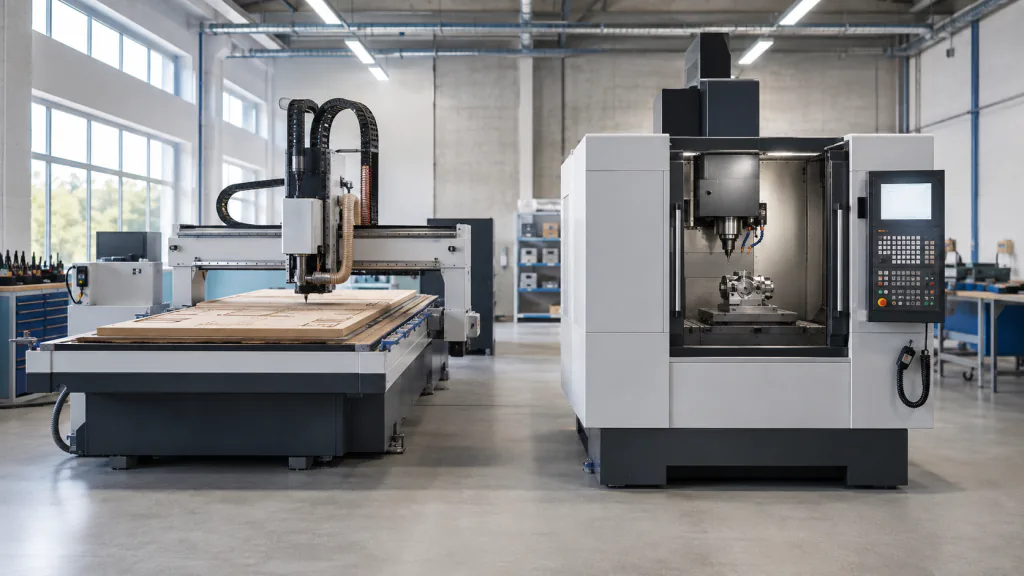
Choosing the right CNC machine is one of the key decisions that can significantly impact your company’s efficiency and profitability. Various solutions are available on the market, and among them, a common dilemma arises: CNC router (milling plotter) or CNC machining center? Although both machines are used for material processing, their design, capabilities, and applications differ significantly. Understanding these differences is fundamental, especially for small and medium-sized enterprises that prioritize precision and production process optimization.
CNC Router – When Is It the Best Choice?
A CNC router, often referred to as a milling plotter, is a machine typically characterized by a lighter construction, often featuring a moving gantry. Its main advantage is a large working area, which can reach up to 3×8 meters. This makes routers excellent for processing sheet materials such as furniture boards, plastics, composites, or light aluminum alloys.
Key Features of a CNC Router:
- Construction: Lightweight, often based on a moving gantry, allowing for the processing of large elements.
- Spindle: Usually equipped with electro-spindles with high rotational speeds (from 18,000 to 40,000 RPM). High speeds are crucial for effective processing with small-diameter tools, especially in soft materials.
- Torque: Electro-spindles are characterized by constant but relatively low torque. This means they are less effective under very high loads and when processing hard materials.
- Applications: Ideal for the advertising industry (cutting letters, forms), woodworking (nesting, board formatting), 3D model production, thermoforming, and processing light metals like aluminum.
CNC Machining Center – Precision and Power for Demanding Tasks
A CNC machining center is a machine designed for the highest precision and durability. It features a much stiffer and heavier construction, often cast from iron, which minimizes vibrations and ensures stability during intensive processing. Machining centers are indispensable in the production of complex details from hard materials.
Key Features of a CNC Machining Center:
- Construction: Solid, rigid, often cast iron, providing excellent stability and precision even under heavy loads .
- Spindle: Equipped with spindles with gearboxes that offer high torque at lower rotational speeds. This allows them to effectively process hard metals and use larger diameter tools .
- Torque: Variable and high, allowing for rough and precise machining of bodies, molds, dies, and matrices .
- Applications: Essential in the machinery, automotive, aerospace, and medical industries, and wherever processing of steel, titanium, and other hard alloys with the highest accuracy is required.
How to Recognize the Machine at a Glance? Visual Identification
For someone taking their first steps in the world of CNC, distinguishing a router from a machining center might seem difficult. However, there are several characteristic visual features that allow for instant identification on the production floor.
- 1. Housing and Guards
This is the easiest way to recognize the machine. A CNC machining center almost always has full cabin housing. It looks like a large, closed cabinet or container with inspection windows. This design protects the operator from metal chips, tool breakage, and an intensive stream of coolant. In contrast, a CNC router typically has an open construction. You will see a large, flat table over which a gantry with a spindle moves. The operator has free access to the material from almost every side. - 2. Type of Working Table
Look at the surface where the material is placed. In machining centers, the table is relatively small, made of heavy metal, and has characteristic T-slots. These are used for bolting down heavy vices or specialized fixtures. In CNC routers, the table is huge and flat. Most often, you will find a vacuum table here with a dense grid of holes or channels that „suck” the furniture board or plastic sheet to the surface. - 3. Tool Magazine and Cooling System
In a machining center, the tool magazine is usually hidden inside the housing (visible only during tool changes). Cooling is „flood-type” – large amounts of coolant flow from nozzles and drain into a tank at the bottom of the machine. In a router, the tool magazine is often „in plain sight,” for example, at the end of the table in a linear form. Instead of streams of coolant, you will rather see a dust extraction pipe (similar to an industrial vacuum) near the spindle and a mist cooling system that delivers a minimal amount of lubricant.
Main Differences: CNC Router vs. CNC Machining Center
To facilitate the choice of a CNC machine for your company, we present the key differences in a table:
| Feature | CNC Router (Milling Plotter) | CNC Machining Center |
| External Appearance | Open construction, large table, visible gantry | Full housing (cabin), closed construction |
| Working Table | Vacuum (suction) or hybrid | Cast iron with T-slots |
| Construction | Lightweight, often with a moving gantry | Heavy, rigid, often cast from iron |
| Rigidity | Lower | High |
| Spindle | Electro-spindle (high speed, constant, lower torque) | Spindle with gearbox (lower speed, high torque) |
| Tools | Smaller diameters (up to 16mm in metals) | Larger diameters (heads up to 300mm, drills up to 40mm) |
| Materials | Wood, plastics, composites, aluminum | Steel, titanium, hard alloys, cast iron |
| Working Area | Usually large (e.g., 3x8m) | Usually smaller, but with 5-axis capability |
How to Make a Decision? Practical Tips for Your Company
The decision to purchase a CNC machine should be primarily dictated by the nature of your business and planned tasks. Here are some questions to help you make the right choice:
- What materials will you be processing?
• If mainly wood, plastics, composites, furniture boards, or aluminum – a CNC router will be more suitable.
• If mainly wood, plastics, composites, furniture boards, or aluminum – a CNC router will be more suitable. - What is the required precision and finish quality?
• For applications where good precision is sufficient (e.g., advertising, furniture) – a CNC router will meet expectations.
• For industries requiring the highest accuracy (e.g., aerospace, medical, injection molds) – opt for a machining center. - What is the size of the processed elements?
• If you work with large sheets of materials – a CNC router with its large working area will be more efficient.
• If you process smaller but complex details – a machining center, often with 5-axis capability, will provide greater flexibility. - What is your budget?
• CNC routers are generally cheaper to purchase and maintain, making them attractive for small businesses with limited budgets.
• Machining centers are a larger investment but offer unmatched power and precision, translating into long-term profitability in specific applications.
Summary
Both a CNC router and a CNC machining center are powerful tools that can revolutionize your production. The key to success is a conscious choice of a CNC machine, tailored to the individual needs and goals of your company. Remember that investing in a CNC machine is an investment in the future – so it is worth carefully analyzing all aspects to make the best decision.
Ready to invest in a CNC machine? Request a free quote and consultation with Roboteus experts! We will help you choose a machine perfectly matched to your materials and production scale – from design to service, all in Poland. Gain an advantage with Polish quality and reliability.
Ready to invest in a CNC machine? Request a free quote and consultation with Roboteus experts! We will help you choose a machine perfectly suited to your materials and production scale – from design to service.