
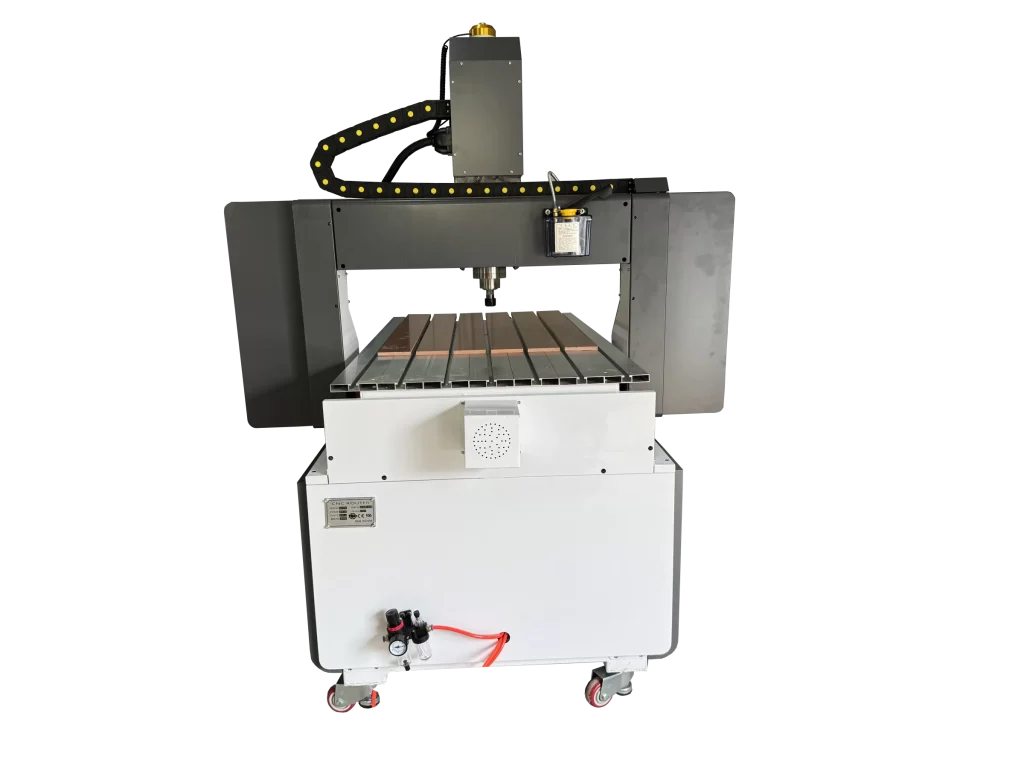
CNC plastic milling tends to fail in familiar ways: instead of flying clear, the chip melts and winds around the cutter, the edge becomes dull and ragged, and fine cracks appear in a transparent sheet several days later. Most of these symptoms come from heat not removed with the chips; cracking also has other causes, explained below.
This article covers plastic sheet milled on a gantry router: cast and extruded PMMA, commonly called acrylic or plexiglass, polycarbonate PC, POM and PE. We discuss cutter selection, starting parameters from material and tool manufacturers LEUCO, ACRYLITE/Röhm, Covestro and MCG, cooling, milling direction, edge finishing, annealing and thin-sheet workholding.
We do not derive spindle-speed and feed formulas again here. They are in the guide to choosing spindle speed, feed rate and cutting depth.
Why plastic melts
According to Leitz, thermoplastics soften around 60 °C, depending on the type. Above that temperature, chips melt and the tool starts to clog. MCG, a producer of POM, PE and PC stock shapes, summarises the rule as “keep it cool”. Plastics conduct heat poorly, so heat not carried away by the chip stays in the edge.
Insufficient feed is the most common cause. ACRYLITE states that excessive feed during edge machining causes chipping, while too little causes melting. If plastic melts or chips adhere to the cutter, increase chip thickness by reducing spindle speed or increasing feed. Onsrud adds that switching to a single-flute cutter also helps when chips weld back onto the material.
Milling acrylic: cast GS versus extruded XT
PMMA is produced in two forms. Röhm’s guide describes PLEXIGLAS GS as cast, in thicknesses of 2–80 mm, and XT as extruded, up to 25 mm. The machining difference is specific: LEUCO says XT is more sensitive to heat than GS and recommends avoiding excessively low feed and high spindle speed.
LEUCO gives three rules for both types. A single plunge should not exceed two cutter diameters. Several passes rather than one limit chip and tool heating. Compressed air reduces heating and stress whitening. For cutting parts out of sheet, LEUCO suggests two passes: roughing slightly short of the sheet thickness, followed by finishing slightly beyond it.
Röhm recommends leaving the protective film in place until machining is complete, clamping the sheet firmly, using sharp cutters and inserting the shank deeply into the collet.
Cutters for acrylic and polycarbonate
Manufacturers agree on the general approach. ACRYLITE recommends solid-carbide VHM up-cut O-flute tools with 1, 2 or 3 flutes for PMMA: the chip curls naturally and clears the cutting zone more easily. More flutes improve the edge but cost more, so ACRYLITE recommends starting with 1–2. For finishing, LEUCO specifies a single-flute solid-carbide cutter with a polished channel. Vortex states that a polished flute improves chip curling and reduces heating.
Polish retailers offer the equivalent as a single-flute acrylic cutter with a polished edge and channel, for example CE 1F 3×12 Low Helix from cnc-sklep.pl at 109.76 PLN excluding VAT, catalogue price from October 2026. MCG recommends 2–3 flutes and a larger helix angle for POM, PE and PA. The complete geometry comparison is in types of CNC cutters.
Sharpness matters even more than in wood. According to ACRYLITE, a dull edge causes chipping or overheating, both of which introduce stresses into the sheet.
Starting parameters for PMMA, PC, POM and PE
The figures come from manufacturer data. ACRYLITE gives them in inches; conversions to millimetres are approximate.
| Material | Source and cutter | Spindle speed | Feed rate | Notes |
|---|---|---|---|---|
| PMMA, roughing | LEUCO, VHM Z = 2/3 | 18,000 rpm | 5–10 m/min | ae ≤ D |
| PMMA, roughing | LEUCO, VHM Z = 1, Ø 3–12 mm | 18,000 rpm | 2–6 m/min | — |
| PMMA, finishing | LEUCO, VHM Z = 1, Ø 3–8 mm | 18,000–24,000 rpm | 0.5–1.5 m/min | ae 0.1–0.4 mm |
| PMMA | ACRYLITE, Ø 1/4–1/2″ | 16,000–18,000 rpm | 100–300 IPM, approximately 2.5–7.6 m/min | chip load, ACRYLITE’s general optimum: 0.004–0.015″, approximately 0.10–0.38 mm/tooth |
| PC | Covestro Makrolon, straight, 2–3 flutes, Ø 1/4–1/2″ | 20,000–25,000 rpm | — | excessive feed causes vibration and cracking |
| PC | MCG, carbide | — | fz ≤ 0.4 mm/tooth | Vc 200–400 m/min |
| POM | MCG, HSS or carbide | — | fz ≤ 0.5 mm/tooth | Vc 200–400 m/min |
| PE-UHMW, PA | MCG, 2–3 flutes, larger helix angle | — | fz ≤ 0.5 mm/tooth | Vc 200–500 m/min |
How does this fit a router? RBF spindles rated 3.2 kW and 5.5 kW stop at 24,000 rpm, so only the lower part of Covestro’s PC range is available. Specifications give working speeds up to 7000 mm/min on the RBF 1212 and 10,000 mm/min on RBF 1325V. LEUCO’s upper roughing feed for PMMA, 10 m/min, therefore equals the RBF 1325V’s full working speed.
Take a single-flute Ø 6 mm cutter at 18,000 rpm as an example. Cutting speed is approximately 339 m/min, within MCG’s POM and PC range. With fz assumed to be 0.15 mm for this example, feed is 0.15 × 1 × 18,000 = 2700 mm/min. This is at the lower end of ACRYLITE’s approximate 2.5–7.6 m/min range for Ø 1/4–1/2″. It also fits LEUCO’s single-flute roughing range of 2–6 m/min and is within every RBF machine’s capacity. Start there and increase feed until the edge begins to deteriorate.
Milling polycarbonate, POM and PE
Covestro describes polycarbonate as notch-sensitive, like most transparent plastics. A notch or microcrack at the edge can later initiate a fracture. Excessive feed causes vibration and cracking. For drilling, Covestro recommends cooling with air or water where necessary.
The most important warning concerns coolant. MCG states that mineral-oil-based fluids can cause stress cracking in amorphous plastics such as PC, and then recommends immediately washing the PC part with isopropyl alcohol and clean water. Do not apply that recommendation to PMMA: ACRYLITE warns that incompatible cleaners and solvents cause crazing in acrylic, so check the cleaning agent with the sheet manufacturer.
PE and PA behave differently. According to MCG, chips in polyamides, UHMW-PE and soft plastics tend to wrap around the tool; it recommends maximum feed and spindle speed, 2–3 flutes with a larger helix angle, and an air blast. For plate stock, MCG adds that excessive material should not be removed from one side.
Sign makers also mill foamed PVC and Dibond, a composite panel with aluminium skins. October 2026 service prices from Pontus and Anmur group them with plywood and MDF. The cited data does not specify their parameters: confirm settings through trials, and remember that Dibond also means cutting aluminium, discussed in CNC aluminium milling.
Milling direction for PMMA and PC
ACRYLITE recommends conventional milling for most PMMA operations, and climb milling only on rigid machines without leadscrew backlash. LEUCO chooses conventional milling at higher feeds and climb milling at lower feeds, with a tool-breakage risk where backlash exists. MCG recommends climb milling for POM, PE and PC: less heat and better finish.
Backlash and rigidity are the common factors. The sources are compared in CNC milling parameters. With clockwise spindle rotation, an external contour followed anticlockwise gives conventional milling; a clockwise toolpath gives climb milling. CAM controls this through contour direction. Test both on an offcut of the same sheet.
Cooling, extraction and safety
ACRYLITE states that extraction and cooling with compressed air, mist or cold air from a vortex tube substantially reduce heating, improve edges and extend tool life. MCG considers coolants usually unnecessary, while mist and compressed air are effective. If using an emulsion, ACRYLITE recommends checking sheet compatibility because incompatible emulsions cause crazing.
Remove plastic chips immediately. Chips left in the groove are cut again and heat the edge. ACRYLITE also notes that PMMA is a combustible thermoplastic that releases carbon monoxide when burning with insufficient air. An overheated cutter and accumulated chips therefore mean more than a poor edge. According to ACRYLITE, edges from edge-finishing machines are sharp and require additional finishing before delivery.
Edges: cutter, diamond and flame polishing
According to Leitz, a transparent, smooth PC or PMMA edge needs polished carbide; monocrystalline diamond is preferred for fully glossy surfaces. LEUCO offers a five-flute PMMA polishing cutter, Ø 6–8 mm, ae 0.05–0.1 mm, at 20,000–22,000 rpm. ACRYLITE states that a well-milled edge can be polished without sanding first.
Flame polishing is another method. ACRYLITE describes an oxyhydrogen torch with a bluish flame approximately 75 mm long. It warns that sudden heating creates high stresses, so the part must be annealed afterwards. Do not use a flame near a machine or extractor containing wood dust: Directive 1999/92/EC treats dust deposits as a hazard like a dust cloud, and PMMA is combustible. Polish at a separate, cleaned workstation.
Stresses and stress-relief annealing
ACRYLITE lists three sources of PMMA stress: machining vibration, a dull edge and sudden heating. Stresses are not immediately visible. They can later cause crazing, and notch sensitivity allows a cut to develop into a crack.
Annealing is the remedy. According to ACRYLITE, heat the sheet at 80 °C, just below its heat-deflection temperature, for 1 h per millimetre of thickness, with a minimum of 2 h. Above 8 mm thickness, cooling time in hours equals thickness in millimetres divided by 4. Remove the part below 60 °C. Annealing removes most milling and polishing stresses; according to ACRYLITE, bond strength increases by more than 50%. If the part will be bonded or flame-polished, plan an oven stage before dispatch.
Holding thin sheets
Thin sheet on a vacuum table stays stable until a cut-out part loses suction area. Spoilboard types and limitations for small parts are explained in CNC vacuum tables. Vortex adds that a straight O-flute neither lifts nor presses the material, making it suitable for parts weakly held by vacuum.
RBF 1325V has a vacuum table with 6 zones and an included pump, and also allows conventional clamping. RBF 1212 has an aluminium T-slot table with PVC inserts, so plastics are clamped mechanically, with a soft pad under the clamps and moderate pressure: ACRYLITE and Covestro describe PMMA and PC as notch-sensitive. The full range is in Roboteus CNC routers.
CNC plastic milling versus a CO2 laser
A CO2 laser cuts PMMA thermally through its thickness. A cutter leaves a kerf as wide as the tool, but also machines pockets, chamfers and sculpted 3D surfaces, the main difference highlighted by Roboteus’s FAQ. An edge chamfer or magnet pocket calls for a cutter. For a contour-only part, compare both technologies on a sample. Material-based selection is discussed in choosing a CNC machine for the material.
We explain edge differences and stress risks after laser cutting in what a CO2 laser machine can do. Machines are listed under CO2 laser machines.
Frequently asked questions
How do I mill acrylic without melting it?
Increase chip thickness by reducing spindle speed or increasing feed, as ACRYLITE recommends. Use a sharp single-flute cutter with a polished channel, several passes and compressed-air cooling. LEUCO states that extruded XT is more heat-sensitive than cast GS.
Single- or double-flute cutters for acrylic?
ACRYLITE recommends starting with 1–2-flute O-flute cutters. More flutes improve the edge but cost more. LEUCO specifies a single flute and polished channel for finishing.
What should I use to cool polycarbonate during milling?
Compressed air or mist. MCG warns that mineral-oil-based coolants can stress-crack PC. After contact, wash the part with isopropyl alcohol and clean water.
Why does acrylic crack after milling?
Vibration, a dull cutter or sudden heating introduce stresses that ACRYLITE says can later cause crazing. A sharp tool, rigid holding and annealing at 80 °C for 1 h per millimetre help. Also avoid emulsions incompatible with PMMA.
Is it better to mill acrylic or cut it with a CO2 laser?
It depends on the part. The laser cuts contours thermally through the thickness; a router also makes pockets, chamfers and 3D shapes. For a contour alone, compare edges on a sample of the same sheet.
Sources
- https://roboteus.com/pl/maszyny/frezarki-cnc/
- https://roboteus.com/pl/maszyny/frezarki-cnc/frezarka-cnc-rbf-1212/
- https://roboteus.com/pl/maszyny/frezarki-cnc/frezarka-cnc-rbf-1325v/
- https://www.leuco.com/EN/AU/media/DOK_MBR_LEUCO-Kunststoffbearbeitung_DL.pdf
- https://www.zenit.cz/public/media/Plasty/Zenit_Montaz_Plasty_Plexiglas_Zpracovani2_AJ.pdf
- https://www.acrylite.co/resources/fabrication-manuals/routing-premium-acrylite-acrylic-sheet
- https://www.acrylite.co/resources/fabrication-manuals/machining-acrylite-acrylic-sheet
- https://www.acrylite.co/resources/fabrication-manuals/finishing-acrylite-acrylic-sheet
- https://www.acrylite.co/resources/fabrication-manuals/annealing-acrylite-acrylic-sheet
- https://www.emcoplastics.com/assets/pdf/makrolon/Makrolon%20Fabrication%20Guide%20.pdf
- https://www.mcam.com/mam/41701/MCG-Machinist-Toolkit-A4-EU-metric.pdf
- https://www.hoechsmann.com/cz/lexikon/pdf/lei_lexikon_edition6_2011_en.pdf
- https://www.vortextool.com/media/assets/Vortex_Catalog.pdf
- https://www.woodweb.com/images_forums_public/cnc/Hard_Plastic.pdf
- https://cnc-sklep.pl/pl/p/Frez-CE-1F-3x12x6x60-LH-HP/612
- https://pontus.pl/cnc/cennik/
- https://anmur.eu/news/n/299/Frezowanie-i-wycinanie-CNC-Rzeszow
- https://eur-lex.europa.eu/legal-content/PL/TXT/HTML/?uri=CELEX:31999L0092
Editorial note
Cutter catalogue prices refer to October 2026 and may change. Parameters depend on the machine, workholding, cutter, plastic grade and thickness. Manufacturer data is a starting point that must be confirmed on the same material. This article does not replace the machine, tool and plastic manufacturers’ instructions or machine-tool safety requirements.