
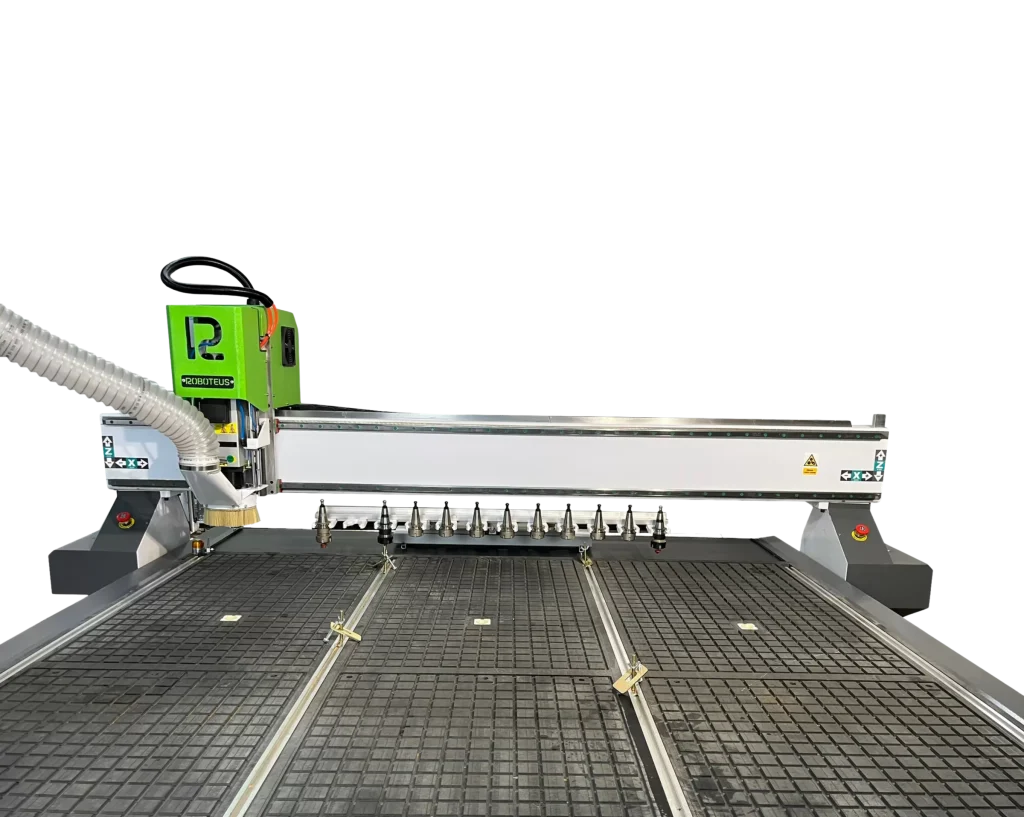
CNC aluminium milling brings a machining centre to mind: a rigid frame, a high-torque spindle and flood cooling with an emulsion. An owner of a gantry router for wood and plastics often finds that such recommendations specify figures their machine cannot handle, or methods that cannot be used on a vacuum table.
This article concerns aluminium on a CNC router with an integrated motor spindle: what the machine can do, which cutter to choose, how to adapt GARANT, HAIMER and Sandvik Coromant data to your spindle, how to cool the cut and when to outsource. The formulas are in the guide to choosing spindle speed, feed rate and cutting depth.
Aluminium milling on a CNC router: capabilities and limits
The specifications of Roboteus CNC routers list wood, plastics, composites and soft metals, primarily aluminium. Metal milling on these gantry machines, including overhead-spindle routers, is limited to soft metals. Their specifications do not list steel: the category FAQ directs steel cutting towards plasma and fibre laser machines. A gantry router has a beam moving over the table and a structure designed for large panels, rather than metal-cutting forces.
The relevant standard gives a similar picture. EN ISO 19085-3:2021, applicable to CNC woodworking routers, also covers light aluminium-alloy profiles and aluminium plates up to 10 mm thick. A safety standard does not establish a particular machine’s capability, but it illustrates typical woodworking-router applications: thin plate, profiles and composite panels, rather than a block requiring a deep mould cavity.
In practice, there are three limits. Rigidity: axial cutting depth ap is much smaller than on a machining centre. Tool overhang: HAIMER states that its data apply to short overhang and must be adjusted when this increases, so check whether your tool projects farther than the data assume. Data sheets: GARANT and HAIMER address metalworking machines, without allowances for gantry stiffness. The differences are explained in CNC router or machining centre.
Aluminium cutters for a CNC router: DLC-coated or uncoated
A common choice is a single-flute solid-carbide VHM cutter. GARANT offers one for aluminium with a 26° helix, either uncoated or DLC-coated. Vortex describes its 5600A series as a single-flute up-cut O-flute for most grades of aluminium sheet, plate, blocks and profiles. One flute leaves a large chip channel; according to Vortex, an open flute evacuates chips and limits heating.
Sandvik Coromant recommends sharp, polished edges and positive geometry for aluminium. Polish retailers likewise specify polished cutting edges and chip channels. For example, a BF 1F 3×12 AL single-flute cutter costs 102.44 PLN excluding VAT at cnc-sklep.pl, a catalogue price recorded in October 2026. Further prices, geometries and cutting materials are compared in types of CNC cutters and their applications.
Spindle speed determines the coating choice, as the example below shows. A three-flute cutter gives a higher table feed at the same feed per tooth, but has narrower chip channels. Start with a single flute on a gantry router.
Aluminium milling on a CNC router: manufacturer data
Each figure applies to a particular cutter, diameter and flute count; do not transfer it to another tool.
| Source | Cutter | Vc | fz |
|---|---|---|---|
| GARANT | VHM, 1 flute, DLC | 480 m/min (Alu); 440 (short-chipping Alu); 400 (Alu > 10% Si) | 0.04 mm for Ø 10 (short-chipping Alu); 0.004 mm for Ø 1.5 |
| GARANT | VHM, 1 flute, uncoated | 180 m/min (Alu); 140 (short-chipping); 105 (> 10% Si) | 0.03 mm for Ø 8; 0.015 mm for Ø 4 |
| HAIMER | MILL Alu, Ø 10–20 mm | 300–400 m/min roughing; 400–500 finishing | 0.03–0.09 mm (Ø 10) … 0.05–0.13 mm (Ø 20) |
| Sandvik | indexable milling cutters | a higher Vc usually improves the result | chip thickness hex 0.10–0.20 mm |
Data conditions: GARANT specifies fz for full-width slotting at ap = 1×D; HAIMER addresses wrought alloys, for example AlMg1, and short overhang; Sandvik addresses aluminium Si < 13% on metalworking machines.
The most important figure is the difference between coatings. The same GARANT single-flute cutter has Vc 480 m/min with DLC and 180 m/min without a coating. At the same diameter, this means almost three times the spindle speed.
Now adapt this to a router. Take a GARANT DLC Ø 10 mm cutter in short-chipping aluminium, using a pair of values from the same data group: Vc 440 m/min and fz 0.04 mm. The formula n = Vc · 1000 / (π · D) gives approximately 14,000 rpm in this example. Feed F = fz · z · n gives 0.04 × 1 × 14,000 ≈ 560 mm/min. The same calculation for an uncoated Ø 8 mm cutter (Vc 180, fz 0.03) gives approximately 7160 rpm and 215 mm/min.
Such low speeds are at the bottom of a router motor spindle’s range, where it delivers less power than at full speed. Check the spindle data to establish whether it can work under load at that speed. A DLC cutter whose Vc is attainable at high spindle speed is therefore a natural choice for a router.
From several millimetres in diameter upwards, spindle speed is less problematic: Ø 6 mm at 24,000 rpm achieves approximately 452 m/min, close to the GARANT DLC figure. For a Ø 3 mm DLC cutter, the formula requires about 50,900 rpm in this example; at 24,000, actual Vc falls to approximately 226 m/min. The calculated feeds of a few hundred mm/min are only a fraction of RBF working speeds of up to 7000, 10,000 or 14,000 mm/min, depending on the specification. In aluminium, gantry rigidity and cutting depth limit the router, rather than axis speed.
Small ap, high spindle speed and trochoidal milling
GARANT’s fz figures concern a full-width slot at a depth of one cutter diameter. On a router, they are a reference, not an initial setting. Several shallow passes are safer: lower beam loading and less vibration.
Another approach is HSM with small radial engagement. Sandvik explains that a small ae reduces radial force; normally only one tooth is engaged, reducing vibration, while short contact limits heat and permits higher Vc. For trochoidal milling on metalworking machines, Sandvik gives ae up to 20% of the diameter, ap up to two diameters and an initial fz of 0.1 mm; these are not starting values for a router. It also states that the method requires specialised programming and machine capabilities. Its aluminium recommendations add that high feeds require look-ahead in the control.
Treat this as a direction for a router: a narrow path, constant tool loading and no full-width engagement. Establish depth by testing, starting shallow.
Cooling: liquid, MQL or compressed air
The sources differ. Sandvik states that, unlike most milling applications, aluminium should always use cutting fluid to avoid smearing and improve the surface. It also links emulsion concentration to silicon content: 5% for Si < 8%. However, this recommendation concerns indexable cutters on metalworking machines.
GARANT assesses cooling separately for each version of its single-flute solid-carbide cutter:
| Cooling method | GARANT, DLC | GARANT, uncoated |
|---|---|---|
| Flood coolant, nass maximal | suitable | suitable |
| MQL, minimum-quantity lubrication, nass minimal | conditionally suitable | conditionally suitable |
| Dry, trocken | conditionally suitable | conditionally suitable |
| Compressed air, Luft | suitable | conditionally suitable |
Leitz describes polycrystalline diamond DP tools as excellent for dry machining of non-ferrous metals. The practical conclusion: on a router without a coolant tray, compressed air is supported by GARANT’s DLC-cutter data; for the uncoated version it remains conditional.
Routers have limitations not covered by cutter data. Liquid cooling in RBF specifications refers to the spindle, not the cutting zone. Protect electronics, sensors and guideways before using mist or MQL. We do not recommend alcohol as coolant: none of the cited manufacturer data lists it.
Liquid and the vacuum table. Liquid or mist above a vacuum table is drawn through the porous MDF spoilboard towards the pump, while the board absorbs moisture. When using liquid or MQL, follow the pump manufacturer’s recommendations and protect the spoilboard: isolate the cutting zone from the vacuum circuit or clamp the workpiece mechanically.
Aluminium chips and wood dust. Do not mix aluminium chips and wood dust in one extraction system or collector without a risk assessment. Hot metal chips in a wood-dust system can cause a fire or ignition inside the collector; EPF recommends spark detection in extraction installations, and IMP regular removal of dust deposits. Clean the machine and table before machining aluminium. Wood-dust hazards are discussed in CNC wood milling.
Air blast. Compressed air scatters sharp, hot chips around the machine and towards the operator. Wear safety glasses and shield the cutting zone.
Built-up edge and burrs
According to Sandvik, built-up edge, BUE, is the dominant wear mechanism in aluminium: material adheres to the edge and smears, producing burrs and a poor surface. Effective chip evacuation helps because chips remaining in the groove scratch the surface. Sandvik also states that excessively thin chips cause burrs; too little feed is harmful, not cautious.
Sandvik identifies burrs and surface quality, rather than visible edge wear, as the criteria for end of tool life. Leitz adds that silicon content from 12% upwards increases wear, while diamond avoids built-up edge through low friction and thermal conductivity.
Holding plate and sheet: vacuum or clamps
A vacuum table holds a large, flat plate well. Once a small part’s contour is cut, suction area decreases; metal-cutting forces are higher than those in wood. Choose workholding to suit the part.
Both methods can be combined on 2000 × 3000 mm formats. The RBF 2030 ATC has a vacuum-grid table with 9 zones and 4 T-slot rails: vacuum holds sheet, while mechanical clamps hold profiles or irregular plates. Its magazine holds 12 ISO30 tools, useful in aluminium because roughing, finishing, chamfering and drilling already require four tools. The category FAQ states that ATC pays off when a part needs more than one tool and is made in series. A smaller format with the same HQD 6 kW spindle is the RBF 1325 ATC, from 79,675.00 PLN excluding VAT, indicative and configured for the process; RBF 2030 ATC starts at 89,431.00 PLN excluding VAT on the same basis. Confirm the HQD 6 kW spindle speed with an adviser because the specifications do not state it; this article’s calculations assume 24,000 rpm.
Alloys 5754, 6061 and 7075 versus cutter-data groups
Sheet suppliers commonly list 5754, 6061 and 7075, but the cited cutter data does not give parameters for those designations. GARANT divides aluminium into standard, short-chipping and over 10% silicon groups. HAIMER distinguishes wrought alloys, for example AlMg1, from higher-silicon casting alloys. Leitz states that wrought alloys are more ductile and easier to machine than casting alloys.
Ask the material supplier which tool-data group your alloy belongs to. Start at the lower end of the specified cutting-speed range and set feed per tooth for your diameter without reducing it below the recommendation.
What not to do when milling aluminium on a router
- Do not mill steel: the RBF specifications do not provide for it.
- Do not machine deep pockets without cooling and chip evacuation. Chips remain inside, heat up and, according to Sandvik, scratch the surface.
- Do not transfer fz from full-slot data to a long tool overhang and deep pass.
- Do not reduce feed “for safety”: an excessively thin chip causes burrs.
- Do not treat alcohol as coolant.
- Do not draw aluminium chips into wood-dust extraction, or work with an air blast without safety glasses.
- Do not overload axes driven by stepper motors: an excessively deep pass can cause lost steps and a shifted contour.
When to outsource aluminium machining
Outsource parts requiring machining-centre rigidity: deep moulds, thick blocks, tight tolerances or 5-axis work. Also outsource occasional aluminium jobs. Pontus, October 2026 prices excluding VAT on a page with a 2023 footer, lists aluminium, copper and brass milling at 8.00 PLN per linear metre up to 1 mm, 10.00 PLN up to 2 mm, 20.00 PLN up to 3 mm and 40.00 PLN up to 5 mm. Techglow lists 135–250 PLN/h for metal machining, without specifying VAT.
We calculate when owning a router begins to pay off in CNC machining: outsourced service or your own router.
Frequently asked questions
How thick an aluminium plate can a CNC router machine?
EN ISO 19085-3 for CNC woodworking routers covers light aluminium-alloy profiles and aluminium plates up to 10 mm. This is not a statement of a specific machine’s capacity, but illustrates typical applications. Deep moulds and thick blocks belong on a machining centre.
Which cutter should I choose for aluminium on a CNC router?
A single-flute carbide cutter with a polished edge and chip channel. GARANT offers coated DLC and uncoated versions, and Vortex recommends single-flute O-flute for aluminium sheet and profiles. According to GARANT, DLC permits a considerably higher cutting speed.
What cutting speed should I use for aluminium?
GARANT’s single-flute data gives 480 m/min with DLC and 180 m/min uncoated; HAIMER gives 300–500 m/min for its Alu series. At 24,000 rpm, small diameters will not reach the specified Vc.
Does CNC aluminium milling require coolant?
Sandvik always recommends liquid for aluminium, but addresses indexable cutters on metalworking machines. GARANT rates compressed air suitable for its DLC cutter and conditional for the uncoated one. A router without a coolant tray generally uses air blast or MQL, with electronics and spoilboard protected. Wear safety glasses with an air blast.
Why does aluminium stick to the cutter?
This is built-up edge, BUE, which Sandvik identifies as aluminium’s main wear mechanism. Sharp polished edges, effective chip evacuation and a feed producing thicker chips help: too little feed causes burrs.
Sources
- https://roboteus.com/pl/maszyny/frezarki-cnc/
- https://roboteus.com/pl/maszyny/frezarki-cnc/frezarka-cnc-rbf-1325-atc/
- https://roboteus.com/pl/maszyny/frezarki-cnc/frezarka-cnc-rbf-2030atc/
- https://cdn.hoffmann-group.com/dsh/de-DE/dsh_de-de_99645.pdf
- https://cdn.hoffmann-group.com/dsh/de-DE/dsh_de-de_25530.pdf
- https://cdn.hoffmann-group.com/dsh/de-DE/dsh_de-de_99637.pdf
- https://cdn.hoffmann-group.com/dsh/de-DE/dsh_de-de_25336.pdf
- https://shop.haimer.com/downloadfile/386200157a4c4d1da8dcb36bec41d807/null/DL20F4002MN2000CDC
- https://www.sandvik.coromant.com/en-gb/knowledge/milling/milling-different-materials
- https://www.sandvik.coromant.com/en-us/knowledge/milling/milling-holes-cavities-pockets/slicing-trochoidal-milling
- https://cdn.sandvik.coromant.com/files/sitecollectiondocuments/services/metal-cutting-e-learning/formulas-and-definitions/formulas-and-deinitions-for-milling-metric-enu.pdf
- https://www.hoechsmann.com/cz/lexikon/pdf/lei_lexikon_edition6_2011_en.pdf
- https://www.vortextool.com/media/assets/Vortex_Catalog.pdf
- https://www.iso.org/standard/75953.html
- https://mdf-info.eu/using-mdf/handling-and-storing/dust-control
- https://www.gov.pl/attachment/6efaf7dd-ddfd-4d25-8a24-5fde675302f9
- https://cnc-sklep.pl/frezy-do-aluminium
- https://pontus.pl/cnc/cennik/
- https://techglow.pl/cennik/
Editorial note
Cutter and machining-service catalogue prices refer to October 2026 and may change. Cutting parameters depend on the machine, overhang, workholding, cutter and alloy. Tool manufacturers mainly write their data for metalworking machines; confirm every setting with a trial. This article does not replace the machine and tool manufacturers’ instructions or machine-tool safety requirements.