
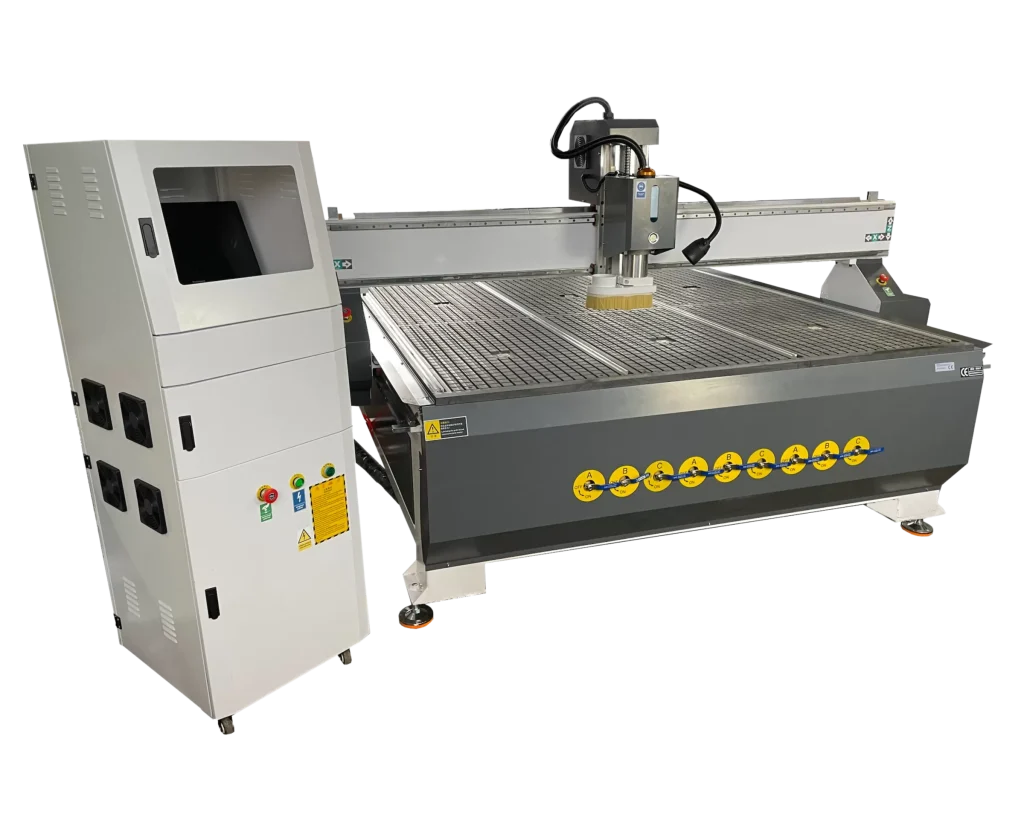
CNC routing wood differs from routing panels because the material is not homogeneous. Grain runs in one direction, growth rings vary in hardness, knots change the cutting direction within a few centimetres, and plywood combines cross-grain layers with glue joints. Settings that give a smooth edge along a board can tear fibres out of its end grain.
This article covers solid wood, edge-glued panels and plywood. MDF and HDF have a separate article on routing MDF without burning. Below we cover grain and tear-out, cutters and manufacturers’ chip-load data, strategies, 3D carving, workholding, extraction and dust regulations.
We do not repeat the speed and feed formulas here. They are in CNC milling parameters, together with calculations against gantry-router limits.
Solid wood versus plywood: what changes with the material
Woodworking tool manufacturer Leitz describes wood as anisotropic: its properties depend on direction. Wood-based panels were developed to obtain a material that is approximately uniform in at least two directions. Plywood achieves this through cross-laminated veneers.
For the cutter, that has two consequences. According to Leitz, a tool in plywood cuts along and across the grain simultaneously, while glue joints dull the edge most rapidly. Different layer strengths mean cutting forces can delaminate layered materials. Leitz adds that plywood was what pushed tool manufacturers towards fine-grain carbide.
Moisture is the second variable. Wood should be dried before routing; wetter wood continues to move after machining, so a pocket and groove that fitted on the machining day may no longer fit after a week in a heated room. Before routing, let the board acclimatise in the workshop where it will be machined, agree the target moisture content with the timber supplier and check it with a moisture meter.
Grain direction, tear-out and delamination
Leitz distinguishes three cutting directions. Along the grain, forces are lowest and the surface smoothest. Across the grain, forces are low but the surface is slightly rough because fibres are “peeled”. In end grain, forces are high and fibres can tear out as the edge exits the material. Leitz therefore recommends a lower chip load and a wooden backing piece beyond the edge. On a router running at full spindle speed, watch for end-grain burning; reducing spindle speed together with feed can help. All three grain directions occur around knots.
On a CNC router, the grain’s orientation relative to the edge changes throughout a single contour. Leitz notes that stationary machining on CNC centres requires special techniques to avoid unfavourable grain-cutting angles. Two are available on any router:
- Milling direction. According to Leitz, in conventional milling the edge enters at zero chip thickness, and pre-splitting ahead of it can produce a rough surface with torn fibres. Climb milling produces a relatively good surface against unfavourable grain but reduces edge life by about 30%. Leitz’s description suggests trying climb milling on visible edges and conventional milling for roughing. Other sources assess direction differently (compared in CNC milling parameters), so test both on an offcut.
- Order of sides. Machine the board’s ends before its long-grain sides. Tear-out at the exit from the end grain is then removed by the following longitudinal pass.
With plywood, the top and bottom veneers fray according to the cutter’s spiral direction. In its PCD spoilboard surfacing datasheet, Amana applies a chip-load correction factor of 0.7 for veneer cut across the grain. This indicates that the manufacturer recommends a thinner chip than the datasheet’s base value.
Choosing a cutter for solid wood and plywood
A full comparison of tool types, prices and manufacturers’ warnings is in CNC router bit types. For wood and plywood, the Vortex catalogue offers three practical rules:
- Pockets and slots: a spiral up-cut evacuates chips upwards and gives a smooth bottom edge but may fuzz the top; a down-cut gives a smooth top and must enter on a ramp.
- Through-cutting plywood and double-sided laminated panels: a compression bit presses both outer layers towards the centre, leaving top and bottom without chipping.
- Deep contours in hardwood: start with a roughing cutter (high feed rates, serrated edge), then a finishing cutter; a three-flute tool gives a better finish than a two-flute tool at the same feed rate.
Cutting material according to Leitz: high-speed steel (HS) suits solid wood, mainly softwood; carbide (HW) is the “universal cutting material for wood”; polycrystalline diamond (DP) suits abrasive materials and large batches.
Chip load for wood: Onsrud and Amana data
Tool manufacturers specify feed per tooth (chip load) for a particular series, diameter and cutting-edge count. The table collects wood values; the editorial team converted inches to millimetres.
| Datasheet and cutter | Material | Feed per tooth | Spindle speed and feed from datasheet |
|---|---|---|---|
| Onsrud 52-200, Ø 1/4″, 2 cutting edges | softwood | 0.007–0.009″ (converted: 0.18–0.23 mm) | 18,000 rpm; 6.4–8.2 m/min |
| Onsrud 60-300, Ø 1/2″ (12.7 mm), 2 cutting edges | hardwood and hard plywood | 0.021–0.023″ (converted: 0.53–0.58 mm) | 18,000 rpm; 19.2–21.0 m/min |
| Amana, DLC-coated solid-carbide spiral, Ø 1/4″, 2 cutting edges | softwood / hardwood | 0.007–0.009″ / 0.005–0.007″ | max. 24,000 rpm |
| Amana Spektra, ball-nose, Ø 1/4″ (6 mm), 2 cutting edges | softwood / hardwood | 0.007–0.009″ / 0.005–0.007″ | 18,000 rpm |
Three conclusions follow. First, for the same diameter, Amana specifies a lower chip load for hardwood than softwood. Onsrud’s hardwood values are larger because they apply to a tool twice the diameter from a different series, so the two datasheets must not be compared directly.
Second, the datasheets apply at a depth equal to cutter diameter. According to Onsrud, at 2 × D depth, chip load is reduced by 25%, and at 3 × D by 50%. Leitz gives a cutting speed of 10–40 m/s for shank cutters.
Third, Onsrud’s hardwood datasheet assumes a feed around twice the RBF 1325V’s working speed, which is up to 10,000 mm/min. On a gantry router, reduce spindle speed or choose a smaller-diameter tool or one with fewer edges whose datasheet requires less feed; do not reduce chip load below the datasheet. An electric spindle delivers less power at lower speeds, so check its datasheet for sufficient reserve; if not, reduce pass depth. The parameters article explains the calculation.
Strategy: roughing, finishing and tabs
A deep hardwood contour is made in two stages. First rough with a roughing cutter or spiral up-cut, using several depth passes and leaving a small wall allowance. Then finish in one full-depth pass with a small width of cut, climb milling and a sharp cutter. A roughing cutter deliberately leaves a wavy edge, so Vortex specifies a second pass with a finishing tool.
Parts through-cut from plywood or thin boards are retained by tabs: CAM leaves several short connections along the outline, each a fraction of material thickness, which are cut off manually after removing the sheet. Without them, a small part can move on the final pass and be damaged by the cutter. Holes and internal contours are routed first, with the external contour last while the part remains attached to the sheet.
3D wood routing: carving and reliefs
According to the Roboteus CNC routerscategory page, a CNC router can perform three-dimensional machining: pockets, chamfers and sculpted surfaces. All RBF routers have 200 mm Z-axis travel.
Carving uses two stages. A flat-end cutter removes stock in layers, leaving an allowance; a ball-nose cutter then follows closely spaced finishing paths across the surface. The step-over determines how many tool marks remain for sanding and how long the machine runs. The Amana Spektra datasheet above applies to this ball-nose cutter. Species with uniform hardness suit reliefs best. In wood with pronounced growth rings, harder bands deform differently from softer ones.
3D routing takes time, so service providers charge by the hour; rates are compared in CNC machining: outsourced service or your own router.
Holding solid wood and plywood
Flat plywood holds well on a vacuum table. RBF 1325V has a 1300 × 2500 mm working area, a 6-zone vacuum table with a pump included and provision for conventional clamping (quoted to suit the process). A warped board or an edge-glued panel with an uneven underside leaks air, so clamp it mechanically or surface the underside first.
RBF 2040V combines both methods: a 12-zone grid table with 4 T-slot rails, a 7.5 kW side-channel pump and a 5.5 kW electric spindle with an ER25 collet (from 62,593.00 PLN excluding VAT, indicative price, configured for the process). Zones, pumps and spoilboards are covered in when a CNC vacuum table is needed.
Extracting sawdust and chips
OSHA states that routers and milling machines generally generate the most dust and that conventional extraction hoods are relatively ineffective for them. Extraction therefore starts at the tool: a brush around the cutter and an extraction port, followed by ducting with sufficient air velocity to prevent settling. In HSG258, the UK’s HSE gives minimum duct velocities of around 15 m/s for sawdust and fine dust and around 20 m/s for process dust containing wood chips.
For a sense of scale, one woodworking machinery manufacturer’s industrial nesting centre requires an extraction port of at least Ø 200 mm and airflow of 3170 m³/h. Catalogue extraction prices at one Polish online retailer (excluding VAT, as of October 2026) range from 1,243.90 PLN for the simplest model to 15,317.07 PLN for an industrial extractor. Select airflow for the machine port and duct length, not the price.
Leitz highlights a fire hazard: trapped splinters can block the extraction guard, and rubbing against a rotating tool can ignite them. Do not leave long veneer strips or plywood splinters in the brush. According to IMP, the local extraction system and machine should be earthed and dust deposits removed regularly.
CNC wood routing and dust: Polish NDS limits, carcinogenicity and explosion hazards
Exposure limits. Directive (EU) 2017/2398 set a hardwood-dust limit of 2 mg/m³ (inhalable fraction, 8 h). Until 17.01.2023, the value was 3 mg/m³. When hardwood dust is mixed with other wood dust, the limit applies to the entire mixture. In Poland, according to the Institute of Occupational Medicine and CIOP-PIB, the NDS limit of 2 mg/m³ has applied to all wood dust since 18.01.2023 (Dz.U. 2020 poz. 61).
Carcinogenicity. Since 2020, work exposing employees to wood dust without specifying the species has been included in Poland’s list of carcinogenic processes (Dz.U. 2020 poz. 197). Previously, the entry covered hardwood only. The directive identifies cancers of the nose and paranasal sinuses as the most serious effect. Employers therefore measure workplace concentrations rather than assuming pine is safe.
Explosion hazards. According to CIOP-PIB’s 2022 catalogue, almost all tested wood dusts with 20–71 µm particles fall into explosion class St 2, with KSt of 175–253 bar·m/s. The lower explosion limit is 30–50 g/m³ and minimum ignition energy 10–100 mJ; pine and spruce have the lowest values. Directive 1999/92/EC divides dust-hazard areas into zones 20, 21 and 22 and requires dust layers and deposits to be treated like any other hazard source. Removing deposits from beams, ledges and inside the machine enclosure is therefore part of explosion protection, not just housekeeping.
Machine standard. EN ISO 19085-3:2021 is the relevant standard for CNC woodworking routers. It covers vacuum workholding and automatic tool changing but not machines intended for explosive atmospheres. From 20 January 2027, new machines are subject to Regulation (EU) 2023/1230.
Finishing after routing
A final pass with a sharp three-flute tool at the full, not reduced, chip load leaves the least sanding. Across-grain edges will always be slightly rougher than along-grain edges, which Leitz attributes to fibres being peeled. Remove plywood veneer fuzz with fine abrasive paper along the surface veneer grain. Sand ball-nose pockets by hand or reduce the step-over in CAM.
Frequently asked questions
What spindle speed should I use for CNC wood routing?
Onsrud datasheets assume 18,000 rpm, while Amana permits up to 24,000 rpm for a Ø 1/4″ tool. Maintaining the datasheet chip load for that diameter and edge count matters more than speed alone. If the router cannot reach the required feed, lower spindle speed rather than making the chip thinner, remembering that spindle power is then lower.
Which plywood cutter avoids frayed edges?
Vortex recommends compression bits for double-sided laminated panels and for wood with fuzzy edges. When through-cutting plywood, the tool compresses both outer layers towards the centre. For shallow slots and pockets where only the top matters, a ramp-entered down-cut is sufficient; it can clog in deep blind slots, so cut them in several passes. Up-cut gives a smooth underside but may fuzz the top veneer.
What moisture content should wood have for CNC routing?
Wood should be dried and equilibrated before machining with the room where it will be used. Agree the target with the timber supplier and check it with a moisture meter. Otherwise, fits machined on the day can change later.
Is wood-routing dust carcinogenic?
Yes. Since 2020, Poland’s list of carcinogenic processes includes work exposing employees to dust from all wood species, and the NDS limit has been 2 mg/m³ since 18.01.2023. Tool-point extraction, regular removal of deposits and workplace measurements are needed.
Can a CNC router make 3D wood carvings?
Yes. RBF routers have 200 mm Z-axis travel and produce pockets, chamfers and sculpted surfaces. Carvings are roughed with a flat-end tool and finished with a ball-nose cutter. Machining time depends on path spacing, so 3D services are charged by machine-hour.
Sources
- https://www.hoechsmann.com/cz/lexikon/pdf/lei_lexikon_edition6_2011_en.pdf — Leitz Lexicon: wood anisotropy, plywood and glue joints, delamination, cutting directions, climb and conventional milling, cutting materials, shank-cutter cutting speed, extraction fire hazards
- https://www.woodweb.com/knowledge_base_images/zp/Chipload_Softwood.pdf — Onsrud, softwood
- https://www.woodweb.com/knowledge_base_images/zp/Chipload_Hardwood.pdf — Onsrud, hardwood
- https://www.woodweb.com/knowledge_base_images/zp/Chipload_Hard_Plywood.pdf — Onsrud, hard plywood
- https://www.amanatool.com/pub/media/productattachments/Solid-Carbide-Spiral-Plunge-Solid-Wood-DLC-Coated-Speed-Chart.pdf — Amana, solid-carbide DLC spiral tools
- https://www.amanatool.com/pub/media/productattachments/Spektra-Spiral-Ball-Nose-Speed-Chart-v11.pdf — Amana Spektra, ball-nose cutters
- https://www.amanatool.com/pub/media/productattachments/PCD-Spoilboard-Speed-Chart-v3.pdf — Amana, correction factor for cross-grain veneer
- https://www.vortextool.com/media/assets/Vortex_Catalog.pdf — Vortex: up-cut, down-cut, compression, roughing, three-flute tools, ramp entry for down-cut tools, clogging in blind slots
- https://eur-lex.europa.eu/legal-content/PL/TXT/HTML/?uri=CELEX:32017L2398 — Directive (EU) 2017/2398
- https://www.gov.pl/attachment/6efaf7dd-ddfd-4d25-8a24-5fde675302f9 — IMP: wood-dust NDS limits, list of carcinogenic processes, earthing extraction and machines
- https://chemia.ciop.pl/CIOPPortalWAR/file/92353/2021070912220&PIMOS_2_2021_27_138.pdf — CIOP-PIB / IMP: NDS for all wood dust
- https://www.ciop.pl/CIOPPortalWAR/file/96358/Wlasciwosci_palne_i_charakterystyki_wybuchu_poszczegolnych_pylow_drewna.pdf — CIOP-PIB, wood-dust explosion catalogue
- https://eur-lex.europa.eu/legal-content/PL/TXT/HTML/?uri=CELEX:31999L0092 — Directive 1999/92/EC, dust zones
- https://www.iso.org/standard/75953.html — ISO 19085-3:2021, scope
- https://www.hse.gov.uk/pubns/priced/hsg258.pdf — HSE HSG258, duct velocities
- https://www.osha.gov/etools/woodworking/health-hazards/wood-dust — OSHA, wood dust at routers
- https://roboteus.com/pl/maszyny/frezarki-cnc/ — Roboteus CNC router category, FAQ
- https://roboteus.com/pl/maszyny/frezarki-cnc/frezarka-cnc-rbf-1325v/ — RBF 1325V datasheet
- https://roboteus.com/pl/maszyny/frezarki-cnc/frezarka-cnc-rbf-2040v/ — RBF 2040V datasheet
Editorial note
Catalogue prices are quoted as of October 2026 and may change. Manufacturers’ values apply to particular series, diameters and cutting-edge counts; results depend on the machine, wood species and batch, so test on an offcut before each production run. This article does not replace the machine and tool manufacturers’ instructions or workplace safety rules for woodworking machinery and wood dust.