
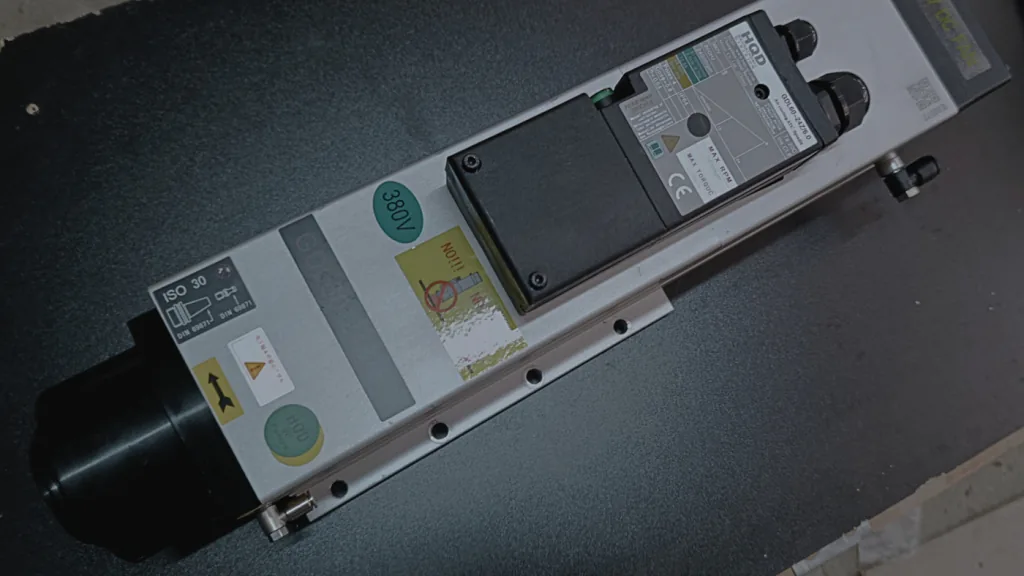
The spindle is often called the „heart” of every CNC machine. It is this component that is directly responsible for the cutting process, and its parameters determine how fast, how deep, and in what materials you can work. For an entrepreneur planning to purchase their first machine, choosing between different power levels, cooling types, or drive systems can be a challenge. In this article, we explain what to look for so that your spindle choice is optimal for your business.
Types of CNC Spindles: Mechanical Drive vs. Electro-spindle
The basic division of spindles stems from the way power is transmitted from the motor to the tool. Understanding this difference is key to determining the machine’s capabilities in terms of roughing and finishing.
- Belt-driven or Gear-driven Spindles: In this solution, the motor is separate from the spindle, and power is transmitted via belts or gears. This allows for very high torque at low speeds, which is essential for machining heavy steel. The disadvantage is limited maximum speed and a higher noise level.
- Electro-spindles: The motor and spindle form a single unit enclosed in a common housing. This is the standard in modern milling plotters and machining centers for wood, plastics, and aluminum. Electro-spindles offer very high rotational speeds (even up to 24,000 – 60,000 RPM), quiet operation, and high precision, although they have lower torque at low speeds .
Cooling: Air or Liquid?
Effective heat dissipation from the spindle directly impacts its lifespan and the dimensional stability of machining. Two systems dominate the market:
- Air Cooling: The spindle has an integrated fan. This is a simpler solution in terms of construction and cheaper to operate (no pumps, radiators, or liquid lines). It works perfectly in the woodworking industry for processing MDF or wood, where work is not conducted in a continuous 24/7 mode. The disadvantage is the higher noise generated by the fan and lower efficiency in very hot workshops.
- Liquid (Water) Cooling: Coolant circulates around the spindle and dissipates heat in an external radiator. This system is significantly quieter and more efficient, allowing for long-term work under heavy loads without the risk of overheating bearings. Many professional machines, such as the RBF series models from Roboteus, standardly use liquid-cooled spindles (e.g., 3.2 kW), which guarantees work stability even in serial production.
How to Choose CNC Spindle Power for the Material?
CNC spindle power should be matched to the hardest material you plan to process regularly and the diameter of the tools you intend to use. Too little power will force you to reduce the feed rate, which will lengthen production time and may lead to faster wear of the cutters.
| Spindle Power | Recommended Applications and Materials | Example Tools |
| 0.8 kW – 1.5 kW | Engraving, light work in plastics, modeling. | Cutters up to 6 mm |
| 2,2 kW – 3,2 kW | Standard for SMEs. Furniture production, cutting in plywood, MDF, plexiglass, light aluminum. | Cutters up to 12-16 mm |
| 4,5 kW – 7,5 kW | Intensive serial production, nesting, frequent processing of aluminum and composites. | Cutters 16-20 mm+ |
| 9,0 kW+ | Heavy industry, steel processing, fast cutting with large heads. | Milling heads |
Remember that for materials like wood or plastics, not only power but also high rotational speed (RPM) is key. Spindles reaching 24,000 RPM allow for a perfectly smooth edge without burns.
Collets (ER) – Why Are They Important?
When choosing a spindle, pay attention to the tool mounting standard. The most popular system is ER-type collets. The size of the collet (e.g., ER20, ER25, ER32) determines the maximum diameter of the cutter shank you can mount. For example, a spindle with an ER20 collet allows for mounting tools with a diameter of up to 13 mm, which is an optimal choice for most woodworking shops .
Summary: What to Choose?
There is no single „best” spindle for everyone. If your company is involved in furniture production or advertising, the optimal choice will be a 3.2 kW liquid-cooled electro-spindle. it will ensure quiet operation, high precision, and sufficient power reserve for cutting full sheets of boards.
At Roboteus, we believe in the principle: „match the machine to the process, not the other way around”. That’s why we configure our CNC routers, such as the RBF 1325V model, so that their parameters – including efficient, liquid-cooled spindles – truly build your company’s competitive advantage.
Need help choosing a spindle?
Contact our team! We will prepare a free quote for you and advise which configuration will work best in your production.
Contact us