
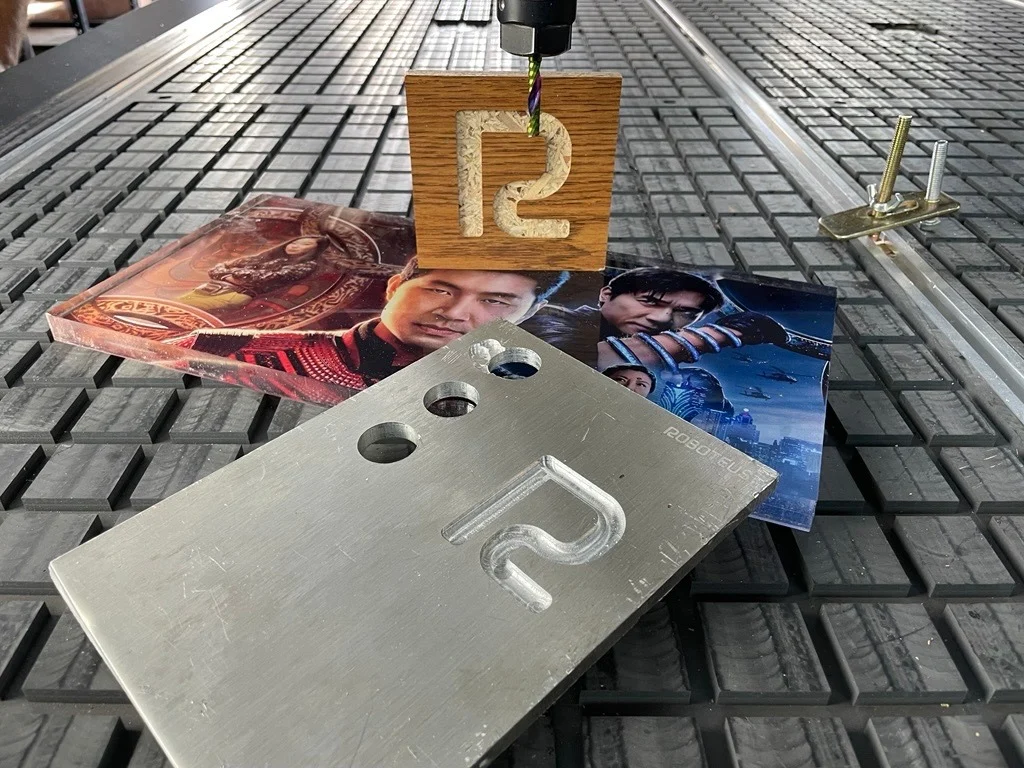
Start choosing a CNC machine with the material
Choosing a CNC machine often starts with comparing power, work area, and price. These are important parameters, but they shouldn’t be the first step. First, you need to answer a simpler question: what material will I be machining and what effect do I want to achieve?
A company cutting MDF panels needs different technology than a shop producing steel parts, and yet another technology is needed by a studio specializing in personalizing gadgets. Wood, acrylic, glass, aluminum, and steel differ in their properties, which is why the same machine won’t be equally good for all applications.
It’s also worth determining whether the planned work will involve cutting, engraving, milling, marking, drilling, or serial transfer of elements. A CO₂ laser can excellently cut acrylic and wood, but it won’t be a universal solution for cutting steel. Fiber laser, on the other hand, is a natural choice for marking and cutting metals, but it won’t replace a CO₂ laser for many non-metal materials. Kern Laser Systems describes CO₂ as a technology popular among others for wood, plastics, textiles, and foams, while fiber lasers are described as a solution particularly efficient for metals.
The most important rule: material determines technology
The table below provides a general starting point. However, it is not a substitute for material testing, because the result depends on thickness, composition, surface quality, required accuracy, and planned efficiency.
| Material | Most suitable technology | Typical applications |
| Wood, plywood, MDF | CO₂ laser or CNC router | Cutting, engraving, decorative elements, furniture, signs |
| Acrylic and some plastics | CO₂ laser or CNC router | Letters, stands, advertising, covers, decorative elements |
| Glass | CO₂ laser, most often for engraving | Personalization, decorations, markings |
| Black and stainless steel | Fiber laser or CNC plasma | Sheet metal cutting, structural elements, parts and markings |
| Aluminum and non-ferrous metals | Fiber laser, plasma, or CNC router — depending on thickness and effect | Cutting, marking, machine elements |
| Structural plastics | CNC router or CO₂ laser — depending on the plastic | Prototypes, enclosures, technical parts |
| Paper, cardboard, leather, advertising materials | CO₂ laser | Cutting, engraving, personalization |
| Metal elements requiring permanent marking | Fiber laser | Serial numbers, codes, logos, part identification |
CNC machine for wood, MDF, and plywood
For machining wood-based materials, a CNC router or CO₂ laser is most often considered. Both technologies can work with wood, but they give different results and work well for different tasks.
When should you choose a CNC router?
A CNC router will be a good choice when the following are important:
- greater machining depth;
- milling pockets, grooves, and 3D surfaces;
- machining thick panels and spatial elements;
- the ability to use various milling cutters;
- work requiring mechanical material removal;
- production of furniture, fronts, molds, templates, and structural elements.
A router can also machine some plastics, aluminum, and other materials, but its capabilities depend on the rigidity of the construction, spindle power, material fixing, tools, and cutting parameters. This is an important distinction: a small hobby router and a heavy production machine may have similar names but completely different applications.
When is a CO₂ laser better?
A CO₂ laser is an interesting solution when fast cutting and engraving of flat sheets is most important. It works well with wood, plywood, MDF, acrylic, paper, cardboard, leather, and many advertising materials.
The laser doesn’t require mechanical contact between the tool and material. Thanks to this, it can perform fine details and complex contours without changing cutters. However, you need to remember about extraction, air assist, cooling, optics cleaning, and safe material selection.
In the case of wood and MDF, the result depends on density, moisture, glue, and sheet repeatability. The same program may give a slightly different edge on two batches of material. Before serial production, it’s worth performing a speed and power test.
Acrylic and plastics — the choice depends on the type of material
Acrylic is one of the materials where a CO₂ laser often gives an attractive effect, especially for cutting. You can achieve a smooth, attractive edge, which matters in the production of letters, signs, stands, and decorative elements.
A CNC router will be better if you need to make holes, pockets, chamfers, or elements of greater thickness. It also allows machining many structural plastics that should not be cut with a laser without checking the composition.
With plastics, you need to be careful with materials of unknown origin. Not every plastic is suitable for laser processing. Some may emit dangerous combustion products or cause cutting quality problems. For laser work, you should always check the material documentation and the device manufacturer’s recommendations.
Glass — primarily engraving, not typical cutting
A CO₂ laser can be used to engrave glass. This usually involves obtaining a matte, decorative marking on the surface of a bottle, glass, window, or other element.
However, it should not be treated as a universal tool for cutting glass panes. When engraving glass, speed, power, focus, type of glass, and heat dissipation method matter. Higher power doesn’t always give a better effect — too much energy can increase the risk of cracks or uneven engraving.
Glass requires different parameters than acrylic, and settings for different materials and laser models should be treated as a starting point for testing.
Steel, stainless steel, and aluminum — fiber laser or plasma?
For metals, fiber laser and CNC plasma are most often compared. In some applications, a heavier CNC router can also be considered.
Fiber laser for metal
Fiber laser is a good direction when the following matter:
- precise contours;
- narrow cutting kerf;
- minimal finishing work;
- repeatability;
- fast metal marking;
- working with steel, stainless steel, aluminum, and other metals.
For thinner and medium sheets, fiber laser can be attractive for companies producing parts, plates, advertising elements, enclosures, and short series. When choosing, you need to analyze not only the source power, but also the head, table, software, laser source, cooling, and service.
CNC plasma cutter
CNC plasma can be a beneficial solution when a company cuts metal sheets and needs relatively efficient technology for structural elements, metal decorations, or thicker parts.
When choosing a plasma cutter, you should consider the thickness and type of metal, sheet format, work intensity, plasma source, torch height control, compressed air quality, and the method of removing smoke and spatter. Hypertherm also points to the importance of budget, company growth potential, software, warranty length, and technical support quality.
Plasma doesn’t always give the same edge quality as fiber laser, but in certain applications it can be a more rational choice in terms of cost, material thickness, and efficiency.
CNC router for metal
A CNC router is the right technology if, instead of just cutting, you need to perform spatial machining: holes, threads, pockets, planes, grooves, or precise surfaces. However, it requires a sufficiently rigid construction, appropriate spindle, cooling, tools, and stable fixing.
You shouldn’t assume that every router advertised as „CNC for aluminum” will be suitable for regular production of steel parts. For metals, rigidity, accuracy, chip removal, and the ability to work with parameters adjusted for the specific alloy are particularly important.
CO₂, fiber, or plasma laser — how do they differ in practice?
| Technology | Works best with | Typical applications | What to watch out for? |
| CO₂ laser | Wood, MDF, plywood, acrylic, paper, leather, and many non-metal materials | Cutting and engraving | Ventilation, extraction, air assist, optics, and safe material composition |
| Fiber laser | Steel, stainless steel, aluminum, and other metals | Cutting and permanent marking | Selection of power, head, work area, enclosure, and parameters for the alloy |
| CNC plasma | Steel, stainless steel, and aluminum, especially at larger thicknesses | Fast cutting of structural and decorative elements | Edge quality, smoke, spatter, compressed air, and consumables |
Fiber or plasma? Simple explanation
Both technologies are mainly used for machining metal, but they work completely differently. A fiber laser cuts metal with a focused beam of light. Plasma cuts it using very hot, ionized gas, i.e., a plasma arc.
The simplest way to remember this: fiber laser is usually chosen when accuracy, detailed contour, and an aesthetic edge are most important. CNC plasma is often more practical when you need to quickly cut larger or thicker metal sheets, and maximum edge precision is not the most important criterion.
| Criterion | Fiber laser | CNC plasma |
| Cutting method | A focused beam of light melts and vaporizes the material | A plasma arc melts the metal, and a gas stream removes the molten material |
| Typical advantage | Accuracy, detailed contours, and narrow cutting kerf | Efficient metal cutting and a good choice for larger thicknesses |
| Edge | Usually smoother and requiring less additional processing | May require removal of scale or further finishing |
| Best applications | Parts, enclosures, plates, advertising elements, short series | Structures, metal decorations, steel elements, and thicker sheets |
| What needs to be provided | Appropriate power, head, optics, cooling, and extraction | Plasma source, compressed air, torch height control, and smoke extraction |
| Operating costs | Depend among others on the source, gas, optics, and service | Mainly include energy, air, and torch consumables |
Example: if a company wants to cut precise steel plates with holes and a complicated contour, fiber laser may be a better direction. If, however, it plans to make larger steel elements for structures, gates, decorations, or machines, plasma may prove more cost-effective.
This doesn’t mean fiber laser is always better or that plasma is a less professional solution. These are tools for different tasks. The final choice depends primarily on the type and thickness of the metal, required accuracy, number of elements, and acceptable amount of post-cutting processing.
For metal marking, fiber laser is the natural choice for serial numbers, codes, logos, and part identification. Plasma is primarily used for cutting, not precise marking.
Advertising materials — what to pay attention to?
Advertising companies often work with many materials and handle both single orders and short series. In such a case, the most important factor may not be maximum cutting thickness, but versatility and quick changeover.
Typical materials include wood, plywood, MDF, acrylic, engraving laminates, paper, cardboard, leather, foils, anodized aluminum, and steel elements. A CO₂ laser can be a good solution for cutting and engraving many non-metal materials. Fiber laser works well for permanent metal marking, and a CNC router for thick panels, letter milling, and spatial machining.
It’s worth paying attention to the possibility of using a rotary attachment if the company plans to mark mugs, bottles, or other cylindrical elements. With a larger number of similar orders, automatic height setting, quick homing, and simple file preparation will also matter.
Parameters that need to be matched to production
After choosing the technology comes configuration time. Here too, there is no single parameter that decides everything.
| Parameter | Question you need to answer |
| Work area | What is the largest element, and are we machining the whole sheet or smaller pieces? |
| Material thickness | What is the typical thickness, and what is the occasional maximum thickness? |
| Source or spindle power | Is it more important to work with thicker material, speed, or delicate engraving? |
| Accuracy and repeatability | What tolerances are required, and does every element need to be identical? |
| Work speed | How many pieces or sheets need to be produced per day? |
| Number of passes and changeovers | Does the product require one operation or several stages? |
| Material fixing | Will you need a vacuum table, clamps, a water table, or special fixtures? |
| Software | Does the team already have experience with CAD/CAM, nesting, or marking? |
| Extraction, cooling, and compressed air | What requirements does the workstation have, and is the infrastructure already available? |
| Service and parts | How quickly can a breakdown be resolved, and does the manufacturer provide training and support? |
How to choose a CNC machine step by step?
Step 1: List the materials
Write down not only the material name, but also its thickness, format, manufacturer, and expected quantity. „Wood” can mean thin plywood, thick furniture board, or a hard element requiring milling.
Step 2: Define the process
Decide whether you need cutting, engraving, marking, milling, drilling, or several operations in one process.
Step 3: Estimate production
A hobbyist making a few elements a month needs a different machine than a company handling a dozen orders a day. Think about what the typical workload is, how long a single operation can take, and whether you plan to grow.
Step 4: Check the technical conditions
Consider the space, transport, flooring, power supply, ventilation, extraction, cooling, compressed air, and noise level. The device price doesn’t always include preparation of the entire workstation.
Step 5: Ask for a material test
A test on a specific material is often more valuable than a table of parameters alone. It lets you check edge quality, accuracy, work pace, and any necessary finishing.
Step 6: Compare support, not just specifications
Check whether the manufacturer offers installation, training, parts, remote diagnostics, service, and configuration assistance. Hypertherm emphasizes that technical support, educational materials, and warranty conditions are important elements in choosing a plasma table.
The most common mistake: choosing a machine „just in case”
Buying a larger and more powerful machine may seem safe, but it’s not always reasonable. An oversized device can mean a higher purchase cost, higher space requirements, more expensive service, and parameters the company will never use.
On the other hand, a machine that’s too small can limit growth after just a few months. That’s why it’s worth distinguishing three levels of needs: typical material and thickness, maximum needs, and possible growth in the coming years. The best configuration is usually found between a device bought solely for today’s task and a machine chosen for a completely hypothetical future.
Summary: which CNC machine will be best?
There is no single best CNC machine. There is, however, a machine best suited to a specific material, process, element size, and production scale.
- For wood, MDF, and plywood, it’s worth comparing a CNC router with a CO₂ laser.
- For acrylic, a CO₂ laser often works well, and for mechanical machining — a router.
- For glass, a CO₂ laser for engraving is most often considered.
- For steel, stainless steel, and aluminum, it’s worth comparing fiber laser with CNC plasma, taking into account thickness and required edge quality.
- For precise spatial metal machining, you’ll need a sufficiently rigid CNC router.
- For permanent metal marking, fiber laser is most often chosen.
If you’re not sure which technology will be right for your material, contact Roboteus. We can help you choose a machine for your planned production, discuss workstation requirements, and organize a demonstration on a specific material. More information is available at roboteus.com.
Contact: +48 533 566 701
Sources
- [1] Kern Laser Systems — Laser Cutting and Laser Cutter Guide
- [2] Epilog Laser — Material Settings
- [3] Hypertherm — How to choose the best CNC plasma table for your needs
- [4] MIT Environment, Health & Safety — Laser Cutter Safety
Editorial note
The table and recommendations are for general guidance only. The final selection should take into account the specific material, its thickness and composition, the required effect, production volume, installation conditions, and a test performed on real samples. Especially for plastics and advertising materials, their composition and processing safety should be verified before starting work.