
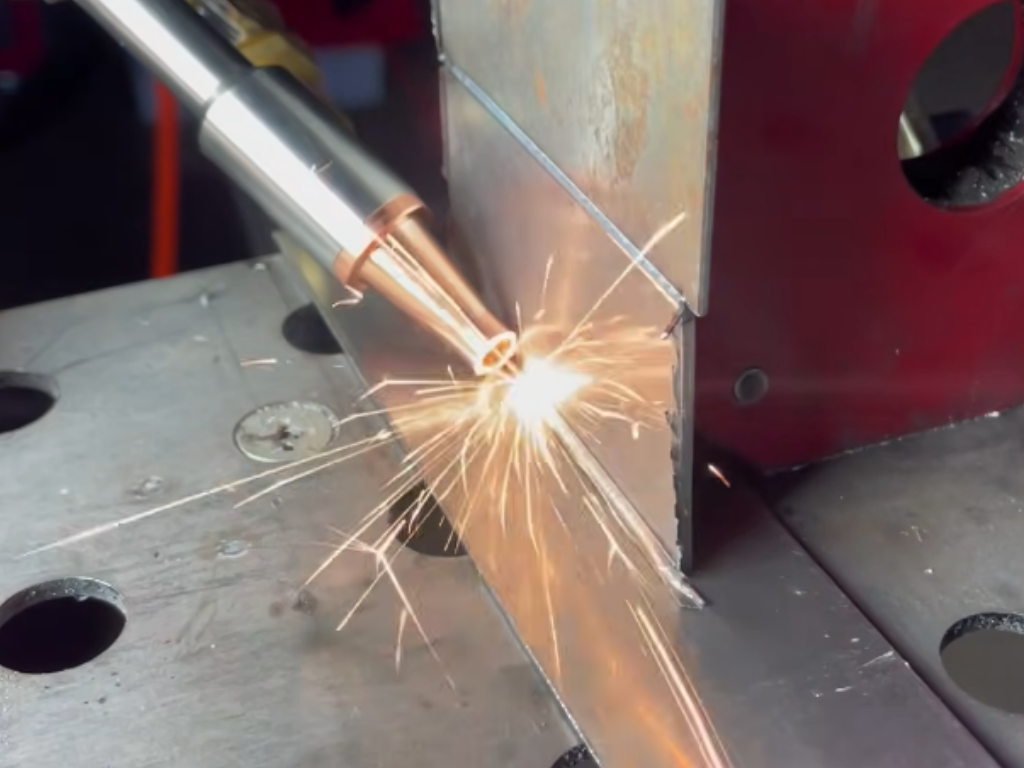
A handheld laser welder is a fiber-optic source (fiber laser, in which the beam is generated in a doped optical fiber and guided through it to the welding head), a gun in the operator’s hand instead of a robot-mounted head, a wire feeder and a cooling system. The operator guides the beam along the joint as they would guide a TIG torch, but the weld forms faster, is narrower and introduces less heat into the material.
This equipment has found its way into small and medium-sized workshops as an alternative to TIG for stainless steel sheets and thin structures. However, it has clear limits: material thickness, batch length, type of metal and safety when working with a Class 4 laser. This text describes how a handheld laser welder differs from an automated station, what you get in the package, how to select the power class and cooling, for whom it makes sense and where its limits are.
The figures in the text come from product datasheets and publications from laser welder manufacturers and suppliers, including Roboteus; where we do not have data, we write descriptively. Prices are left to a separate text about what makes up the price of a laser welder.
How a handheld laser welder differs from an automated station
The physics of the process is the same: a focused laser beam melts metal in conduction mode (thin, aesthetic weld) or deep penetration mode (keyhole, when the beam creates a vapor channel in the material). Beam oscillation, called wobble, widens the weld and allows tolerating a larger gap. Shielding gas and filler wire work as in arc methods. The difference is who holds the welding head.
In an automated station, a robot guides the head: the same trajectory, the same speed and the same angle in every part. In the handheld version, the operator is responsible for speed, angle and distance from the material. This provides flexibility — you can weld an atypical part without programming — but it also means that repeatability depends on the human, and the narrow window of laser welding parameters is less forgiving than MIG arc.
There are two more practical differences. A robot requires a positioner, tooling and a programmer; a handheld welder requires a table, guards and a trained operator. A robot works in an enclosed cell, so protection from the beam is a matter of cell design; in the handheld version, Class 4 protection covers the operator and anyone who enters the range of reflections.
What you get in the package: source, gun, feeder, cooling
A typical package consists of four elements worth checking separately. Using the example of the RBW 1500 laser welder:
- Source: Raycus 1500 W fiber laser, continuous and pulsed mode, power adjustment, wobble width, frequency and wire feed speed adjustment.
- Gun: lightweight, with replaceable optics and nozzles. Protective glasses of the optics and nozzles are consumable parts.
- Feeder: automatic wire feeder included, with replaceable rollers and tips selected for wire diameter.
- Cooling: S&A industrial chiller, liquid cooling.
In addition, there is a controller — in the RBW 1500, the controller and feeder menu is in Polish. This is a detail when purchasing, but it determines daily whether the operator changes parameters themselves or waits for someone who understands the menu.
Glasses, guards and fume extraction are usually not included in the package — ask about them separately. These elements are selected for the station, not for the welder model; we describe them in a separate section on safety.
1. Power class and material thickness
The power of the source determines what thickness can be penetrated and how quickly. Two reference points from manufacturer datasheets: RBW 1500 (1500 W) welds carbon steel, stainless steel and aluminum up to 5 mm; one of the domestic manufacturers declares for their welder 2000 W that „power up to 2 kW provides full penetration up to 6 mm”. In one distributor’s catalog, the lightest model has 800 W, and the next two — air-cooled and water-cooled — have 1500 W each.
These figures are maximum values declared by manufacturers, not working values. Full penetration at the upper limit means working at the edge of the parameter window: slower, with greater sensitivity to gap and edge preparation. If you regularly weld material close to the maximum, consider a higher class or two-sided welding instead of squeezing the last millimeter out of the machine.
With thin sheets, the situation is reversed: a 1500 W handheld laser welder then works at a fraction of its power, and you are limited more by hand stability and precision of guidance than by the source. This is precisely the range where handheld laser gives the greatest advantage over TIG — according to materials from one laser welder seller, productivity can be even ten times higher than with TIG, and according to another manufacturer you gain limited heat-affected zone, weld aesthetics and repeatability.
2. Air or water cooling
The source and optics heat up, so every handheld laser welder has a cooling system. Liquid cooling with a chiller — as in RBW 1500, in the water-cooled 1500 W model of the mentioned distributor and in the 2 kW welder mentioned above — is an industrial solution: the manufacturer of the latter declares a duty cycle of one hundred percent with water cooling. Air cooling (800 W and 1500 W models from the same distributor, and in one of the domestic shops also 2000 W and 2500 W welders) eliminates the chiller, fluid and cooling hose — the equipment is lighter and easier to transport to the job site.
The distributor describes its water-cooled 1500 W model as intended „for thicker materials”, and the air-cooled 800 W model as the lightest in the offer. This is a good summary of the compromise: air for mobility and intermittent work, water for continuous work and heavier tasks. When choosing air cooling, ask the seller how long the equipment maintains full power in continuous operation before it is limited.
The chiller is not maintenance-free: it requires fluid and system cleanliness, and a contaminated circuit ends in optics overheating. This is an item on the maintenance list, not a one-time expense.
3. Gun: weight, optics and what wears out
The operator holds the gun throughout the shift, so its weight is an ergonomic parameter, not a marketing one. One manufacturer gives the gun weight as 650 g. Roboteus describes the RBW 1500 gun as lightweight, with replaceable optics and nozzles. When comparing models, take the gun in your hand with the fiber optic and hose connected — the gun alone weighs less than what the operator actually guides.
Three things wear out in the gun: protective glass of the optics (spatter deposits on it and scatters the beam), nozzles (mechanical wear and from spatter) and wire guide tips. Ask how much they cost and how often they are replaced with your material — this is a daily item in operation, not a curiosity from the manual.
Replaceable optics has another significance: different nozzles and settings for welding with and without wire, for fillet and butt welds, sometimes for surface cleaning. The faster the operator changes configuration, the less time the station is idle.
4. Power supply, weight and space in the workshop
A handheld laser welder does not always require three-phase power: RBW 1500 operates from a 230 V single-phase network. In practice, this means the station can be placed where there is no power socket. However, this is not a rule for the entire power class — some equipment, also in the 1500–2000 W class, requires three-phase power, so check this in the datasheet of the specific model. The manufacturer of the mentioned 2 kW welder gives source efficiency above forty-two percent — at the same output power, a more efficient source draws less energy and generates less heat.
Equipment weight: RBW 1500 weighs 120 kg, which allows moving it around the workshop, but not carrying it up stairs. If you need work on site, consider air-cooled designs — at the cost of duty cycle.
Space in the workshop is not just a stand for the machine. A handheld laser welder station requires guards to stop the beam and reflections, fume extraction at the table and a cylinder with shielding gas. Plan this before purchasing, because a welder without guards cannot operate in a workshop where there are other people.
Who is a handheld laser welder suitable for?
Four typical profiles of workshops where handheld laser makes sense:
- Locksmith workshop and unit production. Welding without programming, quick transition between parts, aesthetic weld on visible elements (railings, metal furniture, enclosures).
- Service and repairs. Single-phase power supply and ability to move the station around the workshop; welding thin elements without distortions that cannot be straightened afterwards.
- Small-batch production. When batches are too short to justify programming a robot, and TIG is too slow. Hand-held laser shortens weld time and reduces grinding after welding.
- Stainless steel structures. Low heat input means fewer discolorations (oxide deposits) and lower risk of sensitization to intergranular corrosion in austenitic steels 304 and 316. Argon shielding gas, ER308L or ER316L wire, passivation or pickling after welding — the process is the same as with TIG, but faster and with less distortion.
Common denominator: many short, different welds on thin and medium material, with emphasis on appearance and low distortion. If this describes your workshop, a handheld laser welder is a tool that replaces TIG in most tasks, not an addition to it.
The limits of handheld laser welding
An honest list of limits has four points. Each of them is not a flaw in the technology, but a limit of the handheld version.
Thick sections. According to manufacturer datasheets, the upper limit is 5 mm (RBW 1500) and 6 mm (2 kW welder from one manufacturer). Above this range, MIG/MAG or multi-pass welding with other methods remains. Hand-held laser will not replace a semi-automatic in heavy steel structures and that is not what it is for.
Long batches. With hundreds of identical parts, operator repeatability becomes a limitation, and the cost of the welder’s hour becomes the main cost. This is when the head should be guided by a robot. RBR 2110S welding robot is a six-axis robot with a reach of 2100 mm, payload of 10 kg and repeatability of ±0.07 mm in a package with a 350 A MIG welder — for batches where every weld must be the same as the previous one. When this change makes sense and when it does not is described in the text about when a robot replaces a welder.
Aluminum and galvanized steel. According to materials from one laser welder seller, this is the biggest challenge in laser welding. Aluminum and copper reflect a beam of wavelength around 1 µm — this is a hazard to the operator and a technological difficulty at the same time. Galvanized sheet vaporizes zinc in the pool and causes porosity. RBW 1500 declares aluminum welding up to 5 mm, but the parameter window is narrow and requires trials on the specific alloy.
Gap and edge preparation. The laser beam is narrow, so sensitivity to gap and fit-up is greater than in MIG. Wobble and wire widen the tolerance, but will not replace part preparation. If your parts come from plasma cutting with burrs and gaps, a laser welder will show this faster than a semi-automatic. A complete list of limitations with explanations of mechanisms is collected in the text on defects in laser welding.
Safety: Class 4 laser in the operator’s hand
A handheld laser welder is a Class 4 laser with a wavelength of around 1 µm, invisible to the eye. The beam and its reflections from metal damage vision without warning, so protective equipment is not optional. The minimum is glasses with appropriate optical density for this wavelength for the operator and anyone in the area, station guards to stop the beam and reflections, and fume extraction for welding fumes.
With the handheld version, the risk is greater than in a robot cell for two reasons. First, the operator themselves decides where to direct the beam; contact safeties on the gun (the beam turns on only after the nozzle touches the part connected to the clamp) limit this risk, but do not eliminate reflections. Second, reflections from shiny surfaces (aluminum, copper, polished stainless steel) change direction unpredictably. Therefore, station guards are selected based on the size of parts and the workshop layout, not the welder model.
Operator training is part of implementation, not an add-on. It includes menu operation, parameter selection, replacement of glasses and nozzles, and rules for working with a Class 4 laser. On the Roboteus laser welders category page you will find RBW 1500 parameters and the ability to order a quote for your process — along with questions about guards and training.
Frequently asked questions
What thickness does a handheld laser welder weld?
According to manufacturer datasheets: RBW 1500 (1500 W) up to 5 mm in carbon steel, stainless steel and aluminum; 2000 W welder from one of the domestic manufacturers — full penetration up to 6 mm. These are maximum values, at which you work slower and with less tolerance for gap. The comfortable range is clearly below the maximum.
Does a handheld laser welder weld aluminum?
Yes, RBW 1500 declares aluminum up to 5 mm. In practice, aluminum is, according to materials from one laser welder seller, along with galvanized steel one of the biggest challenges: it reflects the beam and has a narrow parameter window. Before purchasing, ask for a trial on your alloy and thickness.
Does a handheld laser welder require three-phase power?
Not always. RBW 1500 operates from a 230 V single-phase network, which allows setting up the station without a power socket. Other models, also in the same power class, may be three-phase powered — check the requirements of the specific equipment with the supplier.
Water or air cooling — what to choose?
Water (chiller) is a solution for continuous work and thicker materials; one manufacturer declares a one hundred percent duty cycle with water cooling. Air provides a lighter device without a chiller and fluid, at the cost of duty cycle. One distributor describes their water-cooled 1500 W model as „for thicker materials”, and their air-cooled 800 W model as the lightest.
Will a handheld laser welder replace TIG?
In thin and medium sheets, especially stainless, usually yes — according to materials from one laser welder seller, productivity can be even ten times higher, and the heat-affected zone smaller. TIG remains where very precise pool control on difficult material is important or where the investment in laser does not pay off.
Do you need to buy guards for a handheld laser welder?
Yes. This is a Class 4 laser, so glasses with appropriate optical density, station guards and fume extraction are a condition for operation, not an option. Usually they are not included in the machine price — in catalogs of domestic shops, PPE sets and fume extractors are separate items.
Sources
- https://roboteus.com/pl/maszyny/spawarki-laserowe/spawarka-laserowa-rbw-1500/ — RBW 1500 parameters (source, thicknesses, cooling, power supply, weight, feeder)
- https://roboteus.com/pl/maszyny/spawarki-laserowe/ — Roboteus laser welders category
- https://roboteus.com/pl/maszyny/roboty-przemyslowe/robot-przemyslowy-rbr-2110s/ — RBR 2110S robot parameters
Editorial note
The parameters cited in the text come from product datasheets as of October 2026 and depend on the specific machine, material, thickness and edge preparation; supplier catalog prices change. This text does not replace the manufacturer’s manual or safety regulations for working with a Class 4 laser.