Laser welder manufacturers’ materials describe speed, narrow weld bead and small heat-affected zone. The phrase „laser welding drawbacks” appears in them rarely, and if it does, in abbreviated form: „higher price, but quick payback”. Meanwhile, laser welder limitations are as concrete as its advantages and follow directly from the physics of a focused beam.
This article is technological, not purchasing-focused. We do not describe user experiences or what to ask a seller; that is the subject of a separate text on laser welder reviews. Here we explain the mechanism of each drawback: why it occurs, when it manifests and what limits it. If you want to first understand the process itself, start with the text on how laser welding works.
The figures in the text come from product datasheets and manufacturer publications, and we cite competitors’ numerical claims with the source name.
Where laser welding drawbacks come from: physics of a focused beam
A laser welder with a fiber source (fiber, i.e. a laser in which the beam is generated and guided in an optical fiber) concentrates energy on a very small spot. Everything good comes from this: narrow weld bead, small heat-affected zone, minimal distortion. And most of the drawbacks come from the same thing.
A small spot means the beam „sees” only a narrow strip of material on both sides of the joint. Small heat input means the pool is small and solidifies quickly, so there is no time to correct preparation errors. High energy density means that the same setting that gives full penetration on one sheet will burn through an adjacent one of slightly smaller thickness.
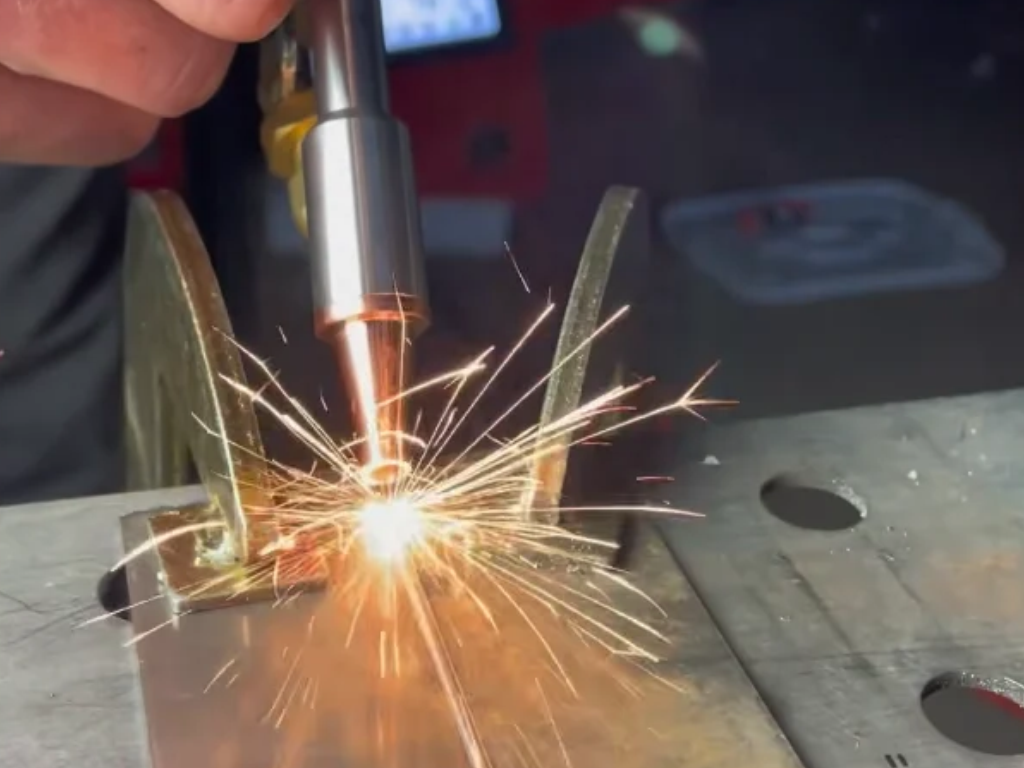
There are two operating modes: conduction mode, in which metal melts from the surface (thin, aesthetic weld bead), and deep penetration mode, called keyhole, in which the beam vaporizes metal and creates a vapor channel through which energy enters the material depth. Most laser weld defects are essentially instability of this channel.
1. Entry cost
According to materials from one laser welder seller, investment in laser welding can be 2–3 times higher than MIG/TIG. Catalog data confirm this: manual laser welders in one domestic online shop (hereinafter: shop A) cost from PLN 19,500 net to PLN 39,500 net, and air-cooled welders in another shop (hereinafter: shop B) PLN 42,900–49,900 net (net catalog prices, as of October 2026). To this add a PPE kit (in shop A PLN 3,600–7,500 net) and fume extraction (in shop B PLN 3,950 or PLN 7,500 net; also net catalog prices, as of October 2026), without which the workstation should not operate.
The mechanism is simple: you pay for the laser source, optical system, cooling and safety measures that a MIG welder does not have. The cost itself is not a technology drawback, but becomes one when working hours do not allow it to be amortized; the full calculation can be found in the text on how much a laser welder costs.
2. Narrow parameter window
In MIG, an operator can make up for a lot by hand: change the angle, slow down, add wire. In laser, power, speed, focus position, oscillation width and shielding gas form a connected system and have a narrow range in which the weld is correct. According to materials from one laser welder seller, outside this window cracks and porosity appear, and the laser „does not forgive random settings”.
Mechanism: too small linear energy (power too low or speed too high) does not open the vapor channel and gives lack of penetration. Too much overheats the pool, the channel becomes unstable, collapses and traps gas bubbles in the solidifying metal; hence porosity. Stresses from rapid cooling cause cracks. Changing one parameter requires correction of the others, and changing material or thickness requires a new window.
In practice, this means that for each repeatable joint you must record a tested set of settings and monitor it. Welders with power regulation, frequency, oscillation width and wire feed speed, like RBW 1500, allow this to be done, but someone must first develop these windows on samples.
3. Sensitivity to gap and fit
This is a drawback that most often surprises shops transitioning from MIG. The MIG arc with large amounts of filler metal bridges gaps that are impassable for a laser. A small spot hits a void, energy escapes, and the weld has undercuts, concave face or does not join both edges at all.
Mechanism: the amount of metal a laser can melt and move is limited by pool size. Without wire, a butt weld is formed solely from base metal, so every gap is a loss. Wire adds filler, and wobble (beam oscillation) widens the weld and tolerates larger gaps, but both methods have limits and reduce speed.
Organizational consequence: edge preparation, cutting and bending must be more precise than before, and parts require fixtures that hold them in contact. The cost of the laser often hides not in the welding shop, but on the cutting machine and edge press.
4. Aluminum, galvanized steel and copper
According to the same seller, aluminum and galvanized steel are the biggest challenge for laser welding. There are three mechanisms.
Aluminum and copper reflect a large portion of fiber laser radiation at a wavelength of approximately 1 µm, especially on a shiny surface and initially, before the metal melts. This reflection is not only energy loss but also a hazard to optics and the workstation environment. In addition, there is high thermal conductivity: heat escapes from the pool faster than the beam supplies it, the vapor channel is unstable and according to the mentioned seller leads to porosity.
Galvanized steel has a different problem: zinc vaporizes at a temperature much lower than the melting temperature of steel. In a lap joint, zinc vapor has nowhere to escape, so it ejects liquid metal from the pool, leaving bubbles and spatter. A vent gap between sheets or removal of the coating in the weld zone helps, but both procedures add operations.
5. Section thickness
A manual laser welder has an upper thickness limit that cannot be exceeded by settings. RBW 1500 with a 1500 W source welds carbon steel, stainless steel and aluminum up to 5 mm. One domestic manufacturer declares for its welder with power up to 2 kW full penetration up to 6 mm. At power levels typical for hand-held devices around these values, the reasonable range of applications ends.
Mechanism: vapor channel depth increases with power, but not infinitely. At larger thicknesses the channel becomes long and unstable, and multi-pass welding, natural in MIG, is troublesome in hand-held laser because successive passes require wire and a wider groove, which takes away the laser’s advantage. Thick steel structures remain the domain of MIG/MAG, submerged arc and automated stations.
More on where hand-held device application ends in the article on hand-held laser welder.
6. Safety equipment and workstation screens for Class 4 lasers
A laser welder is a Class 4 laser: the highest class, in which even scattered and reflected radiation is hazardous to eyes and skin. Radiation at a wavelength of approximately 1 µm is invisible, and the eye focuses it on the retina, so damage occurs without a protective reflex.
Hence requirements that do not exist with MIG: glasses with optical density matched to this wavelength (ordinary welding filters are not sufficient), workstation shields that absorb reflections, access procedures and fume extraction, because metals and coatings vaporize in the weld.
The cost of these measures is measurable: PPE kits in shop A cost from PLN 3,600 to PLN 7,500 net, and fume extractors in shop B PLN 3,950 or PLN 7,500 net (net catalog prices, as of October 2026). The drawback is that a workstation that could stand in an open hall with MIG requires a separate zone with a laser.
7. Consumables: protective glass, nozzles, rollers
Every welder has consumable materials, but laser has one that directly controls weld quality: protective glass of the optics. Spatter and fumes settle on it, and any contamination absorbs part of the beam and scatters it. The mechanism is self-reinforcing: dirty glass means less power in the spot, less power means worse penetration and more spatter, and more spatter means glass gets dirty faster.
An operator who does not replace the glass on time observes parameter drift, even though they changed nothing. Add nozzles (burned or clogged ones disrupt gas shielding and cause porosity) and feeder rollers, which must be matched to wire diameter, otherwise the wire slips and feeding becomes uneven. Consumables are cheap, but omitting them from maintenance plans is a common cause of sudden quality drop.
8. Cooling
The laser source and optics generate heat that must be removed. Liquid-cooled welders, like RBW 1500 with an industrial S&A chiller, require fluid, its purity and periodic replacement; contaminated circulation reduces cooling efficiency, and chiller failure stops the machine. Air-cooled welders (e.g. 800 W and 1500 W models from one distributor or 2000 W and 2500 W welders from shop B) are lighter and simpler, but during long, continuous welding in a hot hall their limitation can be duty cycle.
Manufacturers themselves point to this relationship: the mentioned 2 kW welder manufacturer declares 100% duty cycle for this water-cooled machine, and one distributor describes their water-cooled 1500 W model as intended „for thicker materials”. Cooling must therefore be matched to actual load and maintained.
9. Operator qualifications
Sellers often say that a laser welder is simpler to operate than TIG. In part this is true: guiding the torch requires less dexterity than maintaining a TIG arc while simultaneously feeding wire. The difficulty shifts elsewhere: to process setup.
Mechanism: in TIG a good welder corrects errors in real time because they see the pool and have reaction time. In laser the pool is small, speed is high, and consequences of bad settings are seen only after welding, often only on fracture or in inspection. The operator must therefore understand what power, speed, focus and oscillation do, and be able to read the weld: face, root, undercuts, discoloration. These are different competencies than a skilled hand and must be built through training and trials.
10. Documentation and WPQR for structures
Laser beam welding has its own process number in ISO 4063: 52. For structures under supervision (construction, pressure equipment, vehicles) a welding procedure qualification (WPQR) and WPS instructions are required specifically for this process, not for MAG (135) or TIG (141), which the shop has welded with so far.
The mechanism of this drawback is organizational: owning a machine does not mean owning a qualified technology. You must make test joints, examine them and document them, and this costs time and money. Some manufacturers address this (one manufacturer declares ready WPQR for their welder), but the scope of such documentation must always be checked against your own materials and joints. Until it exists, laser is suitable for unsupervised parts, not for certified structures.
Laser welding: drawbacks, mechanisms and remedial measures in one table
| Drawback | Mechanism | What limits it |
|---|---|---|
| Entry cost | Source, optics, cooling, PPE | Working hours, break-even threshold calculation |
| Narrow parameter window | Small linear energy margin | Recorded windows for each joint, trials |
| Gap and fit | Small spot, small pool | Precise preparation, fixtures, wire, wobble |
| Aluminum, galvanized steel, copper | Reflections, thermal conductivity, zinc vapor | Trials, vent gap, coating removal |
| Section thickness | Vapor channel depth limit | Selection for thickness up to 5–6 mm, different method above |
| Class 4 PPE | Invisible, reflected radiation | Glasses, shields, fume extraction, separate zone |
| Consumables | Dirty glass means power loss | Replacement schedule, inspection before change |
| Cooling | Heat from source and optics | Cooling matched to duty cycle, fluid purity |
| Operator qualifications | Error visible only after welding | Process training, weld reading |
| Documentation and WPQR | Process 52 requires its own qualification | Test joints, inspections, WPS |
When it is still worth it: what balances laser welding drawbacks
None of the above limitations disappear after reading the manual, yet in certain applications the balance tips in favor of the laser.
According to materials from one seller, laser welding productivity can be even 10 times higher than TIG; another manufacturer lists high speed, limited heat-affected zone, weld aesthetics and repeatability as main advantages. Where you weld thin and medium stainless steel sheets with visible face, small heat input means fewer discolorations, less distortion and less grinding; for this material laser is often simply a better tool, which we write about in the text on laser welding of stainless steel. Where parts are repeatable and well-fitted, the narrow parameter window stops being a drawback because it is set once.
There is one condition: buy for the process, not for the promise. Check your materials, thicknesses and fit on trials, and select the configuration (feeder, optics, cooling, PPE) for them. Such selection is offered by Roboteus laser welders, priced for a specific process, not from a price list.
Most frequently asked questions
What are the biggest drawbacks of laser welding?
Entry cost (according to one seller’s materials 2–3 times higher than MIG/TIG), narrow parameter window, sensitivity to gap and fit, and difficult materials: aluminum, galvanized steel, copper. Add to this Class 4 PPE requirements and the need for your own technology qualification for supervised structures.
Why does porosity appear in a laser weld?
Most often due to an unstable vapor channel: too much energy or wrong speed causes it to collapse and trap gas in the solidifying metal. Porosity is also caused by poor gas shielding (clogged nozzle), contaminated edge and zinc vapor in galvanized sheets.
Does a laser welder weld aluminum?
Yes, but it is a difficult material: it reflects radiation at a wavelength of approximately 1 µm and quickly conducts heat away, which according to one laser welder seller’s materials leads to unstable penetration and porosity. For RBW 1500 the manufacturer declares aluminum welding up to 5 mm; before purchase, make trials on your own parts.
What thickness can be welded with a hand-held laser?
RBW 1500 (1500 W) welds carbon steel, stainless steel and aluminum up to 5 mm; one domestic manufacturer declares for their welder with power up to 2 kW full penetration up to 6 mm. Above these values, hand-held laser stops being the right tool.
Is a regular welding mask sufficient for laser welding?
No. A Class 4 laser at a wavelength of approximately 1 µm requires glasses or a helmet with optical density matched to this wavelength, workstation shields and fume extraction. Regular welding filters protect against arc light, not invisible laser radiation.
Sources
- https://roboteus.com/pl/maszyny/spawarki-laserowe/spawarka-laserowa-rbw-1500/
- https://roboteus.com/pl/maszyny/spawarki-laserowe/
Editorial note
Net catalog prices given in the text come from shop and manufacturer websites as of October 2026 and may change. Thicknesses, operating modes and parameters depend on the specific machine, material and part preparation. This article does not replace the manufacturer’s manual or PPE regulations for Class 4 laser devices.