
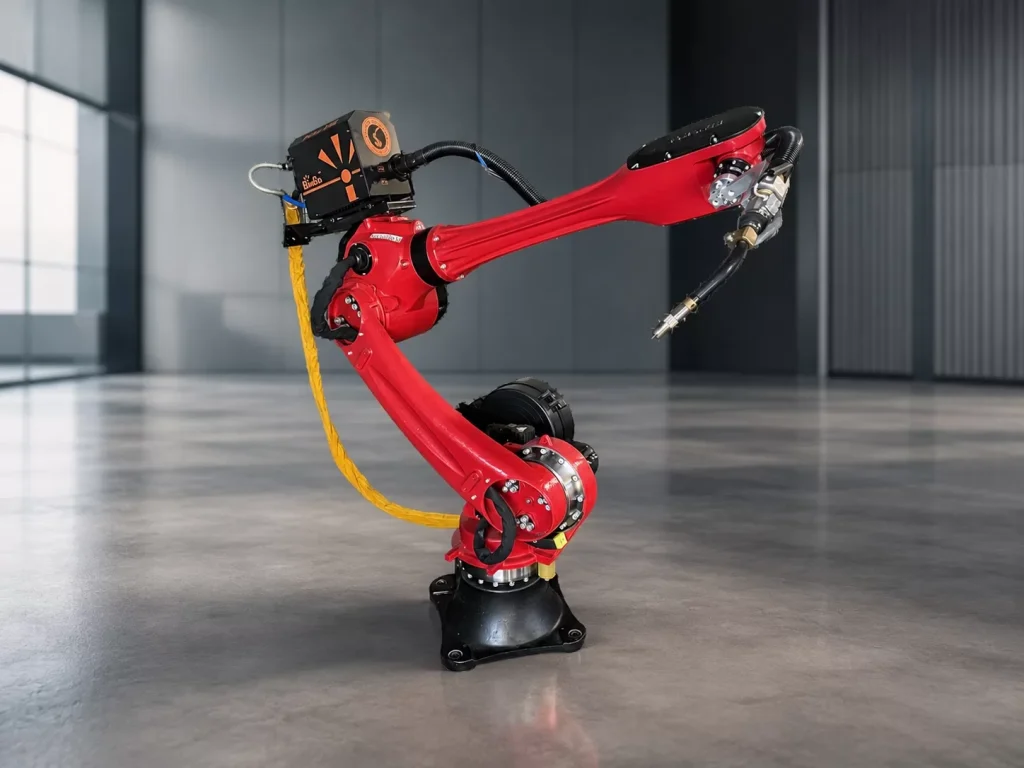
A welding robot is not a better welder. It is a different tool: it does not get tired, does not improvise and has no opinion. It welds exactly as it was programmed, which in some plants is the greatest advantage, and in others the reason why the machine stands against the wall half a year after purchase.
This text is for an owner or production manager wondering whether robotic welding makes sense in their plant. We do not provide prices here, because a robotic workstation is priced for a specific process: the cost for steel frames welded with MIG/MAG will be different from that for stainless steel tanks. Instead, we give five criteria that can be checked against your own production data, and a list of things without which the robot will not start working.
At the end, a brief note on the difference between an industrial robot and a cobot, because this question comes up in almost every conversation about welding automation.
What a welding robot does differently than a human
A welder works in a loop: he looks, assesses, corrects. He sees that the gap is larger than on the previous part, so he slows down and adds material. He feels that the sheet is heating up, so he changes the order of passes. This ability to correct is valuable when parts look slightly different each time.
A robot works in a sequence: it executes a program that was created on the first part. The torch travels the same trajectory at the same speed with the same arc parameters. If part number one hundred lies in the fixture the same way as part number one, the weld will be the same. If it lies differently, the robot will not notice, unless the workstation has sensors that need to be added and configured separately.
From this difference comes everything else: a robot pays off where parts are repeatable, and a welder where they are not. The remaining criteria only refine this principle.
Five criteria for welding robot profitability
The following criteria are worth checking in order. If at least three of them favor the robot, a conversation about implementation makes sense. If one or none of them do, a better direction is usually a manual laser welder or simply a second welder.
1. Series repeatability
A robot is cheapest per part when the same program runs many times. Programming and tooling preparation is a fixed cost for a given part; it is spread over the number of units. With series counted in hundreds or thousands of units per year, this cost fades into the background. With a few units, programming takes longer than the welding itself.
So check what share of your production consists of parts that come back every month in the same form. If single orders dominate, the robot will stand idle.
2. Total weld length per part
A robot earns while the arc is burning. A part with many short welds in different planes requires a lot of torch movement between welds and little welding. A part with a few long straight or circumferential welds is a case where the robot leaves a human far behind, because it guides the torch at a constant speed without breaks to change body position.
Count the meters of weld per part and multiply by the annual number of parts. This number, compared with the time it takes welders today, tells you more about profitability than any brochure.
3. Repeatability of part preparation
This is the most often overlooked criterion and most often responsible for failed implementations. A robot assumes that the edge is where it was during programming. If elements are cut with a tolerance that changes the gap from part to part, if they are bent on different machines or assembled by hand without a template, the robot will produce defects with the same repeatability with which it would produce good welds.
Before you ask about a robot, ask about your cutting machine and edge press. If there is order there, the robot will use it. If not, the robot will expose it.
4. Welder availability
In many plants, the argument for a robot is not cost at all, but lack of people. If orders are waiting because there is no one to weld, a robot operated by a trained operator who does not need to have manual welding qualifications unblocks production. The operator places the part in the fixture, runs the program, checks the result. For structures performed under the supervision of standards, however, the operator of a mechanized workstation has their own separate qualifications.
It is worth remembering that a robot does not eliminate the welder from the plant. Someone must set the parameters, assess the first weld and correct what the program did not anticipate. The proportion changes: one experienced welder for several workstations instead of a welder at each one.
5. Required quality and documentation
If the customer requires every weld to look identical, or if the process must be documented so it can be reproduced, the robot has an advantage that a human cannot match. A program is a record of parameters. Repeatability of positioning expressed in hundredths of a millimeter means that two welds from two different days do not differ in trajectory.
For plants producing under design standards, where compliance with the technological instruction matters, this is an independent argument, regardless of economics.
What a welding robot will not do
The list is shorter than the list of advantages, but each point can stop implementation.
Single parts. Programming one unit takes longer than manually welding it. Even with hand-guided programming, which cobots offer, preparing the trajectory and trials for a single part rarely makes economic sense.
Poor fit. A robot will not „fill” a weld where the gap is wider than assumed. It will either burn through or fail to fuse. A welder would change technique in this place; a robot will not do this without sensors or without program correction by a human.
Difficult access without a positioner. A six-axis arm has great reach, but the physics of the joint does not disappear: a weld in overhead position, a weld inside a closed profile, a weld behind a rib that the torch cannot reach without collision. The solution is a positioner that rotates the part to a suitable position. Without it, the robot welds only what it can see from above.
Parts that no one drew. A robot needs unambiguous information about the type, thickness and side of the weld. If the drawing does not contain this, the program is created from guesses. On how to read and record this information, we write in the text about weld symbols on technical drawings.
RBR 2110S: what the parameters in the robot datasheet mean
Let us look at how general criteria translate into specific numbers from the datasheet of the RBR 2110S welding robot. Not to advertise it, but to show what to look for in every catalog sheet.
| Parameter | Value for RBR 2110S | What it means in practice |
|---|---|---|
| Number of axes | 6 | The torch can be positioned at any angle to the joint, including in corners and around pipes |
| Reach | 2100 mm | Determines how large a part or how many small parts fit in one workstation without repositioning the robot |
| Payload | 10 kg | Must accommodate the torch with cables and any sensor; for MIG/MAG welding this is typical capacity |
| Repeatability | ±0.07 mm | The robot returns to the same place with accuracy of hundredths of a millimeter; this is a guarantee of identical welds, not a guarantee of identical parts |
| Welding source | MIG 350 A (BINGO 350A) included | Current sufficient for welding structural steel in typical thicknesses; integrated control means arc parameters are part of the program |
Reach and payload determine what physically fits on the workstation. Repeatability determines weld quality, but, as noted above, only when the part is repeatable. An integrated MIG source means that changing current or wire feed speed is a program parameter, not an action by the operator at the welder.
The price of the workstation remains a quote for the process: it depends on tooling, positioner, guards and scope of integration, not on the arm itself.
Cobot or industrial robot for welding
A cobot, or collaborative robot, is often the first association with automation in a small plant, because it promises simpler programming and less infrastructure. It is worth understanding what this entails.
The RBR 0805 cobot is six-axis and is programmed by hand guidance: the operator grasps the arm, guides the torch along the weld, and the robot remembers the points. For a plant that has many different parts in short series, this shortens the time from drawing to first weld. No programmer is needed, just a trained welder.
An industrial robot, such as the RBR 2110S, is built for continuous operation with large series; in this class of equipment, higher movement speed and greater reach than cobots are also typical. However, it requires full fencing, guards and programming via panel or offline software, which means a separate competency in the plant.
In short: a cobot wins when part variability is high and series are short; an industrial robot when series are long and parts are large. A welding cobot is a separate topic and will return to the blog in a separate article.
What you need to have before the robot starts welding
The robot arm is the most visible, but not the only part of the workstation. A list of things without which implementation will not succeed:
- Positioner or rotator. Rotates the part to a position convenient for the torch. Without it, the robot welds only what is accessible from above and loses purpose with spatial parts.
- Tooling and fixtures. Each part needs a fixture that positions it always in the same place. The cost and time of designing fixtures can be comparable to the cost of the robot itself, especially when there are many parts.
- Programmer or trained welder. Someone must create and correct programs. With an industrial robot this is a separate skill; with a cobot a welder after training is enough.
- Guards, fume extraction and safety zone. An industrial robot requires fencing with interlocks, and arc welding requires fume extraction. With laser workstations, guards for class 4 lasers are added.
- Repeatable process before the robot. Cutting, bending and assembly must produce the same part every time. This is a requirement for the entire plant, not for the robot supplier.
- Unambiguous documentation. Drawings with complete weld symbols and technological instruction from which a program can be built without guesses.
Good practice is to start with one part: the one with the longest welds, that comes back most often and is best prepared. If the robot works on it, subsequent parts are added gradually. We write about experiences from such implementations in the article on industrial robots in welding.
When to choose a laser welder instead of a robot
There is a group of plants where the question about a robot comes too early. Small-batch production, variable parts, lots of stainless steel and emphasis on weld appearance: here the bottleneck is not the number of hands, but welding time and post-processing. In such a case, a manual laser welder from Roboteus’s offer provides some of the benefits of a robot (speed, small heat-affected zone, aesthetics) without tooling and programming.
The boundary between these solutions is not sharp. A plant that today buys a manual laser welder for stainless steel may add a robot for repeatable steel frames in a few years. What matters is that the order follows from production data, not from which machine looks better at trade shows.
Frequently asked questions
Does a welding robot completely replace a welder?
No. It replaces a welder with repeatable series, but still needs an operator for loading and inspection and a welder to set parameters and assess the first welds. The ratio of people to workstations changes, not the need for welding skills.
What batch size makes a welding robot worthwhile?
There is no single number, because it depends on weld length, tooling cost and rates in the plant. A good method is to calculate the cost of programming and fixture for a specific part and divide by the annual number of units. If the result is small compared to the cost of manually welding one unit, the robot makes sense.
Can a welding robot handle poorly prepared parts?
Not without additional sensors and program corrections. A robot repeats the trajectory with accuracy of hundredths of a millimeter, so variable gaps or shifted parts result in defects. Repeatability of part preparation is a condition of implementation, not an option.
What is the difference between a welding cobot and an industrial robot?
A cobot is programmed by hand guidance and usually requires less infrastructure, so it works well with short series and variable parts. An industrial robot is faster, has greater reach and is designed for continuous operation with long series, but requires fencing and programming via panel.
Is a positioner needed for a welding robot?
For flat parts welded from above, you can start without one. For spatial parts with welds in different positions, a positioner is necessary because it rotates the joint to a position accessible to the torch. In practice, most welding workstations have at least one positioner axis.
Sources
- https://roboteus.com/pl/maszyny/roboty-przemyslowe/robot-przemyslowy-rbr-2110s/
- https://roboteus.com/pl/maszyny/roboty-przemyslowe/robot-szescioosiowy-rbr-0805/
- https://roboteus.com/pl/maszyny/spawarki-laserowe/spawarka-laserowa-rbw-1500/
- https://roboteus.com/pl/blog/roboty-przemyslowe-w-spawalnictwie/
Editorial note
Robot and welder parameters come from Roboteus product datasheets and depend on workstation configuration, material and process; a robotic workstation is priced individually for the process. Profitability criteria are general in nature and require verification against your own plant’s data. This text does not replace the manufacturer’s instructions or occupational safety regulations for working with industrial robots and class 4 lasers.