
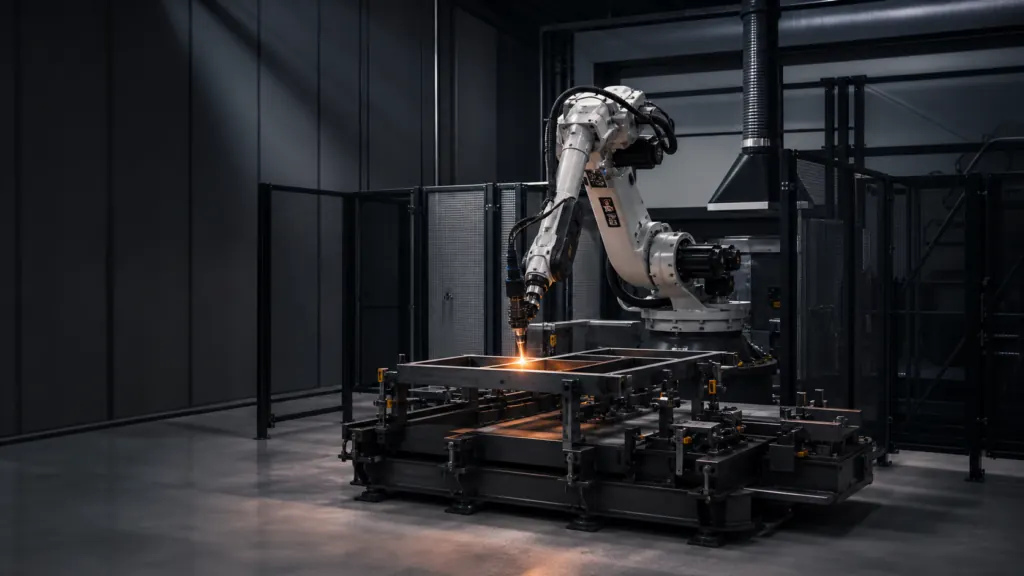
Automating welding processes with industrial robots has become a standard in modern manufacturing plants. Growing expectations for productivity, weld quality, and workplace safety are encouraging companies of all sizes to invest in robotic welding cells.
Industrial robots in welding: benefits and challenges
Automated welding helps manufacturers achieve consistent results while improving productivity and protecting employees from hazardous working conditions. Successful implementation, however, requires the right equipment, process preparation, and technical expertise.
Benefits of welding robots in production
1. Repeatability and weld quality
Robots can produce welds with the same parameters on every part, regardless of how many times the operation is repeated. This minimizes errors and operator-related variation, reduces rework, and lowers material costs.
2. Productivity and shorter production cycles
A robot can weld faster than a person and is not affected by fatigue or staff rotation. Properly designed cells can support continuous production with limited operator involvement.
3. Safety and ergonomics
Robots operate in conditions involving heat, fumes, and ultraviolet radiation, reducing human exposure to harmful factors. The operator controls the process from a safe distance and intervenes mainly during setup and maintenance.
4. Versatile applications
Modern robots equipped with sensors and offline programming can handle both simple repeatable parts and complex welded structures. Fast changeovers make them useful even for short prototype runs and variable production.
5. Production-cost optimization
Robotic cells shorten processing time, reduce waste, and provide precise control over welding material. Over time, the investment generates savings through lower labor requirements and fewer rejected parts.
Implementation challenges in robotic welding
1. Investment cost
A robot, welding power source, safety guarding, and peripheral equipment represent a significant investment. More compact and affordable systems, including collaborative robots for short production runs, are increasingly available.
2. Integration with the production line
Not every process is immediately ready for automation. Workstations may need to be rebuilt, tooling modernized, or parts redesigned to support reliable automated handling.
3. Programming and operation
Although modern robots offer increasingly intuitive interfaces, technicians still require training in path programming, sensor operation, and maintenance. Complex applications may require cooperation with an integrator or automation specialist.
4. Weld quality control
Meeting certification requirements in industries such as automotive and energy may require dedicated quality-control systems, ranging from vision monitoring to automatic process documentation.
Practical applications
• Mass production of automotive frames, structural components, and steel electrical enclosures.
• Repeatable welding operations in the appliance, energy, and construction industries.
• Long welds on steel structures where consistent quality from start to finish is critical.
• Short and variable production runs using collaborative robots, including applications in electromobility and the advertising industry.
Trends in welding robotics
• Continued development of cobots that are easier to implement and well suited to smaller companies.
• Integration of artificial intelligence and vision monitoring for adaptive process control.
• Digital documentation and complete traceability for every weld.
• Plug-and-play solutions that simplify integration with CNC machines, welding positioners, and rotary tables.
Summary
Robotic welding is an important part of efficient and repeatable manufacturing. Better quality, optimized costs, and improved safety mean that automation can be worthwhile even for smaller businesses that want to remain competitive in a rapidly changing market.