
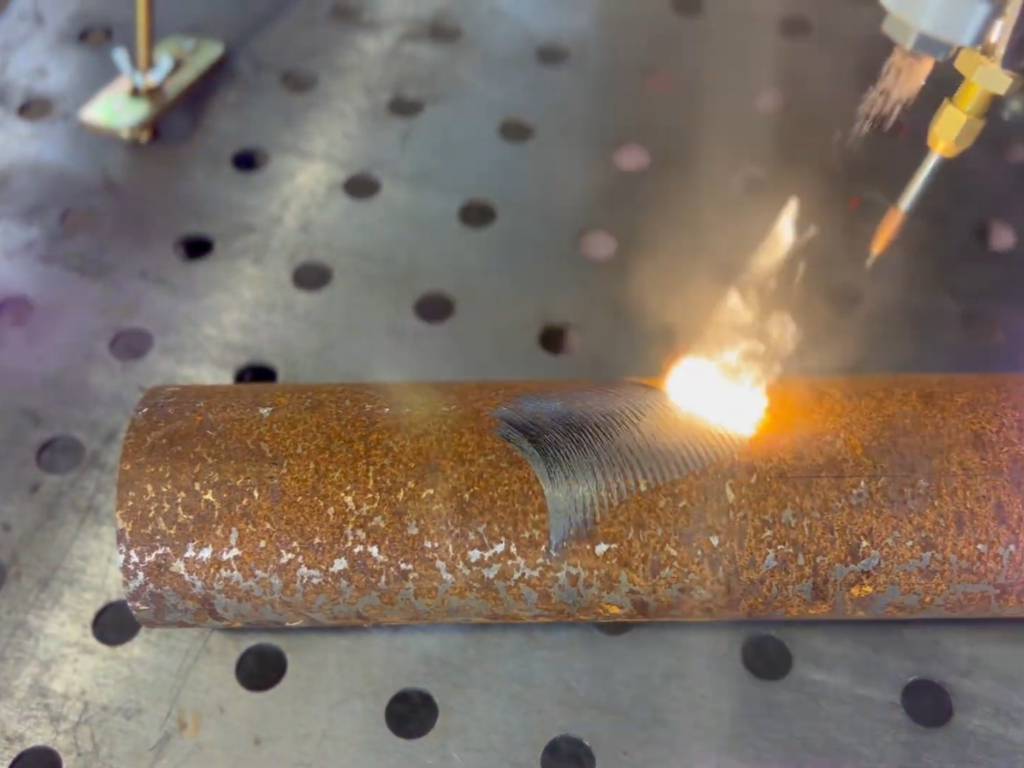
The question “how much does a laser welder cost?” has two answers. The short answer: in Polish retailers’ catalogues, as of October 2026, handheld fibre laser welders (the beam is generated and guided in glass fibre) have net list prices ranging from 19 500 zł (Cormak, SL1000 3w1) to 49 900 zł (LSC Laser, AirWeld 2500 W). This article covers the longer answer.
The machine price is the first line of the bill, not the whole bill. Before the first weld leaves the table, you need to account for screens and eyewear, extraction, gas, wire, training and workshop space. Once production starts, there are consumables, chiller fluid, electricity and servicing.
We will use the same structure as in our article on the cost of setting up a CNC workstation: numbered cost categories, distinguishing what can be calculated from list prices from what you need to estimate yourself. A worked example follows, with explicitly stated assumptions rather than market data.
1. The machine — list price ranges
We have compiled a detailed table of list prices by power class in our article laser welder prices — power and equipment; we will not repeat it here. The overall range, as of October 2026, starts at a net list price of 19 500 zł (Cormak, SL1000 3w1) and reaches 49 900 zł (LSC Laser, air-cooled AirWeld 2500 W).
Factors that move the price within this range include source power, liquid rather than air cooling, 3w1 functionality (welding, cleaning and cutting with one gun), feeder type, source brand and efficiency, and warranty length. Two machines with the same power can differ in price by well over ten thousand złoty and both be reasonably priced — they simply include different equipment.
When comparing quotations, therefore, compare what is included, not just the price. One supplier includes the feeder, chiller, spare protective windows and training; another charges separately. For example, Cormak’s catalogue lists a dual wire feeder separately at 4 400 zł net (as of October 2026).
Roboteus does not publish a standard price: the RBW 1500 laser welder is quoted for the process, meaning the material, thickness and required output. The package includes a Raycus 1500 W source, automatic wire feeder, industrial S&A chiller and gun with interchangeable optics; single-phase 230 V supply; and a declared welding thickness of up to 5 mm in carbon steel, stainless steel and aluminium. When comparing catalogue prices, add the items included here to the other quotations straight away.
2. Workplace safety and protective screens
A fibre laser is a Class 4 device. The workstation requires eyewear with an appropriate optical density for a wavelength of around 1 µm, screens or curtains limiting reflections, area signage and fume extraction (covered below). These are not optional purchases for later — the machine should not be started without them.
For reference, Cormak offers Laser Protect safety kits at net list prices of 3 600 zł (EASY), 4 200 zł (EXPERT), 4 700 zł (BASIC), 5 400 zł (PRO) and 7 500 zł (PREMIUM), as of October 2026. The kits differ in scope; before choosing, check exactly what each contains and whether it suits your workstation layout.
If the workshop already has a dedicated welding station with curtains, some costs may be avoided. If the laser will stand beside other workstations, allow for screens suitable for a Class 4 laser — an arc-welding curtain is not automatically a laser safety screen. Ask the supplier what equipment it recommends for the particular machine.
3. Welding fume extraction
Extraction belongs in the calculation for two reasons. First, operator health: fumes from welding stainless steel and coated sheet are no less concerning than arc-welding fumes. Second, the optics: fumes and spatter settle on the protective window, and a dirty window heats up and cracks. Good extraction therefore also reduces consumable costs.
For reference, LSC Laser’s catalogue lists the FC-350 extractor at 3 950 zł and the FC-700 at 7 500 zł net, as of October 2026. Selection depends on workstation size, arm length and whether extraction serves one station or several.
If the workshop already has central extraction, adding an arm may be sufficient. Otherwise, a mobile filtered extractor is the most common choice for a single station — remember to include replacement filters in the annual budget.
4. Shielding gas and wire
We deliberately give no prices here because they depend on the gas supplier, delivery format (cylinder, bundle or tank) and volume. Argon is used for stainless steel; wire is matched to the grade — ER308L and ER316L for austenitic grades 304 and 316 respectively. For autogenous butt welding, consumption is limited to gas; fillet welds and larger gaps usually require wire.
To calculate your own costs, add up weld lengths in a typical month, measure gas and wire consumption per metre during a welding trial, then multiply. The machine supplier should make such a trial possible on your parts — it is also the least expensive way to make the whole budget more realistic.
If argon back purging is required to maintain corrosion resistance on the reverse side, account for gas twice: shielding the weld face and protecting the root.
5. Consumables and the chiller
A laser welder’s consumable list is short, but no item can be omitted: protective optical windows, nozzles, feeder rollers matched to the wire diameter, coolant and cleanliness of the chiller circuit. Protective-window replacement frequency depends on the material, sheet cleanliness, gun angle and extraction quality — there is no single figure, and workshops’ experiences vary considerably.
Air cooling removes the chiller from the list but limits the duty cycle; liquid cooling requires fluid and periodic maintenance but maintains constant power throughout a shift. JM-Tronik declares water cooling and a 100% duty cycle for its LaserWeld 2000 W; the RBW 1500 has an industrial S&A chiller. This is a choice between a lower initial cost and greater machine availability, and should follow daily welding hours rather than price.
A practical tip: order spare protective windows and nozzles when buying the machine. Downtime caused by one missing protective window costs more than that stock.
6. Operator training
Training has a direct cost (one or two days at the supplier’s premises or on site) and an indirect cost: time spent learning the parameter window on your own parts, and the parts scrapped in the process. The second cost is greater and rarely budgeted.
Laser welding differs from TIG in gun movement, distance and angle; even an experienced welder cannot transfer every habit directly. Check whether training is included, how long it lasts and whether it covers your materials. Also check whether the controller and feeder menus are in Polish — they are on the RBW 1500 — because this can shorten learning more than an extra day of training.
7. Electricity
A laser welder is convenient in this respect. First, a single-phase 230 V supply, as on the RBW 1500, does not require a new connection or switchboard expansion — a cost that can come as a surprise with CNC workstations. This does not apply to every machine: some higher-powered devices need three-phase power, so check the datasheet before buying. Second, fibre sources are highly efficient: JM-Tronik declares source efficiency above 42% for LaserWeld, meaning a substantial share of the electricity becomes beam energy rather than waste heat.
The calculation also includes the chiller, which runs alongside the laser, and extraction. We give no tariffs or kWh figures because they depend on power, duty cycle and the workshop’s tariff. For a calculation, multiply nameplate input power by monthly welding hours and the rate on your electricity bill for an upper estimate; actual consumption is lower because the laser does not run at full power throughout its entire switched-on time.
8. Insurance and servicing
After the warranty, the source, gun and optics are not inexpensive to repair. Warranty and service terms are therefore part of the cost, not a formality. Published commitments help compare quotations: JM-Tronik, for example, specifies a 3/5-year warranty and 24/48 h service response for LaserWeld.
Ask what exactly the source warranty covers compared with the gun warranty; whether response time means contact or arrival on site; and whether parts are stocked in Poland. Add insurance for the machine as a fixed asset and, if your business requires it, a service contract including inspections. These amounts are individual; the example below combines them into one annual item.
Worked example — assumed figures, not market data
The figures below are assumptions used to illustrate the calculation structure. They are neither catalogue prices nor market averages. Replace them with your own quotations.
For this example, assume a workshop buys a machine in the middle of the catalogue range and equips one station from scratch.
| Item | Illustrative assumption | Frequency |
|---|---|---|
| Machine with feeder and chiller | 30 000 zł | one-off |
| Safety kit and protective screens | 4 500 zł | one-off |
| Filtered extractor | 4 000 zł | one-off |
| Operator training | 2 500 zł | one-off |
| Table, fixtures, regulator and spare consumables | 2 000 zł | one-off |
| Total one-off cost | 43 000 zł | |
| Shielding gas and wire | 3 000 zł | annually |
| Windows, nozzles, rollers, fluid and filters | 2 000 zł | annually |
| Electricity (laser, chiller and extraction) | 1 500 zł | annually |
| Post-warranty servicing and insurance | 2 500 zł | annually |
| Total annual cost | 9 000 zł |
Over an assumed 5-year period, the total cost in this example is 43 000 zł + 5 × 9 000 zł = 88 000 zł. The machine accounts for 30 000 zł, or approximately one third. The remainder is workstation equipment and operation — items usually absent from the question “how much does a laser welder cost?” but decisive for the investment budget.
Two points about this example. First, in a lower-cost setup (an air-cooled machine and a workshop with an existing welding station and extraction), one-off costs fall substantially, but thermal downtime risk increases in continuous operation. Second, annual costs scale with welding hours: they rise with two-shift operation and fall almost to zero with occasional use, leaving insurance.
How much will a laser welder cost you — what changes the result most?
Of the eight categories, three determine whether the calculation moves up or down.
Daily welding hours. They decide between air and liquid cooling and between mobile and installed extraction, and drive all annual costs. A workshop welding for two hours a day and one welding for eight are buying different machines, even if both are called a “1500 W laser welder”.
Workshop readiness. An existing welding station, curtains and extraction reduce one-off items; their absence adds amounts listed separately in catalogues to the machine price.
Package contents. An offer including the feeder, chiller, training and spare consumables may cost more than the catalogue headline price yet less overall. That is why Roboteus quotes the RBW 1500 for the process rather than from a price list — and why comparisons should cover all eight categories. See the machine range on the Roboteus laser welders page.
If the total cost seems high relative to your actual weld volume, the right question is not “which machine is cheaper?” but “buy or outsource?”. We cover this separately in laser welding — service prices versus owning a machine.
Frequently asked questions
How much does a handheld laser welder for a workshop cost?
In Polish retailers’ catalogues, as of October 2026, net list prices for handheld laser welders start at 19 500 zł (Cormak, SL1000 3w1) and reach 49 900 zł (LSC Laser, AirWeld 2500 W). Workstation equipment — safety, extraction and gas — is additional and listed separately. A full price comparison by power appears in our separate article on laser welder prices.
Do you need to buy extraction for a laser welder?
Yes, for two reasons: protecting the operator from fumes and protecting the optics, since fumes settling on the protective window shorten its life. If central extraction exists, an arm is sufficient; otherwise, use a mobile filtered extractor. LSC Laser lists the FC-350 and FC-700 at 3 950 zł and 7 500 zł net (as of October 2026).
How much does operating a laser welder cost?
Annual costs include shielding gas, wire, protective windows, nozzles, rollers, chiller fluid, extraction filters, electricity, servicing and insurance. These items scale with welding hours, so there is no single amount. The example in this article uses illustrative assumptions; substitute your own figures from a welding trial.
Is an air-cooled laser welder cheaper to maintain?
It needs neither a chiller nor coolant, removing one operating expense, and the machine is usually lighter. The trade-off is a limited duty cycle during continuous full-power welding. For occasional workshop welding it is a good choice; for shift work, the availability of a liquid-cooled machine usually outweighs this.
How much does the RBW 1500 laser welder cost?
Roboteus does not publish a list price; the RBW 1500 is quoted for the process — material, thickness and expected output. It includes a Raycus 1500 W source, automatic wire feeder, S&A chiller and gun with interchangeable optics, which should be included when comparing other machines’ list prices. A quotation requires the material, thickness and expected number of welds per shift.
Sources
- https://lsc-laser.pl/wady-i-zalety-spawania-laserowego/
- https://jm-tronik.eu/pl/maszyny/laserweld-spawarka-laserowa/
- https://roboteus.com/pl/maszyny/spawarki-laserowe/spawarka-laserowa-rbw-1500/
- https://roboteus.com/pl/maszyny/spawarki-laserowe/
Editorial note
Net list prices are quoted as of October 2026 and may change; figures in the worked example are illustrative assumptions, not market data. Process parameters and consumption depend on the particular machine, material and part preparation. This article does not replace the manufacturer’s instructions or safety regulations for Class 4 laser equipment.