
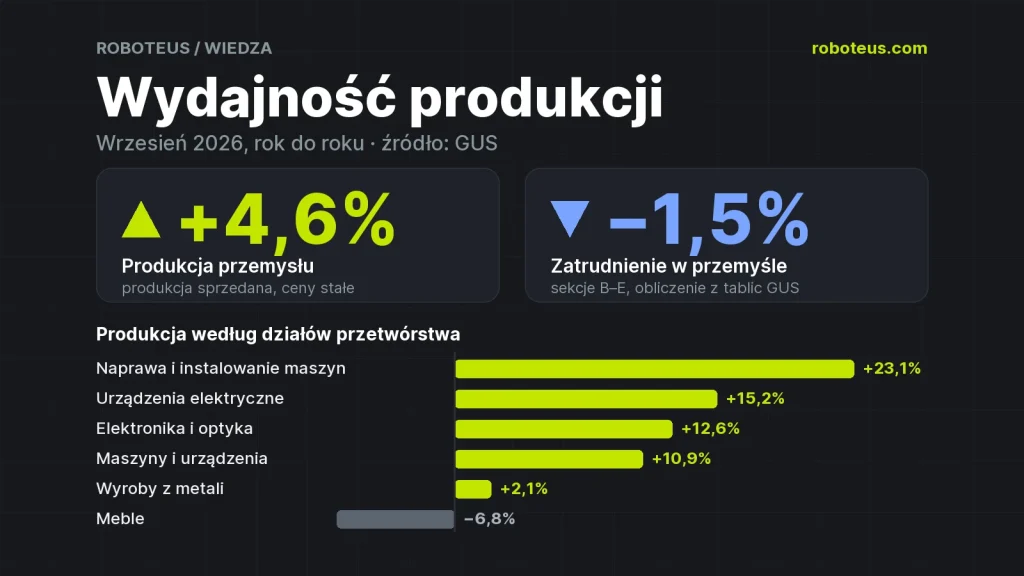
In September 2026, industrial sold production was 4.6% higher than a year earlier, and after seasonal adjustment 3.3%. In the same period, industrial employment fell by approximately 1.5% year-on-year. Economists Ignacy Morawski and Marcin Piątkowski drew attention to this divergence on 21 October: plants are producing more even though they employ fewer people.
The explanation they offer is familiar to anyone running a production facility: production efficiency is rising because companies are making better use of the machinery they already have and shifting towards sectors with higher labour productivity. Below we break down the GUS data and show what it means for a small or medium-sized plant that wants to produce more without adding headcount.
„Poland’s development model is changing before our eyes and in the right direction”
— Marcin Piątkowski (@mmpiatkowski) 21 October 2026
Marcin Piątkowski’s post cites an analysis by Ignacy Morawski on the divergence between production and employment.
1. What exactly did the GUS data for September 2026 show
Two GUS announcements published in October paint a consistent picture. Production has been growing since the start of the year (January–September up 3.6% year-on-year), while employment in the business sector is falling (in September down 0.8% year-on-year, at 6,360.4 thousand jobs).
| Indicator (September 2026, year-on-year) | Value |
|---|---|
| Industrial sold production | +4.6% |
| Production after seasonal adjustment | +3.3% |
| Manufacturing — production | +4.0% |
| Manufacturing — employment | −1.4% (2,285.9 thousand jobs) |
| Mining — employment | −9.5% |
| Industry total (sections B–E) — employment | approx. −1.5% (own calculation from GUS table) |
| Average wage in manufacturing | 8,847.10 PLN gross, +5.6% |
The business sector in GUS statistics covers firms employing at least 10 people. Micro-enterprises are not counted here, but the trend affects them too: it is increasingly difficult to find people for production, and labour costs are rising.
2. Where production is growing fastest
The average masks large differences between sectors. The strongest growth is in branches with many machines, automation and repetitive operations.
| Manufacturing sector (September 2026, year-on-year) | Production change |
|---|---|
| Repair, maintenance and installation of machinery and equipment | +23.1% |
| Manufacture of electrical equipment | +15.2% |
| Computers, electronic and optical products | +12.6% |
| Manufacture of machinery and equipment | +10.9% |
| Manufacture of metals | +6.6% |
| Rubber and plastic products | +4.1% |
| Metal products | +2.1% |
| Motor vehicles | −0.6% |
| Wood products | −1.6% |
| Furniture | −6.8% |
An interesting signal is the growth in repair, maintenance and installation of machinery. Companies are not only producing more but also spending more to keep machines running — installing new ones and maintaining old ones in operation. Meanwhile, the furniture and wood sectors, where many plants work on CNC routers, are having a weaker year and the pressure on unit cost is particularly high there.
3. Production efficiency per job — simple calculation
From these two announcements you can calculate an approximation of production efficiency in manufacturing. Production rose 4.0% while the number of jobs fell 1.4%. The ratio gives approximately 5.5% more production per job than a year earlier.
This is not an official labour productivity indicator (GUS calculates it differently, and production here is in constant prices, jobs in full-time equivalent), but the direction is clear. At the same time, average wages in manufacturing rose 5.6%. If productivity per job is not rising at least at this rate, the cost of labour per unit of output is going up.
For a plant owner the conclusion is practical: rising wages and labour shortage are not a temporary situation but a boundary condition. Companies win by extracting more productive working hours from the same hall and the same machines.
4. Where efficiency comes from: machine utilisation, not just new machines
Economists talk about „increasing the degree of utilisation of existing machine capacity”. In a plant this translates into several specific places where time is lost:
- Downtime during changeover. Tool change, material change, base setting. Automatic tool changer (ATC) on a CNC router and a fixed clamping system reduce these the most.
- Waiting for the operator. The machine has finished its cycle and is idle because the person is at another one. This is helped by automatic loading or a robot at the machine.
- One shift instead of two. An expensive machine often runs only one shift. A second shift without adding full staffing is often cheaper than a second machine.
- Defects and rework. Every piece that needs rework is machine time consumed twice.
All these losses are captured in one indicator: OEE, or availability × performance × quality. You don’t need an MES system to calculate it — just spend two weeks recording working time, downtime and defects on one machine that is your bottleneck. We write more about automation levels at machines in the article automation at CNC machines.
5. Poland against Europe: plenty of room for automation
Polish industry is growing but remains poorly robotised. According to IFR, robot density in Poland for 2023 was 78 robots per 10,000 industrial workers (28th place in the world), while the EU-27 average for 2024 is 231. The measurement years differ, but the order of magnitude of the difference is clear.
Eurostat data for 2022 show where the gap is. Industrial robots were used by 3.66% of Polish firms employing at least 10 people (in EU-27: 4.85%). In large firms (250 people and more) this is already 27.08%, in medium firms 7.72%, and in small firms (10–49 people) only 1.93%. Automation in Poland today is the domain of large plants — small and medium-sized ones have the greatest potential to improve production efficiency.
The Polish Economic Institute points out something important: labour shortage in Poland is an impulse for automation, and research shows no effect of robots replacing people. A robot or cobot typically takes on work for which it is difficult to find people anyway, and experienced workers move to operating multiple machines, quality control and setup.
6. How to increase production efficiency in a small plant — five steps
- Choose one machine — the bottleneck. This is the one orders wait for. Improvement elsewhere will not speed up the whole plant.
- Measure where time is lost. Two weeks of records: work, changeovers, waiting for operator, breakdowns, defects. The result will show whether the problem is availability, speed or quality.
- Start with organisation. Fixed clamping, tool preparation before the job, programmes prepared outside the machine. This costs the least.
- Automate the operation that repeats every shift. Loading and unloading parts, palletising, simple welding of repetitive elements. For lighter parts at the machine a cobot works well — for example cobot RBR 0805 from 16,259.00 PLN net (indicative price, process-specific configuration). For heavier tasks — industrial robot RBR 2110 from 34,146.00 PLN net. Remember that the price of the arm is not the price of the workstation: gripper, guards or scanners, integration and programming are added, and whether the robot can work alongside people is determined by risk assessment of the entire workstation.
- Calculate payback before buying. How many additional productive machine hours will the change give, what is the cost per hour of machine and labour, how will the cost per piece change. We can help with this as part of production automation with Roboteus.
7. Financing: robotisation relief and leasing
The robotisation relief allows you to deduct 50% of qualified costs from the tax base (Article 38eb of the CIT Act, Article 52jb of the PIT Act) — robot, peripheral equipment, safeguards, training. Under current rules it covers costs until the end of the tax year beginning in 2026.
A government bill (parliamentary paper no. 3149) extends it to 2022–2036, taking effect from 1 January 2027. As of 21 October 2026: the bill is after first reading, the committee presented its report on 20 October, but the law has not yet been passed. Before deciding on a purchase date it is worth checking this with a tax adviser. We write about leasing machines and robots on the page financing machine purchases.
Frequently asked questions
Why is production growing while employment is falling?
According to GUS data for September 2026, industrial production rose 4.6% year-on-year while industrial employment fell by approximately 1.5%. Economists explain this by production shifting to sectors with higher labour productivity and better utilisation of machinery that firms already have.
How do I increase production efficiency without hiring new people?
Start with the machine that is your bottleneck and measure where it loses time: changeovers, waiting for operator, defects. Then shorten changeovers, prepare programmes outside the machine and automate the operation repeated every shift, e.g. loading parts.
What is OEE and why calculate it?
OEE is a machine utilisation indicator: availability × performance × quality. It shows what fraction of theoretical working time produces good products and indicates which loss is worth removing first.
Does a robot pay for itself in a small firm?
It depends on task repeatability and number of shifts. It pays back fastest where the machine is idle waiting for an operator or where it is hard to find people for monotonous work. Calculate the cost of the entire workstation, not just the arm.
Sources
- https://stat.gov.pl/obszary-tematyczne/przemysl-budownictwo-srodki-trwale/przemysl/produkcja-sprzedana-przemyslu-we-wrzesniu-2026-r-,13,93.html — GUS, industrial sold production in September 2026 (announcement and table)
- https://stat.gov.pl/obszary-tematyczne/rynek-pracy/pracujacy-zatrudnieni-wynagrodzenia-koszty-pracy/przecietne-zatrudnienie-i-wynagrodzenie-w-sektorze-przedsiebiorstw-we-wrzesniu-2026-r-,3,178.html — GUS, employment and wages in the business sector in September 2026 (tables 1 and 2)
- https://x.com/mmpiatkowski/status/2112814775000240361 — Marcin Piątkowski’s post with quote from Ignacy Morawski, 21.10.2026
- https://ifr.org/ifr-press-releases/news/robot-density-surges-in-europe-asia-and-americas — IFR, robot density 2024
- https://fairp.pl/wp-content/uploads/2024/10/IFR2024-_robotyzacja-1.pdf — Polish Automation and Robotics Forum, IFR data for Poland
- https://ec.europa.eu/eurostat/api/dissemination/statistics/1.0/data/isoc_eb_p3d — Eurostat, robot use by enterprises
- https://pie.net.pl/wp-content/uploads/2024/07/2024-07-03_Polski-przemysl-potrzebuje-wiecej-robotow.pdf — PIE, „Polish industry needs more robots”
- https://www.podatki.gov.pl/ulgi-i-odliczenia/ulga-na-robotyzacje-cit — robotisation relief in CIT
- https://api.sejm.gov.pl/sejm/term10/processes/3149 — progress of work on bill extending relief (paper no. 3149)
- https://roboteus.com/pl/automatyzacja/
- https://roboteus.com/pl/maszyny/roboty-przemyslowe/
Editorial note
GUS data are preliminary and may be revised in subsequent publications; calculations of efficiency per job and total industrial employment are our own calculations based on GUS tables. Roboteus prices are indicative and depend on configuration. This text is not tax or legal advice and does not replace workstation risk assessment or occupational safety regulations.