
Industrial automation is one of the most important processes to have transformed manufacturing in recent decades. Thanks to the rapid development of CNC technology, modern plants are moving from operator-controlled workstations toward fully automated smart factories.
CNC automation: from a single machine to a smart factory
Industrial automation has revolutionized manufacturing. The continuing development of Computerized Numerical Control allows companies to move from a simple workstation supervised by an operator to an integrated, data-driven production environment. How does this transformation work, and why is it so important to the modern economy?
The beginnings of automation in CNC manufacturing
The first CNC machines represented a breakthrough in accuracy, repeatability, and the ability to produce complex geometries. Early automation mainly involved digital control of the machining process, while the operator still supervised most activities, including setting up the part, changing tools, and collecting the finished product.
Integration and the first step toward automated lines
Automation accelerated with the development of peripheral systems:
• automatic tool magazines and pallet changers were introduced,
• automated part transport systems such as feeders and conveyors became available,
• CNC machines were integrated with ERP and MES platforms to provide a continuous flow of production information.
These solutions shortened production cycles and reduced dependence on manual intervention.
Robotics: a new chapter in automation
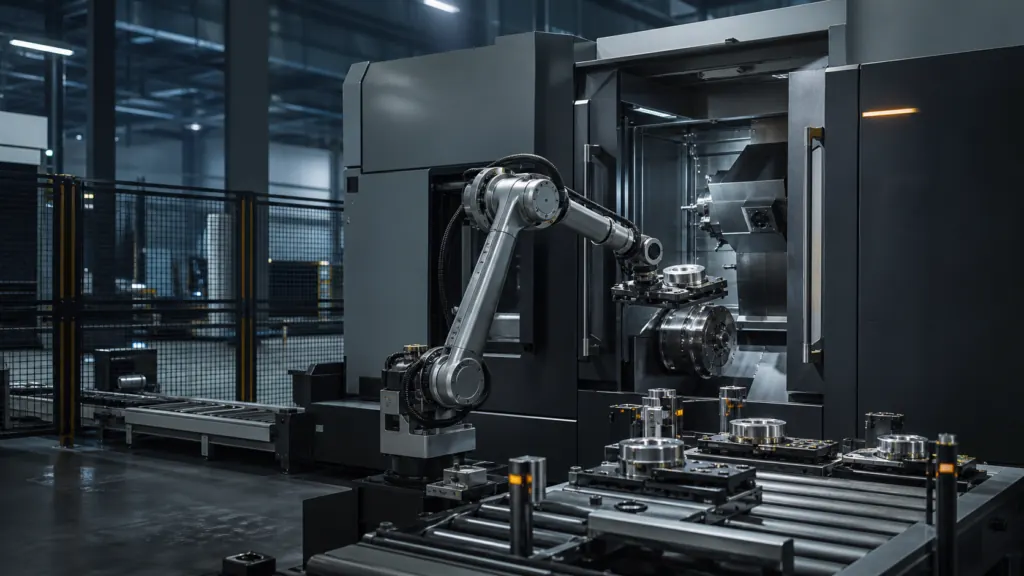
A major breakthrough came with industrial robots and collaborative robots performing repeatable tasks around CNC machines:
• feeding and collecting workpieces,
• loading and unloading machines and handling tools,
• performing quality checks or simple auxiliary operations such as cleaning and marking.
A machine that previously required the constant presence of an operator could now become part of a fully automated production cell. Combining CNC equipment with robots increases productivity, reduces errors, and optimizes labor costs.
The smart factory: digitalization, flexibility, and prediction
Today, the development of a smart factory is based on four main pillars:
• Production digitalization — machines and systems are connected through the Internet of Things, collect real-time data, and make it available in the cloud or central databases.
• Advanced monitoring and data analysis — including OEE analysis, operating-parameter tracking, and rapid responses to alarms.
• Predictive maintenance — artificial intelligence predicts failures or the need to replace components before an actual breakdown occurs.
• Production flexibility — machines and lines can be reconfigured dynamically, allowing new products or production batches to be introduced quickly.
Modern automation can combine milling machines, laser cutters, welding equipment, robots, and vision-inspection systems into one production ecosystem managed from an office or even a mobile device.
Benefits of implementing CNC automation
• Productivity: greater output with the same number of employees.
• Repeatability and quality: fewer human errors and better control of process parameters.
• Scalability: production cells can be expanded with additional machines or robots.
• Safety: less human involvement in hazardous processes and improved workplace ergonomics.
• Cost reduction: less downtime and more efficient use of materials and energy.
The future of automation
New challenges are emerging alongside advanced control algorithms, artificial intelligence, and the need for rapid data transfer. Important future developments include:
• autonomous production lines that manage the flow of parts independently,
• integration with cloud manufacturing systems,
• machines and robots that learn from thousands of completed operations.
Summary
CNC automation is a dynamic process that combines advanced technologies with the ability to implement solutions suited to the scale and needs of each company. The path from a single computer-controlled machine to a fully integrated smart factory is increasingly accessible to small and medium-sized manufacturers seeking to develop in line with Industry 4.0.
This direction is worth watching closely. Technology is advancing faster than ever and creating new growth opportunities across manufacturing industries.