
Before someone asks about the price of a welding machine, they typically type "laser welding pros and cons" into a search engine and get a list of terms: fast, precise, aesthetically pleasing, expensive. The list is true, but it doesn't explain why or at what point the pros turn into cons.
This article goes a step deeper. It describes what happens between the laser source and the weld, the differences between the two heat input modes, the purpose of wobble, shielding gas, and wire, and the thicknesses a handheld welder can actually weld. Only then can you assess whether a laser is suitable for a specific application.
We'll briefly discuss the disadvantages here—a full list of technological limitations can be found in a separate article on the disadvantages of laser welding . The key here is to understand the mechanism, because it determines everything you see on the sheet metal.
How Laser Welding Works: From Source to Weld
Laser welding involves joining metal with heat delivered by a focused beam of light, rather than an electric arc. Today, handheld welding machines almost exclusively use fiber lasers (the Polish terms for fiber and fiber-optic lasers refer to the same source type), and this same type of source is most often used in robots. Both terms mean the same thing and will be used interchangeably.
The fiber source generates a beam in a doped glass fiber excited by diodes. The radiation has a wavelength around one micrometer. This is important for occupational health and safety, as it is invisible to the naked eye and requires glasses adapted to this range. The beam exits the source via a fiber optic cable, a flexible optical cable, and reaches a welding gun or a head on a robot.
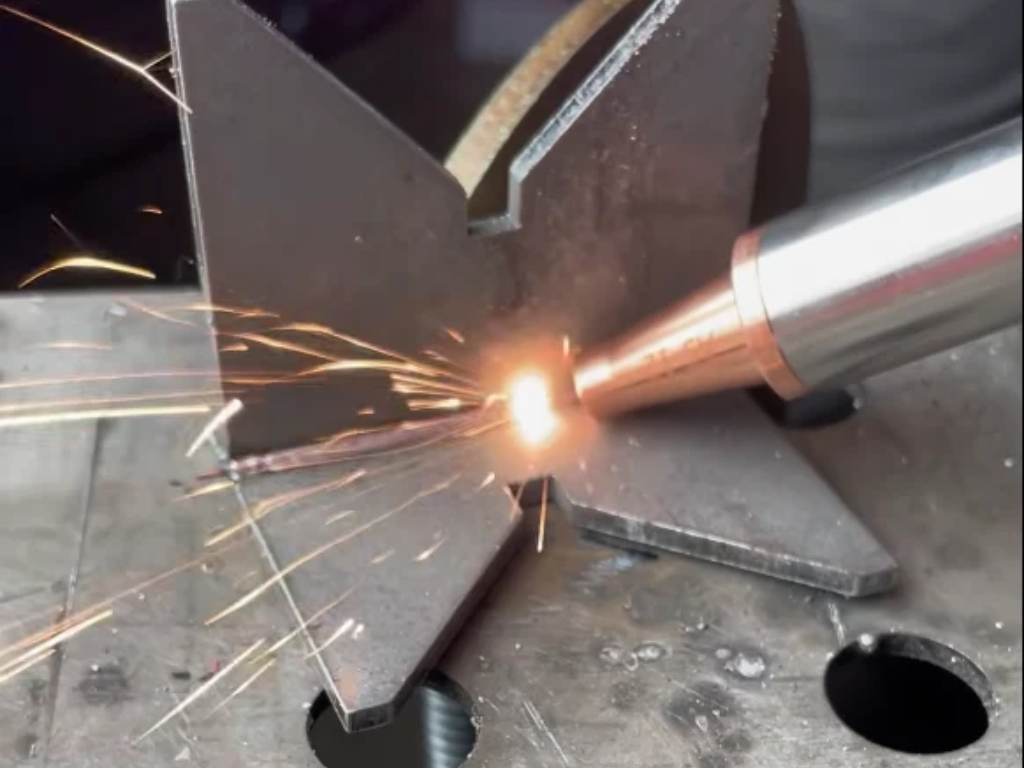
In the gun, the beam is collimated and focused by a lens into a very small diameter spot. This same power, concentrated into a small area, produces an energy density that melts the metal almost instantly in a narrow band. An operator or robot moves the spot along the joint, and the molten metal behind it solidifies into a weld. The final element in the path is the protective window, which covers the lens from the material side—a consumable part that absorbs spatter and is replaced regularly.
The rest of the workstation consists of peripherals necessary for the laser to operate: a chiller to cool the source and gun, a wire feeder, a shielding gas cylinder, fume extraction, and station enclosures. For example,the RBW 1500 laser welder includes a Raycus 1500W source, an industrial fluid chiller, a 230V single-phase power supply, and an automatic wire feeder—a complete package for operation from a single outlet.
Conduction Mode and Keyhole Mode: Two Ways to Inject Heat
The way the beam enters the metal depends on the power density in the spot. At lower density, heat penetrates the material through conduction—this is conduction mode. The weld pool is shallow and wide, the weld face is smooth and aesthetically pleasing, and the penetration is limited. This method is used to weld thin sheets, housing corners, and anything where the appearance of the weld face is important.
At higher power density, the metal in the center of the spot vaporizes, and the vapor pressure opens a narrow channel, called a keyhole. The beam penetrates this channel and melts its walls, resulting in deep and narrow penetration: the ratio of weld depth to width is much greater than in conduction mode. This deep penetration mode is used when a thicker cross-section needs to be melted in a single pass.
In practice, both modes transition seamlessly into each other, with the power, tracing speed, focus position, and material being the deciding factors. Keyhole is more efficient but less stable: the unstable channel opens and closes, leaving pores in the weld. Therefore, according to the materials of one laser welding machine manufacturer, cracks and porosity appear outside the narrow parameter window, and the technology itself is not forgiving of accidental settings.
Wobble, Shielding Gas, and Wire: What Each Does
Wobble is a beam oscillation: the head rapidly moves the spot across the welding direction, so instead of a straight line, it draws a zigzag or a series of circles on the material. The weld becomes wider, and the heat is distributed more evenly. The practical benefit is one, but significant: a wider bead tolerates a larger gap between the elements and poorer fit. In the RBW 1500, the „arc width” adjustment is precisely the wobble setting.
A shielding gas, most often argon, separates the molten metal from the air. Without it, atmospheric oxygen and nitrogen enter the weld pool, leaving colored oxide deposits on stainless steel, and pores and brittle phases on other materials. The gas also serves a second purpose: it blows away the metal vapor cloud above the weld pool, which would otherwise absorb and scatter the beam, and its deposits would land on the protective window.
Wire is not required. A butt weld on well-fitted sheets can be made without filler material, simply by fusion. Wire is fed when a gap needs to be filled, a fillet weld with a specific cross-section needs to be created, or the weld composition needs to be matched to the material, for example, low-carbon wire for stainless steel. The feeder must have rollers matched to the wire diameter, and the feed speed is one of the adjustable parameters, along with power and frequency.
Continuous and pulsed modes are another control option. In pulsed mode, the beam is delivered in batches, reducing the average heat output and is useful for thin sheet metal, edges, and spot welds. Continuous mode produces a more even weld and higher speeds for longer joints.
Advantages and Disadvantages of Laser Welding – Balance Without Marketing
The advantages stem directly from the physics described above. The heat is delivered to a narrow band, so the heat-affected zone is small, and the workpiece around the weld remains significantly cooler than at the arc. Another manufacturer cites four main benefits: high operating speed, limited heat-affected zone, joint aesthetics, and repeatability—noting that actual performance depends on the joint material, thickness, and geometry.
What this means in the workshop: less distortion of thin sheet metal, less straightening, less grinding of the stainless steel face, and a shorter weld time. According to one manufacturer’s materials, laser welding efficiency can be up to ten times greater than TIG, and the precision and minimal deformation are incomparable to TIG. This is the manufacturer’s declaration, not the result of an independent measurement, but the direction matches what is seen in practice on thin stainless steel sheet.
Disadvantages also stem from physics. Concentrated energy means a narrow parameter window: outside this window, there is either no fusion or burn-through, pores, or cracks. A narrow spot means sensitivity to gap and edge preparation, greater than in MIG, where the arc and wire are more forgiving of inaccuracies. Shiny metals (aluminum, copper) reflect the beam, and zinc on galvanized sheet evaporates in the weld; one laser welding machine manufacturer calls aluminum and galvanized metal the greatest challenge of this technology.
In addition, there is the cost—according to the same source, the investment is two or three times higher than in MIG/TIG—and the occupational health and safety of a Class 4 laser: goggles, shields, extraction.
We have outlined the mechanism behind each of these drawbacks, along with what can be done about them, in the article on the disadvantages of laser welding, which we referenced at the beginning. Here, just remember the principle: laser welding offers an advantage when the process is set and repeatable; when working by eye, the advantage disappears more quickly than with MIG welding.
Materials and Thicknesses: What a Handheld Welder Can Actually Weld
Thickness range is determined primarily by the power source, followed by the material and operating mode. Manufacturers declare: the RBW 1500 with a 1500 W power source welds mild steel, stainless steel, and aluminum up to 5 mm thick. One Polish manufacturer claims its 2 kW welder achieves full penetration up to 6 mm. Above these thicknesses, a handheld welder requires edge preparation and multiple passes, or is replaced by traditional methods.
Stainless steel is the material on which lasers show the greatest impact: low heat input reduces discoloration and the risk of intergranular corrosion sensitivity, and the surface often requires no grinding. We expand on this topic in the article onlaser welding of stainless steel. Mild steel welds easily as long as the edges are clean—scale, oil, and paint can cause pores.
Aluminum and copper are more difficult: high thermal conductivity quickly dissipates energy, and their shiny surface reflects some of the beam, which poses both a hazard to the operator and a technological challenge. Galvanized steel requires zinc vapor to be vented away from the weld; otherwise, the gas remains in the metal. These materials are not excluded, but they require experience, testing, and usually wobble.
Where Laser Welding Works: Applications
The most natural application is thin sheet metal and stainless steel structures: housings, control cabinets, boxes, countertops, frames, and balustrades. The weld is narrow and aesthetically pleasing, and the workpiece does not require straightening. Where the surface is visible, saving on grinding can be a greater advantage than the welding speed itself.
The second field is thin-walled frames and profiles: pipes, sections, furniture structures, and light industrial structures. The laser connects walls without melting them through, which a thin profile cannot forgive with an arc. The third field is tanks and sealed elements made of thin sheet metal, where a uniform, continuous, pore-free bead is essential for leak-tightness.
The fourth field is service and prototyping: repairing a workpiece without disassembling the entire assembly, welding a support, or quickly assembling a prototype. The advantage here is different—the low heat input doesn’t damage adjacent components or coatings. One Polish machine distributor in its guide also lists automotive, aerospace, and electronics as industries where laser welding is widely used. However, where thick, full-section welds and purely structural welds are important, classic MIG/MAG is still more sensible.
Manually or Robotically
A handheld laser welder is a pistol in the operator’s hand: flexibility, access to difficult areas, and part changes without programming. Its limitations include hand-dependent repeatability, fatigue during long welds, and the requirement for complete occupational health and safety for the person standing at the beam. We discuss who this type of machine is suitable for and who isn’t in our article onhandheld laser welders.
The same head mounted on a robot provides what a hand cannot: identical speed and angle in every repeat of a series, work in a closed cell, and no fatigue. However, it requires fixtures that position the workpiece exactly the same every time, as the laser will not forgive a gap the robot cannot see. In the Roboteus catalog, the RBW 1500 is paired with the six-axis RBR 0805 cobot, programmable by hand; you can find the full range inthe Roboteus laser welding machines section.
A simple rule: manually when the workpieces are different and the series are short; robotically when the same workpiece returns in large numbers and is to have an identical weld.
What to Check Before Making a Decision
Before you compare offers, answer four questions.
- What material and what thickness dominate in production—because this determines the power and mode.
- What is the quality of the workpiece preparation—because the gap determines whether the laser will work at all without wire.
- Should the face be visible—because then aesthetics and the lack of grinding are the main benefit.
- How many workpieces of the same type come back—because this is the deciding factor between manual and robotic.
With this process described, request a trial on your own material. There is no list price for the RBW 1500—there is a per-process quote, for the same reasons: material, thickness, and number of welds change the workstation setup more than the wattage itself.
Frequently Asked Questions
Laser Welding – Advantages and Disadvantages: What Prevails in a Small Workshop?
The advantages prevail where thin sheet metal, stainless steel, and a visible face dominate, and the workpieces are well-prepared: the benefits include speed, a small heat-affected zone, and no grinding. The disadvantages—narrow parameter window, gap sensitivity, higher cost, and Class 4 occupational health and safety regulations—are most significant when working in batches with poorly fitted workpieces and thick cross-sections. A full list of limitations is provided in the article on the disadvantages of laser welding.
Does a Laser Welder Weld Aluminum?
Yes, aluminum is listed in the RBW 1500 specification alongside mild and stainless steel, up to 5 mm thick. However, it is a more difficult material: it reflects the beam and dissipates heat quickly, so it requires carefully selected parameters and usually wobble. Before purchasing, it is worth testing it on your own alloy and thickness.
Is Wire Needed for Laser Welding?
Not always. A butt weld on well-fitted sheets is made by fusion alone, without any filler material. Wire is needed to fill a gap, create a fillet weld, and when the weld composition is to be different from the parent material.
Is Laser Welding Faster Than TIG?
This is clearly the case with thin sheets and straight welds. According to one manufacturer’s materials, the efficiency can be up to ten times greater than with TIG; another manufacturer notes that the actual gain depends on the material, thickness, and geometry of the joint. In addition to the gains in welding itself, there is also less post-weld processing, as the weld face usually does not require grinding.
What Thickness Can a Handheld Laser Welder Weld?
It depends on the power source: RBW 1500 (1500 W) welds steel and aluminum up to 5 mm, while a 2 kW welder from one Polish manufacturer claims to achieve full penetration up to 6 mm. Thicker cross-sections require edge preparation and multiple passes or a different method.
Does Laser Welding Require Special Occupational Health and Safety Regulations?
Yes. A fiber laser is a Class 4 device: glasses with an optical density matched to a wavelength of approximately one micrometer, workspace shielding, and fume extraction are required. Reflections from shiny metals are a real hazard, so shielding also applies to walls and the surrounding area, not just the operator’s eyes.
Sources
- https://roboteus.com/pl/maszyny/spawarki-laserowe/spawarka-laserowa-rbw-1500/
- https://roboteus.com/pl/maszyny/spawarki-laserowe/
Editorial Note
Manufacturers’ declarations and list prices quoted in the text are subject to change; please verify them at the source before making a decision. Process parameters and thickness ranges depend on the specific machine, material, and workpiece preparation—the values provided are manufacturer declarations for their equipment. This text does not replace the manufacturer’s instructions or occupational health and safety regulations for working with a Class 4 laser.