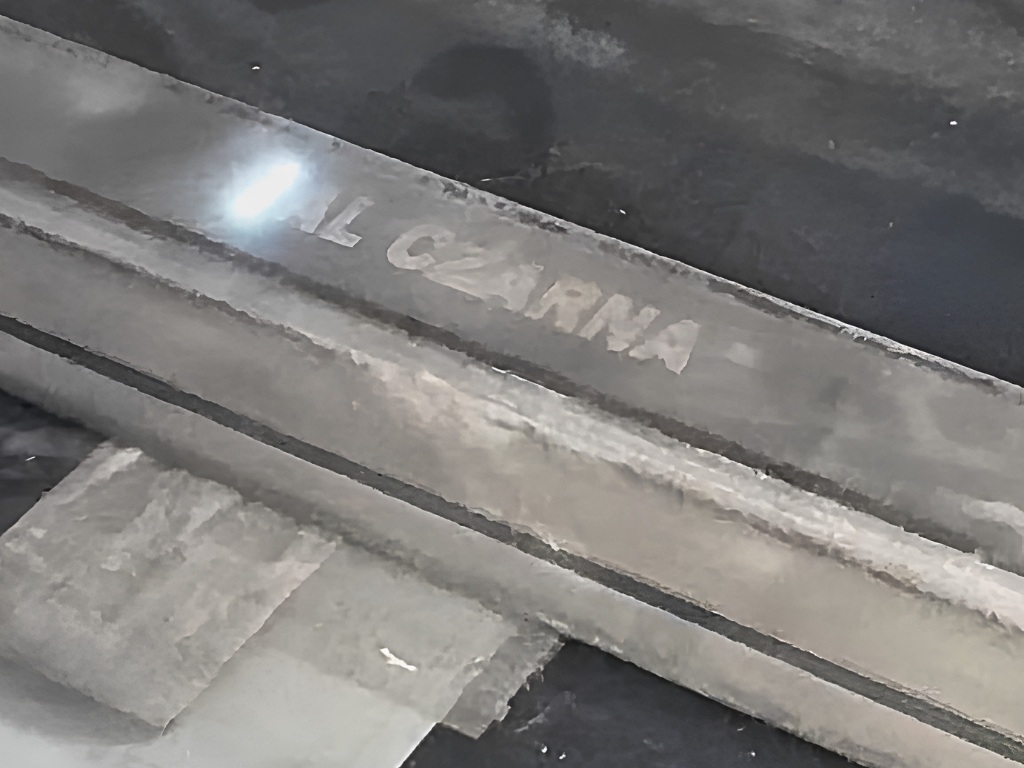
Ask three suppliers for a sample and you may get a smooth black inscription on stainless steel, a recessed number on tool steel and a bright matt logo on anodised aluminium. All three can be made with a 1064 nm fibre laser. Each uses a different process, takes a different amount of time and responds differently to finishing. The parameters below show which direction to adjust. The figures come from JPT and the equipment manufacturers identified as A–H in the Polish source.
Choose the effect before setting parameters
| Effect | Process and surface change | Material removal | Suitable materials | Parameter direction |
|---|---|---|---|---|
| Dark mark | Annealing forms an oxide without melting the substrate | None. Manufacturer D typically reports oxide under 300 nm | Stainless steel, titanium, steel | Slow scan and strong defocus to lower power density. Manufacturer C uses full power in its example |
| Deep engraving | Repeated ablation vaporises metal and displaces molten material towards the rim | Typically 10–50 µm according to A, deeper with repeated passes | Steel, stainless steel, titanium, brass, aluminium | High pulse energy, in focus, rotate hatch between passes |
| Bright surface mark | Shallow ablation or remelting roughens the surface or removes a coating | Minimal | Steel, galvanised steel, anodised aluminium, hardened steel | At or just off focus, fast scan, moderate power |
| Colour | Thin-film interference in a controlled oxide layer | None | Stainless steel, titanium | Adjust MOPA pulse duration, frequency and focus to suit the colour |
1. Smooth black marks: annealing stainless steel and titanium
The beam heats the surface without vaporising metal. According to JPT, iron and chromium oxides grow on steel and can absorb visible light with very little reflection at the right thickness. Manufacturer D describes oxygen diffusing into the metal, an unchanged roughness and an oxide layer usually below 300 nm. JPT recommends slower scanning to allow oxide growth. Manufacturer C describes substantial defocus, very low speed and full power on its setup. The wider spot limits power density. Additional passes can darken the mark, but the cited supplier does not establish greater durability.
Manufacturer A reports that engraving can be faster because it uses high repetition rates. Manufacturer G says annealing leaves the part's dimensions and mechanical properties unchanged, which helps explain its use on surgical tools and food equipment. Manufacturer D limits the process to titanium, steel and stainless steel. This type of black annealing does not work on aluminium.
2. Deep laser engraving on steel: repeated ablation
Focused pulses vaporise metal. Manufacturer A describes a tapered U-shaped recess with molten material forced towards the rim by vapour pressure. Typical engraving depth is 10–50 µm. Moulds and VIN markings can reach millimetre depths with many passes. For stainless steel, manufacturer B recommends high power and low frequency to raise the energy per pulse.
Manufacturer B gives two tests on a 5 × 5 mm area using a 20 W MOPA source and an F-160 lens, targeting 200 µm:
| Approach | Speed | Frequency | Pulse | Passes | Time | Depth | Distortion |
|---|---|---|---|---|---|---|---|
| Fast | 250 mm/s | 60 kHz | 200 ns | 32 | 112 s | 200–240 µm | Up to 100 µm |
| Quality | 900 mm/s | 180 kHz | Not stated in the article | 450 | 375 s | 200–220 µm | None reported |
The second test took more than three times as long at comparable depth. It distributed heat across more passes. As the bottom moves away from focus and molten metal and oxide accumulate, cycle time grows faster than depth. Rotate the hatch angle between passes to avoid ridges and clean oxide from the recess to recover contrast. One reseller gives 20–50 W as a rough range for routine marking and 50–100 W for deeper work. Treat that as commercial guidance.
3. Bright surface marks: matt and white
Shallow ablation in focus produces a matt surface that scatters light. Manufacturer A cites white marks on galvanised steel and good contrast on dark hardened steel. Manufacturer C describes a moderate-power polishing setting for stainless steel that leaves a bright mark without a visible recess.
JPT explains that a fibre laser can remove or bleach dye in anodised aluminium. The mark stays within the anodic layer. Manufacturer C describes widening the spot by defocusing to make a very bright mark. JPT calls a bright mark on dark anodising the easiest result and recommends MOPA for a dark mark on light anodising. Lighting affects contrast. Use a verifier for machine-readable codes. See metal marking and DataMatrix codes.
4. Colour on stainless steel: MOPA and oxide thickness
JPT attributes gold, brown, violet and blue to thin-film interference. Colours shift with changes of tens of nanometres in oxide thickness. Titanium forms its own oxides. Manufacturer C reports vivid colours on bare metal, especially titanium, when varying frequency across 1–100% of its available range, with focus among the main factors.
MOPA makes pulse duration an independent setting, according to G. Manufacturer H gives around 100 ns for a conventional Q-switched fibre laser and 2–500 ns for its MOPA range. Manufacturer F describes 1–350 ns and frequencies above 1 MHz for colour marking AISI 304 with a 30 W source. Manufacturer G reports repeatable colours on stainless steel and titanium with MOPA. A conventional fibre source remains a less expensive choice for simpler jobs. Start with a test grid and keep material batch, surface finish and focus consistent.
Aluminium, brass and copper
Manufacturer C reports shades of grey on bare aluminium and uses an oxidising agent after engraving to obtain black. It reports that 2D codes in grey are still readable and verifiable. Manufacturer H describes MOPA black marking without damaging the protective oxide. It uses a different, more expensive source.
Fibre lasers engrave brass directly. Manufacturer C uses focus and a higher frequency than for annealing steel. Copper, silver and gold reflect much of the 1064 nm beam. One supplier recommends UV for these metals, although fibre is often faster, and manufacturer B includes copper among fibre-compatible metals. Test your alloy and surface finish. On plated parts, removing the coating can create strong contrast with the substrate.
CO₂ on metal: marking compound or anodised stock
Bare steel, brass and aluminium reflect much of a 10.6 µm CO₂ beam. For bare metal, manufacturer B describes using a ceramic compound such as CerMark or LaserBond, which bonds to the surface under the laser. CO₂ can also mark anodised aluminium by removing the coloured layer. A compound adds application, drying and washing and gives neither depth nor an annealed mark. GMgraw's October 2026 Polish list prices, excluding tax, were PLN 2.00/cm² for fibre and PLN 4.00/cm² for CO₂ with CerMark. A compound can make sense for occasional plates on an existing CO₂ machine. Use fibre for serial metal marking.
Durability and process order: passivation, paint and blasting
Recessed engraving survives finishing if it is deeper than the material removed or added. Thin plating or blasting may leave a deep mark legible. Thick powder coating can fill a typical 10–50 µm recess. An annealed mark lies in the oxide layer and can disappear after grinding, blasting or painting. Mark after finishing or engrave deeper where the process allows.
The cited suppliers make different claims about corrosion. JPT says the chromium oxide layer stays intact and reports lower crevice corrosion risk for annealing than engraving. Manufacturer D says the passive layer reforms spontaneously after annealing. The Polish article found no independent comparative study. Manufacturer E warns that nitric acid passivation can remove laser marks and recommends testing at the machine. It reports dark marks that withstand passivation and autoclaving on 300-series stainless steel with a nanosecond fibre laser, with UV or picosecond sources for harder cases. D says passivation after marking can weaken the mark. Agree the final surface operation with quality assurance and test the whole sequence.
Common mistakes
- Reusing settings on another alloy or finish. Brushed, polished and rolled stock respond differently.
- Using the engraving focus for annealing. The same energy concentrated at focus can vaporise metal.
- Trying to get depth in one pass. Too few passes can distort the part. A fixed hatch angle can leave ridges.
- Omitting extraction. Oxide dust can contaminate optics, which may heat up and crack.
- Marking before passivation or painting without a trial.
- Ignoring reflections from copper, brass or aluminium. An open galvo head is a Class 4 laser system. Use appropriate 1064 nm eye protection and guarding. CIOP-PIB warns that even diffuse reflections can be hazardous. See how to choose a laser marker.
- Estimating time from scan speed alone. Include area and all passes.
Which machine to choose
A stationary galvo fibre marker suits dark marks, bright surface engraving and moderate depth. The RBZ 2020 fibre marker uses a 50 W Raycus source and an M6 fixture grid, with an optional rotary axis for cylindrical parts. Specify MOPA for repeatable colour on stainless steel. For very deep engraving, discuss power and cycle time when requesting a quotation. See the Roboteus laser marker range and the comparison of laser marking with printing. Test your own part in the final process order and check it with a scanner or verifier.
Frequently asked questions
### How do you make a black mark on stainless steel?
Anneal with a slow scan and a defocused spot. One supplier uses full power with substantial defocus. The wide spot limits power density and allows the oxide to grow. The result is smooth and can be lost during grinding or nitric acid passivation.
### How deep can a fibre laser engrave?
Manufacturer A gives a typical depth of 10–50 µm. The 20 W example reached about 200 µm with 32 or 450 passes, with very different distortion and cycle times. Millimetre-scale engraving needs longer cycles and typically more power.
### Does metal laser engraving wear off?
Recessed marks withstand finishing shallower than the recess. Annealed and bright surface marks can disappear during grinding or blasting. The sources do not give abrasion cycle counts. Test critical parts.
### Can a CO₂ laser engrave metal?
Bare metal reflects much of the beam. A ceramic marking compound allows a surface mark. Anodised aluminium can be marked through its coloured layer. Fibre is the usual choice for serial marking on steel and aluminium.
### Can an annealed stainless steel mark rust?
The suppliers cited report that passivity is retained or restored, but the article found no independent comparison. Test corrosion resistance and passivation on the final grade for medical or food equipment.
Sources and editorial note
- https://roboteus.com/en/machines/znakowarki-laserowe/fiber-laser-marker-rbz-2020/
- https://roboteus.com/en/machines/znakowarki-laserowe/
- https://jpt-laser.com/applications/laser-annealing-marking/
- https://jpt-laser.com/learn/laser-engraving-anodized-aluminum/
- https://gmgraw.pl/cennik-uslug/
- https://webgate.ec.europa.eu/udi-helpdesk/en/udi-carrier/direct-marking.html
- https://www.ciop.pl/CIOPPortalWAR/file/99433/Ochrona_przed_promieniowaniem_laserowym_MatInf_M.Okrasa_I.PN.06.pdf
Prices and supplier claims can change. Depth, contrast, colour and cycle time depend on the machine, source, alloy and surface finish. The figures describe the cited equipment. Follow the manufacturer's instructions and applicable Class 4 laser safety rules.