Today, stores sell everything under the banner of „laser engraver”: from an open frame with a diode module to a fiber laser marker in a Class 1 housing, or a CO2 laser plotter with a field covering the entire tabletop. The word „laser” unites them all. The differences are wavelength, which determines which materials will absorb the beam, and then power, speed, safety, and what wears out.
This text organizes four sources: diode (approx. 455 nm), CO2 (10.6 µm), fiber (1064 nm), and UV (355 nm): a materials table, a "don't use" list for each type, list prices, and a six-question selection guide. It's written for a company: a laser engraver in a plant needs to be profitable in batches and be located in a hall with people, and this changes the criteria.
The numbers come from Roboteus product sheets, retailer list prices (net, as of October 2026), and laser manufacturer publications. The „to outsource or buy” calculation is in the article aboutwhether outsourcing laser engraving is profitable.
One name, four wavelengths
A laser engraver consists of a source, optics, and mechanics that guide the beam across the workpiece. There are two mechanisms. The plotter moves the head in the XY axes above a large table; this is how CO2 laser plotters and most diodes are constructed. The galvo head deflects the beam with two mirrors in a field bounded by an F-theta lens; this is how fiber and UV markers work. The plotter wins by field size (the RBL 9060 is 900 × 600 mm, the RBL 1610 — 1600 × 1000 mm), while the galvo wins by speed: the RBZ 2020 marks up to 7000 mm/s, the RBL 9060 works up to 450 mm/s.
Absorption determines what can be processed. According to the fiber marker manufacturer, fiber is optimized for metals but does not mark transparent objects; CO2 works on paper, resins, wood, rubber, and transparent materials, while marking metal with a CO2 beam is „nearly impossible” because light is not absorbed. According to the fiber laser manufacturer, fiber lasers produce an intensity „up to 100× higher” than CO2 at the same average power thanks to their small spot size. UV, as the marking machine manufacturer describes, breaks molecular bonds instead of melting the material („cold marking”), so it can handle heat-sensitive materials and glass.
| Material | Diode approx. 455 nm | CO2 10.6 µm | Fiber 1064 nm | UV 355 nm |
|---|---|---|---|---|
| Wood, plywood, MDF, leather, paper | yes, slower | yes, engraving and cutting | poorly or not at all | possible (Roboteus lists wood, plywood and fabrics for RBZ 1515UV) |
| Colorless acrylic, transparent materials | no (beam goes through) | yes (transparent materials, including PET) | no | yes, without additives |
| Glass | no (beam goes through) | engraving, matte white | no (beam goes through) | yes, transparent sign |
| Ceramics, stone | test (opaque, result depends on the glaze) | engraver | attempt | yes (Roboteus replaces ceramic for RBZ 1515UV) |
| Bare metal | no (5–10 W diodes only for coated metals) | only with preparation (CerMark) | Yes | limited – reflective metals (copper, silver, gold); fiber usually faster |
| Anodized aluminum, coated metals | Yes | yes (photo layer) | Yes | Yes |
| ABS, PA, PC | depends on the dye | PC burns out | Yes | yes, most likely |
| PE, PP | depends on the dye | limited | poorly without additives (Polymers 2019) | with UV parameters |
| PVC and chlorinated plastics | no (HCl) | no | no | no |
The ratings in the table are based on materials from marking and laser manufacturers; "depends" fields indicate no source for that pair. Before purchasing, test on your own material.
Diode: cheap, open and free
The diode module emits visible blue light and is the cheapest way to engrave wood, plywood, leather, paper, and anodized aluminum. According to the diode engraver manufacturer, 5–10 W diodes mark only coated metals; at these power levels, the diode won’t mark bare steel, brass, or copper (more powerful modules can leave a shallow mark on stainless steel, but that’s marking that requires testing, not engraving), and glass and transparent materials transmit the beam, so there’s nothing to absorb.
Two other features matter to the company. The first is speed: a diode engraves raster slower than a CO2 plotter and incomparably slower than galvo; we don’t provide times because they depend on the module, material, and raster density. The second is safety. Most diodes are sold as open frames without housings, and according to CIOP-PIB, an open laser where even diffuse reflections are dangerous and pose a fire risk is class 4 according to PN-EN 60825-1. Housings and extraction systems are purchased separately: one Polish online shop (hereinafter: Shop A) prices housings for diodes from one popular brand at PLN 714.63–3,251.22 net, and two extraction system models from this brand at PLN 649.59 and PLN 1,869.11 net (catalogue prices, as of October 2026).
What not to use for: uncoated metal, glass, transparent materials, series in hundreds of units, operation among people without a housing.
CO2: plotter for wood, acrylic, leather and glass
A CO2 plotter uses a gas tube—water-cooled in glass-tube plotters—and mirrors that guide the beam to a head above the table. According to the laser manufacturer, the CO2 laser vaporizes the material, leaving a recess or cut, and engraves glass, ceramics, stone, and coated metals; bare metal only with spray preparation. Roboteus lists plywood, MDF, acrylic, leather, fabrics, cardboard, felt, rubber for stamps and engraving laminates for RBL plotters, engraving on wood, glass and stone, and cutting „up to a dozen or so millimeters”.
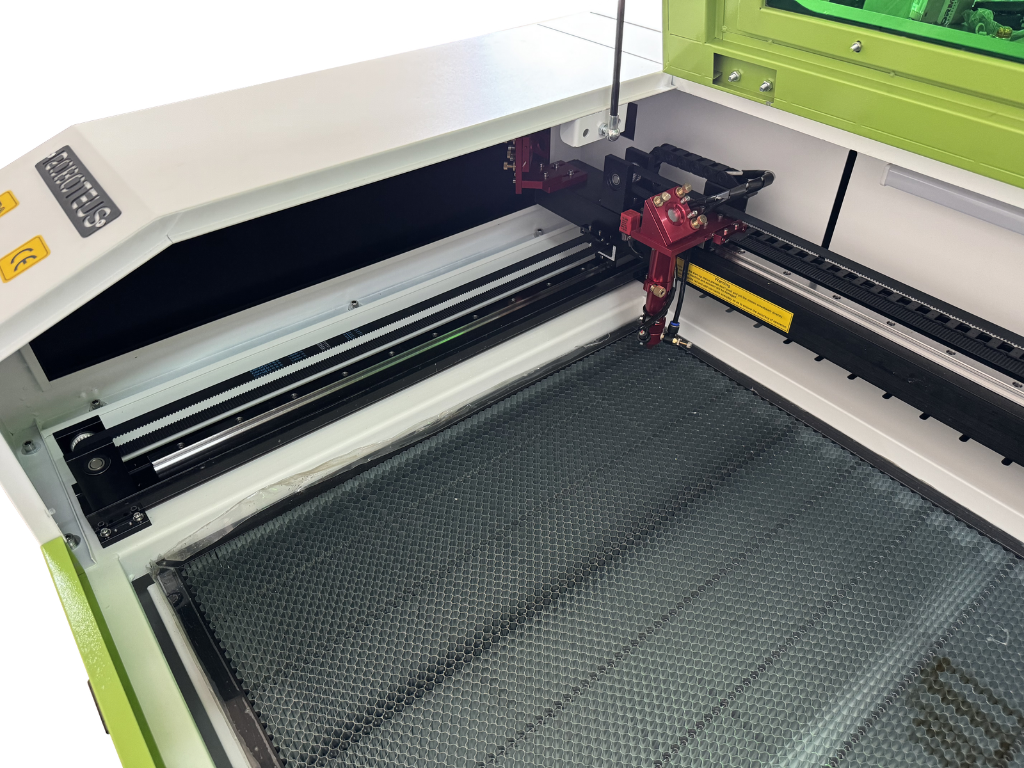
CO2 laser plotter RBL 9060has an 80 W EFR glass tube and a field of 900 × 600 mm; it weighs 250 kg. Larger fields are the RBL 1390 (1300 × 900 mm) and RBL 1610 (1600 × 1000 mm). The full list of materials with cutting/engraving/not suitable effects is described in the text CO2 laser plotter – what it is suitable for.
The tube is a consumable part and represents the main operational difference compared to fiber: shops declare lifespans for glass tubes of 4,500 hours (Shop A) to „approx. 12,000 hours” (Shop B, RECI W1), while the laser manufacturer, writing about sealed RF tubes, states that the tube loses several percent of its power annually even when not in use, and CO2 laser efficiency is 10–15%. Tube prices and the glass/RF difference are described in the text about the CO2 plotter (link above).
What not to use for: bare metal (without preparation), PVC and other chlorinated materials (according to the marking system manufacturer, they produce chlorine and hydrochloric acid, and extraction is a „fundamental requirement”), metal cutting, small serial numbers in thousands of units, where galvo is faster.
Fiber: laser engraving machine for metal and plastic parts
Fiber, or fiber optic laser (the beam is created in a doped optical fiber), operates at 1064 nm and is absorbed by bare metal. According to the laser manufacturer, a typical engraving is 10–50 µm deep, and annealing produces a black mark without material loss through the oxide layer. Deep engraving requires multiple passes: the laser manufacturer shows that the same depth without warping the workpiece costs several times more passes than the high-speed option—the figures are in the text about laser engraving in metal. According to the laser manufacturer, fiber also marks ABS, polyamide, polycarbonate, PMMA, and plastics with laser additives; according to the marking system manufacturer, PE and PP require additives, and fiber does not mark transparent materials.
The RBZ 2020 fiber laser markerhas a 50 W Raycus source, a 200 × 200 mm field, and weighs 50 kg; full specifications are on the product page. This is a benchtop workstation, not a production floor setup. For information on selecting the right power, field, and source, see the text on choosing a laser marker.
The fiber source doesn't have a replaceable tube. Five of the stores reviewed claim "100,000 hours," two marker manufacturers do the same, but the laser manufacturer claims "at least 25,000 hours"; the discrepancy is fourfold, and neither source defines what this number means. The protective glass (PLN 23.09–138.21 net) and lenses are subject to wear.
Net list prices for fiber laser markers, as of October 2026, range from PLN 8,000 for 20 W (store C) to PLN 37,000 for 100 W (store D), without a computer; full tables by power and field are in the texts on selecting a marker and about the CO2 plotter, linked above. RBZ 2020 has process-specific pricing.
What it cannot do: wood, leather, and paper (poorly or not at all), glass (the beam passes through), transparent plastics, cutting thicker materials. Separate fiber laser plottersfiber laser plotters, not markers, are used for cutting sheet metal.
UV: The Fourth Column for Plastics, Glass and Electronics
According to the manufacturer of UV markers, 355 nm is created from 1064 nm by two nonlinear crystals, has a wavelength three times shorter and a smaller spot, and instead of melting the material, it breaks bonds. Polycarbonate, ABS, and polyamide "respond well to UV," PE and PP require specific parameters, transparent materials do not require additives, and on glass, UV produces a transparent mark, not white.
The RBZ 1515UV UV markerhas a 5 W JPT source, a 150 × 150 mm marking field and capacity for workpieces up to 250 mm high. Roboteus states that it can mark a pen in less than a second, supports marking on the fly and has an indicative price starting at PLN 19,512.00 net (configured for the process). In the same shop, a 5 W UV laser costs from around eight thousand to over ten thousand zlotys more than a 30 W fiber laser (list prices, as of October 2026). The full comparison is in the guide to choosing a laser marking machine.
What not to use for: cutting, deep engraving in metal, wood in series; there, fiber or CO2 are cheaper.
When a hobby diode is a trap for your company
A diode purchased as a laser engraving device "on a trial basis" can be a trap in a company for four reasons.
Efficiency. A batch of key fobs or plates is determined by the cycle time, not the module price. Galvo marks in a fraction of a second, while diode engraves a raster many times longer; for runs in the hundreds, the operator spends days working on it, and their cost per unit determines profitability more than the machine price.
Class 4 without an enclosure.The employer is responsible for employee exposure at the plant: CIOP-PIB cites the MPiPS regulation of 27 May 2010 (identification of sources, risk assessment, zone marking, protective measures, training) and the MDE values from the MRPiPS regulation of 12 June 2018. According to CIOP-PIB, a machine in an enclosure that completely encloses radiation is class 1, even at high power; an open frame on an office table is not. Protective glasses are selected according to PN-EN 207 for the wavelength; the selection of the enclosure and protective glasses is described in the text on selecting a marking machine.
Extraction. Wood, acrylic, and plastics produce smoke. According to a manufacturer of marking systems for PVC, extraction is a fundamental requirement; its industrial extractors feature HEPA 99.997% at 0.3 µm and a chemical filter. A fan with a window duct won't replace this.
Service and CE.A 12- or 24-month warranty, training, and on-site installation are a different product from the module package. From 20 January 2027, the Machinery Regulation (EU) 2023/1230 applies, whose Annex III, point 1.5.12 requires protection against useful, reflected, and scattered laser radiation, and point 1.5.13 requires the capture or filtering of hazardous emissions. Ask your supplier how the machine meets this requirement.
6-question selection path
- What material predominates?Metal → fiber. Wood, plywood, acrylic, leather, glass, stone → CO2. Clear or transparent plastics, electronics, glass without microcracks → UV. Two worlds at once (metal and wood) → two machines or CO2 with a preparation for sporadic metal.
- Engraving, marking, or cutting?Cutting non-metals up to several millimeters → CO2. Cutting sheet metal → fiber plotter, not engraving machine. Black mark without material loss on steel → fiber (annealing). Mark on plastic without burns → UV.
- How big is the part?The galvo has a lens field (RBZ 2020: 200 × 200 mm, RBZ 1515UV: 150 × 150 mm); a larger field means a larger spot and lower power density. The plotter has a table from 900 × 600 to 1600 × 1000 mm (RBL), with pass-through for longer parts.
- How many pieces and in what time?Hundreds and thousands of small details → galvo (7000 mm/s). Single large graphics → plotter. Measure the cycle time including loading, not the mark itself.
- Where is it located and who operates it? A hall with people → Class 1 enclosure or a separate workstation with a risk assessment. The RBZ 2020 weighs 50 kg (230 V); the RBL 9060 weighs 250 kg plus chiller and exhaust.
- What wears out and who services it? CO2: tube, mirrors, lens. Fiber and UV: protective window, F-theta lens; source with a service life declaration, which must be read with attribution. Ask about service response time before pricing.
If you're choosing metal or plastics, start with Roboteus laser markers ; if you're working with wood, acrylic, and glass, start with CO2 laser plotters . Some machines have guide prices on roboteus.com (e.g., the RBL 9060 from PLN 15,854.00 net), but configuration and pricing are determined for the process, after testing on your own parts.
Frequently asked questions
Will a diode laser engraver engrave steel?
Not on bare surfaces. According to the engraving machine manufacturer, 5-10W diodes only mark coated metals, such as anodized aluminum. For steel, brass, and copper, a 1064nm fiber is required, which the metal absorbs: engraving or black annealing without loss.
Will a CO2 laser cutter replace a fiber metal marker?
Only temporarily. According to the marking machine manufacturer, marking metal with a CO2 beam is nearly impossible; in practice, a spray preparation is used that leaves a mark on the surface but does not engrave, and engravers charge more for this than for metal on fiber—the mechanism and cost are described in the article about laser engraving on metal.
Which laser is best for engraving glass?
CO2 produces a matte white (according to the marking manufacturer, these are fine cracks in the surface of sodium glass), UV produces a transparent mark, and the diode and fiber pass through the glass without absorption. The recipe for matte white is described in the text about laser engraving on glass.
How much does a metal laser engraving machine cost?
Fiber laser markers at net list prices (as of October 2026): 20 W from PLN 8,000 (store C), 100 W up to PLN 37,000 (store D); the enclosure, extraction system, glasses, and computer are outside these prices, and a full breakdown by power is in the text on selecting a marker. The RBZ 2020 (50 W) is priced for the process.
Can one machine handle wood and metal?
Not from a single source: wood absorbs 10.6 µm (CO2), metal 1064 nm (fiber). A compromise is a CO2 laser plotter with a preparation for occasional metal or fiber, for which you can purchase CO2 when wood becomes mass-produced.
Sources
- https://roboteus.com/pl/maszyny/znakowarki-laserowe/znakowarka-fiber-rbz-2020/ – RBZ 2020 parameters
- https://roboteus.com/pl/maszyny/znakowarki-laserowe/rbz1515uv/ – RBZ 1515UV parameters
- https://roboteus.com/pl/maszyny/plotery-laserowe-co2/ploter-laserowy-co2-rbl-9060/ — RBL 9060 parameters and RBL plotter materials
- https://www.ciop.pl/CIOPPortalWAR/file/99433/Ochrona_przed_promieniowaniem_laserowym_MatInf_M.Okrasa_I.PN.06.pdf — laser classes, employer’s obligations, glasses
- https://eur-lex.europa.eu/eli/reg/2023/1230/oj — Machinery Regulation 2023/1230
- https://roboteus.com/pl/maszyny/plotery-laserowe-co2/ — approximate prices for RBL 9060 and RBL 1610
Editorial note
Net list prices are from retailer websites as of October 2026 and are subject to change. Declarations of service life, speed, and material compatibility are provided by manufacturers and retailers; actual results depend on the machine, power, optics, and specific material, so please test your own parts before purchasing. This text does not replace the manufacturer's instructions or occupational health and safety regulations regarding working with laser devices.