
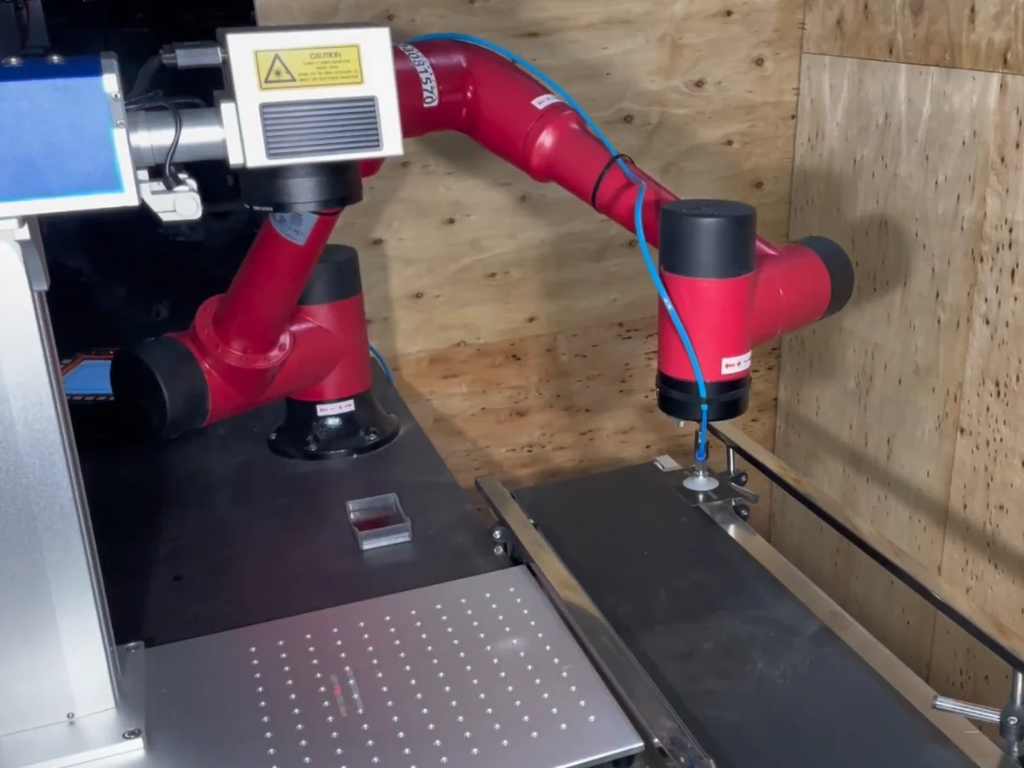
A cobot, or collaborative robot, is an industrial arm designed for applications in which a person and a machine share a workspace. Whether a particular workstation can operate without fencing, however, is determined by the risk assessment of the entire application, not the arm’s datasheet: the tool, workpiece, speed and the area occupied by the operator.
Prices follow a similar pattern. Shops sell cobot arms from the low tens of thousands of Polish zlotys, while integrators’ guides put a complete workstation in the hundreds of thousands. Both figures are true, but describe different things: the first is the arm and controller alone; the second includes the arm, gripper, safeguards, integration and programming.
Below, we explain how standards define a cobot, how it differs from a conventional industrial robot (our table compares two Roboteus robots) and why prices vary. Prices of other offers are sellers’ catalogue prices as of October 2026.
What is a cobot according to the standards?
The starting point is the definition of an industrial robot in ISO 8373:2021, quoted by the International Federation of Robotics (IFR): an automatically controlled, programmable, multipurpose manipulator, programmable in three or more axes. A cobot meets this definition. It is not a separate category of machinery, but an industrial robot built with working alongside people in mind.
The terminology of the standards has changed, however. EN ISO 10218-1:2025 (industrial robots) and EN ISO 10218-2:2025 (robot applications and cells) no longer use the term “collaborative robot”. According to A3, the association providing the secretariat of the ISO working group, the standard refers to a “collaborative application”. Collaboration is therefore a characteristic of the application, not the arm itself. One cobot manufacturer puts it directly: cobots themselves are not collaborative; applications involving them can be.
The second change concerns ISO/TS 15066, the specification cited for cobots for many years. According to A3, the collaborative-application requirements from ISO/TS 15066 have been incorporated into ISO 10218-2:2025. ISO/TS 15066:2016 itself formally remains in the ISO catalogue and is under revision.
Both parts of EN ISO 10218:2025 are harmonised with the Machinery Directive 2006/42/EC by Commission Decision (EU) 2026/2015 of 4.09.2026. We explain what this means when buying machinery in the article on the Machinery Directive and Regulation 2023/1230 (article unavailable).
Four modes of human–robot collaboration
Manufacturers describe collaboration using the four modes of ISO/TS 15066. Each addresses safety in a different way:
- Monitored stop. The robot remains stopped while a person is in the shared area and resumes only after the person leaves. In ISO 10218:2025, this state is called “monitored standstill”.
- Hand guiding. The operator guides the arm by hand at an appropriately reduced speed, for example when positioning a heavy part. Programming by hand guiding looks similar, but is a separate operating mode with its own safety requirements.
- Power and force limiting. The robot may come into contact with a person, but contact force and pressure are limited by its design and control system. This is the mode most commonly associated with the word “cobot”.
- Speed and separation monitoring. Sensors continuously measure the distance between the person and the robot, and the robot slows down, stops or changes its path.
Permissible forces and pressures for individual body regions are given in tables in the paid standards; we do not reproduce them here. How they are checked at a workstation, and what changes the assessment for a cobot, are explained in the article on risk assessment of a robotic workstation (article unavailable).
What does a “safe” cobot mean? The application, not the arm
The most common misunderstanding is: we are buying a cobot, so the workstation is safe. IFR states directly that a safe robot does not guarantee a safe application, and a cobot with a sharp tool is dangerous regardless of speed. After risk assessment, the same arm packaging light cartons may operate beside an operator, while cutting or welding may require guards, a scanner or a light curtain. Details are in the article on when a cobot can work without guards (article unavailable).
Cobot versus industrial robot: differences in a table
The easiest way to show the difference is through two specific datasheets: the RBR 0805 cobot and the RBR 2110 industrial robot. Both have six axes, but are intended for different tasks.
| Parameter | RBR 0805 cobot | RBR 2110 industrial robot |
|---|---|---|
| Type | collaborative robot, 6 axes | industrial robot, 6 axes |
| Payload | 5 kg | 10 kg |
| Reach | 870 mm | 2100 mm |
| Precision (as stated in the datasheet) | positioning accuracy 0.10 mm | repeatability ±0.1 mm |
| Speed | tool max. 2.0 m/s; axes J1–J3 120°/s, J4–J6 180°/s | axes from 110°/s (J1) to 336°/s (J6) |
| Ingress protection | IP64 | IP50 body, IP54 wrist |
| Power supply | 230 V, 1-phase; max. 5.5 kVA | 380 V, 3-phase |
| Mass | not stated in the datasheet | approx. 230 kg |
| Programming | hand guiding (force teaching) | teach pendant (English interface), integrated PLC with I/O support |
| Safeguards | determined by the application risk assessment | determined by risk assessment; typically fencing, light curtains and scanners |
| Price | from PLN 16,259.00 net (indicative price, configuration tailored to the process) | from PLN 34,146.00 net (indicative price, configuration tailored to the process) |
Roboteus prices come from roboteus.com, as of October 2026. They are arm prices, not workstation prices.
Two points in the table deserve careful reading. First, the datasheets give different precision parameters: positioning accuracy and repeatability are not the same, so these figures should not be compared directly. Manufacturers generally specify repeatability using the methods in ISO 9283. Second, a 230 V supply means the RBR 0805 can be connected without a three-phase installation, whereas the RBR 2110 requires one (380 V).
IFR summarises the choice as follows: when speed and precision are priorities, a conventional industrial robot within fencing remains the preferred solution. In our view, a cobot has an advantage where a small footprint, frequent changeovers and an operator working nearby matter, provided the application risk assessment permits it. More models and specifications are collected on the page Roboteus industrial robots.
Programming by hand guiding
Programming a cobot by hand guiding (force teaching) means the operator grasps the arm and moves it through successive trajectory points, which the robot remembers. There is no need to write code or know the syntax of the robot’s language. For simple tasks such as “take a part from the feeder and place it on the table”, this considerably shortens the path from an idea to the first working program.
A conventional industrial robot is programmed with a teach pendant, a handheld programming unit, or offline in the robot manufacturer’s simulation software. The RBR 2110 teach pendant interface is in English, which should be considered when planning operator training.
Hand guiding does not solve everything. The program still needs logic: machine signals, part-presence sensors, stopping conditions and error handling. Someone who understands control systems is still needed, even if they are not a robot programmer.
What are cobots used for?
The RBR 0805 datasheet lists four application groups: assembly and packaging (pick and place), guiding a welding torch or cutting tool, finishing (grinding, polishing and adhesive dispensing), and quality inspection with a camera or measuring sensor. Machine tending is another application, such as loading and unloading a router, discussed in more detail in the article on CNC automation. We devote a separate article to welding: welding cobot: workstation and price (article unavailable).
For each task, payload including the gripper and the centre-of-gravity position matter, not the figure on the catalogue cover. With a 5 kg cobot, the mass allowance must accommodate the gripper and workpiece together, not just the workpiece. We explain load diagrams in the article on how to read payload in a robot datasheet (article unavailable).
IFR shows the scale of the market: in 2022, almost 55 thousand cobots were installed, accounting for 9.9 % of all industrial robot installations. They remain a minority, but not a niche.
How much does a cobot cost? The arm alone
Arm-and-controller prices published in Poland (catalogue prices, October 2026):
| Arm | Seller | Catalogue price |
|---|---|---|
| Roboteus RBR 0805 (5 kg, 870 mm) | roboteus.com | from PLN 16,259.00 net (indicative price, configuration tailored to the process) |
| cobot 5 kg, 922 mm | Polish machinery shop | PLN 20,243.90 net |
| cobots 3 / 5 / 10 kg | distributor of a cobot brand | 4,590 € / 4,990 € / 10,390 € net |
| cobots 10 / 20 kg | cobot seller | 20,000 € / 24,500 € (the website does not state whether net or gross) |
| cobots 3 / 5 / 7 kg | robot shop | PLN 68,175.12 net |
| cobots 10 / 12 kg | robot shop | PLN 82,378.27 net |
| cobot 5 kg, used | used-robot seller | PLN 52,500 + VAT |
The largest established manufacturers do not publish prices for new robots in Poland. A table by a Polish integrator gives an indicative picture of the segment (described as 2025 data, without naming brands): a 6–7 kg arm costs 65–85 thousand PLN net, 10–12 kg costs 85–120 thousand PLN, 18–20 kg costs 120–170 thousand PLN, and 25 kg costs 150–210 thousand PLN net.
Why do budget and established-brand arms differ in price?
An arm costing in the low tens of thousands and one costing over a hundred thousand zlotys can have similar payload and reach. The difference usually lies in what comes with the arm. When comparing offers, check:
- the controller’s safety functions and their documentation, including Performance Level (PL);
- the ecosystem: controller and pendant, software, and grippers with ready-made integration;
- training, warranty and service in Poland, including response time and spare-parts availability;
- documents for incorporating the arm into a machine: the declaration of incorporation and assembly instructions, discussed in the article on the machine’s CE declaration of conformity (article unavailable).
The first point also applies to our robots. The RBR 2110 and RBR 0805 datasheets do not specify PL or the controller’s safety functions (force and power limits, stopping times). Ask about these when requesting a quote: without them, you cannot design guarding or operation without a cage.
How much does a cobot workstation cost?
The arm is only the first item in the budget. To work, it needs a tool, safeguards selected through risk assessment, integration with its surroundings and a program. Example component catalogue prices (October 2026):
| Component | Example and source | Net catalogue price |
|---|---|---|
| Electric gripper | Robotiq Hand-E (DPS Software) | PLN 15,284.55 |
| Two-finger gripper | Robotiq 2F-85 (DPS Software) | PLN 18,292.68 |
| Vacuum gripper | Robotiq EPick (DPS Software) | PLN 16,800 |
| Electric gripper | Jodell RG75-300 (cobot distributor) | 1,789 € |
| Vacuum pump | Schmalz CobotPump Mini (cobot distributor) | 1,100 € |
| Force/torque sensor | 6-axis (cobot distributor) | 829 € |
| Training | cobot course, 3 days (robot manufacturer’s training catalogue, 2026) | PLN 3,850 (the catalogue does not state whether net or gross) |
One observation from this table: the Robotiq Hand-E gripper alone costs almost as much as the RBR 0805 arm. With an inexpensive arm, the tool and safeguards can account for more of the budget than the robot. Also check that the gripper can be mounted and controlled by the selected arm’s controller: not every catalogue gripper has ready-made integration with every robot.
Safeguards are additional: a scanner, light curtain or safety controller, if required by the risk assessment. We have collected their catalogue prices in the article on robot fencing and workstation risk assessment (article unavailable).
Integration and programming are the hardest items to price. We found no published integrator price list; reference points and the complete workstation budget are described in the article on how much an industrial robot and complete workstation cost (article unavailable).
Integrators quote for complete workstations. The integrator whose table we cite above gives a range of 120–350 thousand PLN for a cobot workstation, “most often” 150–300 thousand PLN net; its ready-made CNC-tending workstation starts at PLN 121,700. These are complete integrated systems, not arm prices.
Financing should be considered in the budget. In an indicative table (10 % down payment, 60 months), broker Pro Lease lists a “cobot” costing 50–150 thousand PLN with a monthly instalment of around 850–2,550 PLN. Check the lease type if you are relying on Polish tax relief. Options for Roboteus machines are on the page Roboteus machine financing. Factory-new robots, safety devices and training may be eligible costs (only finance leasing qualifies), as explained in the article on Poland’s robotisation tax relief in 2026. How to compare costs and savings is shown in the article on calculating the return on production automation (article unavailable).
Frequently asked questions
What is a cobot?
A cobot, or collaborative robot, is an industrial robot for applications in which a person and robot share a workspace. EN ISO 10218:2025 no longer uses this term and refers to a collaborative application, because collaboration is a characteristic of the application, not the arm itself.
How much does a cobot cost?
The arm and controller alone cost from the low tens of thousands to over a hundred thousand zlotys net in Polish shops; the RBR 0805 starts at PLN 16,259.00 net (indicative price, configuration tailored to the process). Integrators quote hundreds of thousands of zlotys for a complete workstation with gripper, safeguards and integration. Always ask whether the price is for the arm or the workstation.
How does a cobot differ from an industrial robot?
A cobot is an industrial robot intended for applications where a person shares its space, generally lighter, slower and programmed by hand guiding. A conventional industrial robot has greater payload, reach and speed and usually works behind fencing. In both cases, safeguards are determined by the risk assessment of the entire workstation.
How much does a cobot with a gripper cost?
The gripper must be added to the arm price: electric grippers at a cobot distributor start at a few hundred euros, while Robotiq grippers in the DPS Software shop start at PLN 15,284.55 net (October 2026). Safeguards, integration and programming are additional and cannot be priced without a description of the process.
How is a cobot programmed?
Most often by hand guiding: the operator moves the arm through successive points and the robot remembers them. Logic, machine signals and stopping conditions are then added. Conventional robots are programmed with a teach pendant or offline in simulation software.
Sources
- https://roboteus.com/pl/maszyny/roboty-przemyslowe/robot-szescioosiowy-rbr-0805/
- https://roboteus.com/pl/maszyny/roboty-przemyslowe/robot-przemyslowy-rbr-2110/
- https://ifr.org/standardisation
- https://ifr.org/industrial-robots
- https://www.ppma.co.uk/media/4jmhne5p/ifrdemystifyingcollaborativerobotsupdatev03dec2020.pdf
- https://www.automate.org/robotics/blogs/updated-iso-10218-faq
- https://www.iso.org/standard/73933.html
- https://www.iso.org/standard/73934.html
- https://www.iso.org/standard/62996.html
- http://publications.europa.eu/resource/cellar/093ef8f6-aa55-11f1-b9e5-01aa75ed71a1.0019.03/DOC_1
- https://sklep.dps-software.pl/pl/c/Chwytaki-do-robotow/155
- https://www.pro-lease.pl/leasing-robotow-przemyslowych-jak-sfinansowac-automatyzacje-produkcji/
Editorial note
Catalogue prices come from the named shops and websites (October 2026) and may change; Roboteus prices are indicative and the configuration is selected for the process. Robot specifications depend on configuration, tool and workpiece. This article does not replace the manufacturer’s instructions, occupational safety rules or a workstation risk assessment by a competent person, and is not legal or tax advice.