
Poland’s robotisation tax relief allows half of qualifying expenditure on industrial robots, related equipment, safeguards and training to be deducted from the tax base. It was due to cover costs only until the end of the tax year beginning in 2026, but the extension to 2036 was passed and signed by the President on 18.11.2026. Buying a robot in November or December 2026 therefore does not lose the relief.
We explain the Polish legal basis, robot definition, eligible costs and changes from 2027, and calculate an example purchase near the end of 2026. The legal position described is the historical position as at 23.11.2026.
This is not tax advice. Review the treatment of a specific investment with a tax adviser or your accounting team and, where uncertain, apply for an individual Polish tax ruling.
Poland’s robotisation tax relief: legal basis and deduction rate
For companies, the basis is Article 38eb of Poland’s CIT Act; for entrepreneurs reporting business income under PIT, it is Article 52jb of Poland’s PIT Act.
The mechanism is the same for both Polish income taxes: robotisation costs are ordinary tax-deductible business expenses, with an additional 50 % deduction from the tax base. The combined deductible amount is therefore equivalent to 150 %.
The deduction cannot exceed income from sources other than capital gains; for PIT, the limit is business income. If the business makes a loss or has insufficient income, the unused portion can be deducted over the next 6 tax years.
According to EY, at a CIT rate of 19 %, the tax saving is up to 9.5 % of qualifying costs. The relief reduces tax; it does not fund half the purchase.
Claim it in the annual return: for CIT, CIT-8/O and CIT-RB; for PIT, PIT-RB or PIT-RBS attached to PIT-36, PIT-36L, PIT-36S or PIT-36LS. These details follow podatki.gov.pl pages updated on 26.08 and 24.09.2026. We did not find Ministry of Finance tax guidance specifically addressing this relief.
What Polish law considers an industrial robot
The definition is in Article 38eb, subsection 3, of the CIT Act, with the same definition for PIT. It describes an automatically controlled, programmable, multipurpose stationary or mobile machine with at least 3 degrees of freedom and manipulation or locomotion capabilities for industrial applications.
The machine must also meet all four conditions:
- exchange digital data with control, diagnostic or monitoring devices for remote control, programming, monitoring or diagnosis;
- connect to information and communications systems improving the taxpayer’s production, particularly production management, planning or design;
- be monitored by sensors, cameras or similar devices;
- be integrated with other machines in the taxpayer’s production cycle.
Conditions 2 and 4 concern how the robot works at a particular factory, so the same model may meet the definition in one business but not another.
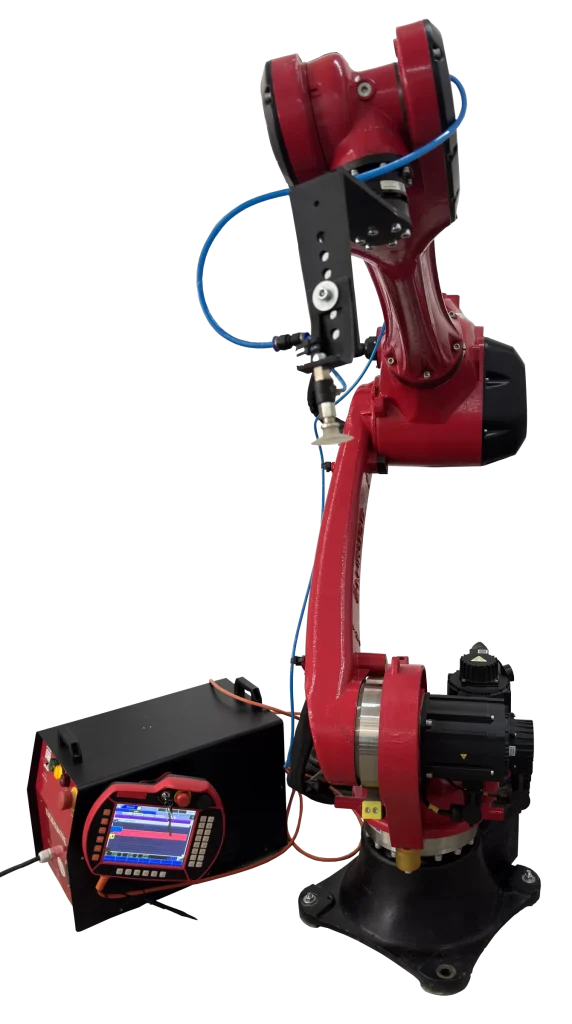
For example, our RBR 2110 industrial robot has 6 axes and a built-in PLC with I/O signals; its specification describes working with sensors and cameras. This helps meet the requirements, but eligibility depends on the installation, not the specification alone.
Qualifying costs: what can be deducted
Robots and equipment covered by the relief must be factory-new. According to the legislation and podatki.gov.pl, robotisation costs include:
| Cost category | Scope |
|---|---|
| Industrial robots | machines meeting the definition in Article 38eb, subsection 3 |
| Peripheral machinery and equipment | including linear units, positioners, travel tracks, rotary tables and end effectors for welding, palletising or tending milling machines and presses |
| Safety and ergonomics | sensors, controllers, relays, safety interlocks, fencing, guards, light curtains and area scanners |
| Remote management and diagnostics | systems for monitoring and servicing robots, including sensors and cameras |
| HMI | human–robot interaction devices |
| Intangible assets | software needed to commission the robot and bring it into use |
| Training | training services relating to robots and the listed equipment |
| Finance leasing | lease payments only under a finance lease transferring ownership to the lessee after the initial lease period |
According to podatki.gov.pl, only costs not reimbursed in any form can be deducted, an important point for grants. If the fixed asset is sold before depreciation ends, previously deducted amounts are added back to the tax base.
Existing rules also exclude costs linked, among other things, to emissions-trading activities with exceptions, fossil fuels, landfills and waste incinerators: the DNSH condition. The amendment removes it, but it remains applicable to costs incurred before 1.01.2027; for CIT, before a tax year beginning after 31.12.2026.
The key practical question for fixed assets is whether qualifying cost means purchase price or depreciation charges. From 2027, the new subsection 2a in Article 38eb CIT and Article 52jb PIT settles this: for depreciable tangible and intangible assets, robotisation costs are the year’s depreciation charges recognised as tax-deductible expenses. The wording applicable in 2026 does not expressly mention depreciation. However, the Ministry of Finance has treated depreciation rather than purchase price as eligible from the outset, as shown by the explanatory memorandum and podatki.gov.pl. In an individual ruling dated 23.05.2023, the Director of KIS likewise confirmed a company’s position on depreciation charges for 2022–2026. We calculate the example’s 2026 charge using the Ministry’s position.
How long the relief lasts: extension to 2036
Legislative progress. The Sejm passed the government bill, print 3149, on 22.10.2026 using the Public Finance Committee report text, print 3227, after rejecting second-reading amendments in print 3227-A. The Senate proposed no amendments on 27.10.2026 and the President signed it on 18.11.2026. As at 23.11.2026, the historical reference date of this article, it had not yet been published in Poland’s Journal of Laws.
What the adopted legislation changes:
- for PIT, the period 2022–2026 becomes 2022–2036; for CIT, relief covers costs until the end of the tax year beginning in 2036;
- new subsection 2a identifies depreciation charges as the qualifying fixed-asset costs, as explained above;
- it repeals DNSH, with the transition described above;
- the additional deduction remains 50 %.
Effective dates. The legislation takes effect on 1.01.2027 and applies to income from that date. The extension provisions take effect earlier, on 31.12.2026, so relief continues uninterrupted. A company whose tax year begins before 1.01.2027 and ends after 31.12.2026 applies the existing rules until that year ends.
Example: buying a robot in November 2026
Assume a CIT-paying company with a calendar tax year and enough income to use the deduction. It buys a factory-new workstation in November 2026, installs and commissions it, and records it in the fixed-asset register that month.
This assumption is crucial: the registered workstation must be complete and fit for use, and the robot must then meet all four conditions. A robot arm invoiced in December but commissioned in 2027 creates no depreciation charge in 2026; depreciation in later years can still qualify.
Prices come from public lists recorded in October 2026. RBR 2110 starts at 34,146.00 PLN excluding VAT, indicative and configured for the process. A Robotiq 2F-85 gripper is 18,292.68 PLN excluding VAT from DPS Software; mounting and control compatibility with RBR 2110 must be confirmed. RedSteel fencing: a 100×200 cm panel is 479 PLN, a post 149 PLN and a 100 cm door 1,190 PLN excluding VAT. Assume one SICK RLY3 safety relay at 506.94 PLN excluding VAT from Automatyka24.
Example assumptions, to be replaced with your own data:
- fencing: assume a 24 m perimeter, a 6 × 6 m square around a robot with a 2100 mm reach, using 23 panels, one door and 24 posts, costing 15,783 PLN in this example. The actual perimeter follows the risk assessment and EN ISO 13855:2024; see robot fencing and risk assessment (article unavailable));
- the complete workstation forms one initial asset value; installation and commissioning are omitted, although they normally increase that value;
- assume straight-line depreciation at 20 % annually; accounting must determine the appropriate rate;
- depreciation starts in the month after registration, so a November registration gives one charge in 2026, for December. Charges continue until November 2031, or 60 months at the assumed rate, with the final charge correcting rounding.
The second column uses the RBR 0805 cobot from 16,259.00 PLN excluding VAT, indicative and configured for the process, with a Robotiq Hand-E gripper at 15,284.55 PLN excluding VAT from DPS Software and a SICK nanoScan3 scanner from 9,789.25 PLN excluding VAT from Automatyka24. The scanner is an example assumption: safeguards follow the risk assessment, not the arm alone.
| Item: example using the assumptions above | RBR 2110 workstation | RBR 0805 workstation |
|---|---|---|
| Initial value in the example | 68,728.62 PLN | 41,332.80 PLN |
| Monthly depreciation charge at the assumed 20 % | 1,145.48 PLN | 688.88 PLN |
| 2026 deduction using the Ministry’s position, 50 % of the charge, example | 572.74 PLN | 344.44 PLN |
| 2026 CIT reduction at 19 %, example | 108.82 PLN | 65.44 PLN |
| Deduction for each year 2027–2030, 50 % of 12 charges, example | 6,872.88 PLN | 4,133.28 PLN |
| 2031 deduction, 50 % of 11 charges, example | 6,300.05 PLN | 3,788.84 PLN |
| Total deduction for 2026–2031, example | 34,364.31 PLN | 20,666.40 PLN |
| Total CIT reduction at 19 %, example | 6,529.22 PLN | 3,926.62 PLN |
In the example, one charge qualifies in 2026 under existing rules using the Ministry’s interpretation; another approach requires your own individual ruling. The example’s 2027–2031 charges expressly qualify under subsection 2a and fall within the relief period, so the deduction covers the entire workstation value. The tax effect is 9.5 % of cost, EY’s stated upper limit, provided sufficient income is available.
Registration in December 2026 gives no deduction for 2026, but the total remains the same: all charges then fall in 2027–2031 in this example.
Two issues need separate advice. First, whether the business can use immediate depreciation and what that would mean for the relief. Second, finance leasing: only that year’s payments enter the 2026 relief.
Buy now or in 2027?
Looking only at the relief:
| Fixed-asset registration | What the relief covers |
|---|---|
| November 2026 | December 2026 depreciation under the Ministry’s position and existing rules, plus later charges under subsection 2a |
| December 2026 | charges from January 2027 under subsection 2a |
| 2027 and later | charges from the month after registration until the relief period ends in 2036 |
Do not base the purchase on tax relief alone. Moving it to 2027 mainly changes the deduction schedule; the difference in 2026 tax is small or nil. Rushing at year-end encourages commissioning without risk assessment, integration or training. First calculate whether the workstation pays for itself without relief. Two guides can help: calculating the return on production automation (article unavailable) and the cost of an industrial robot and the complete workstation (article unavailable).
Treat tax relief as an addition to an investment that already makes sense, and check whether a lease meets Polish finance-lease conditions. Funding options: Roboteus machine financing.
Can a CNC router be a robot for Polish tax-relief purposes?
The phrase “CNC robotisation relief” comes up often because a CNC machine is automatically controlled and programmable. The legislation does not list milling machines; eligibility depends on whether the particular machine meets the definition in its particular factory.
In an individual ruling from June 2025, the Director of KIS agreed with a company that three CNC milling machines could qualify as industrial robots under Article 38eb, subsection 3. The company described factory-new, programmable, multipurpose machines with at least 3 degrees of freedom meeting all four conditions. They had been bought in 2017 and two years later; the question concerned depreciation charges from 2022.
This was an individual decision, protecting only the applicant and only the stated facts, not a general rule for all milling machines. If buying a CNC router with this relief in mind, the safest course is to describe your own installation and obtain an individual ruling.
Documents to prepare
Documents matter if there is a dispute. Collect them when buying:
- Invoices and contracts separating the robot, peripherals, safeguards, software and training.
- Confirmation that equipment is factory-new, for example a supplier declaration.
- Evidence of all four definition conditions at registration: data exchanges, connected systems, monitoring devices and other machines in the cycle. A workstation diagram helps.
- Fixed-asset register and depreciation schedule with registration date, rate and annual charges.
- Separate identification of qualifying costs in the accounts for CIT-RB or PIT-RB.
- Finance lease agreement, where relevant.
- Grant and reimbursement information.
- Training records: syllabus, participants and invoice.
Plan workstation safety and conformity documentation with the purchase. Model range: Roboteus industrial robots.
Frequently asked questions
When does Poland’s robotisation tax relief end?
At the end of the tax year starting in 2036 for CIT, or for costs incurred in 2022–2036 for PIT. The Sejm passed the law on 22.10.2026 and the President signed it on 18.11.2026; the extension takes effect on 31.12.2026, with no gap. As at 23.11.2026, the historical reference date, publication in the Journal of Laws was still pending.
Does a cobot qualify for robotisation tax relief?
The law does not distinguish cobots from guarded industrial robots. The definition and its four conditions matter, including production-system connections and integration with other machines. Differences from a conventional arm are described in whether a cobot is an industrial robot and what it costs (article unavailable).
Does relief cover a used robot?
No. The legislation requires factory-new robots and equipment. Used or refurbished robots are not qualifying expenditure, even if they meet the other definition conditions.
Does robotisation relief cover leasing?
Only finance leasing that transfers ownership to the lessee after the initial period. Operating-lease payments are not qualifying costs for this relief.
Can the relief be combined with a grant?
Only costs not reimbursed in any form can be deducted. The grant-funded portion is therefore usually excluded. If reimbursement arrives after deduction, increase the tax base or reduce the loss in the reimbursement year.
Sources
- CIT robotisation relief, podatki.gov.pl, updated 26.08.2026: https://www.podatki.gov.pl/ulgi-i-odliczenia/ulga-na-robotyzacje-cit
- PIT robotisation relief, podatki.gov.pl, updated 24.09.2026: https://www.podatki.gov.pl/ulgi-i-odliczenia/ulga-na-robotyzacje-pit
- CIT Act, consolidated text Dz.U. 2026 item 554, Article 38eb: https://api.sejm.gov.pl/eli/acts/DU/2026/554/text.pdf
- PIT Act, consolidated text Dz.U. 2026 item 592, Article 52jb: https://api.sejm.gov.pl/eli/acts/DU/2026/592/text.pdf
- Sejm print 3149, legislative progress through the Sejm API: https://api.sejm.gov.pl/sejm/term10/processes/3149
- Print 3227, Public Finance Committee report dated 20.10.2026, adopted text: https://api.sejm.gov.pl/sejm/term10/prints/3227/3227.pdf
- Print 3227-A, supplementary committee report and second-reading amendments: https://api.sejm.gov.pl/sejm/term10/prints/3227-A/3227-A.pdf
- Draft and explanatory memorandum, Government Legislation Centre: https://legislacja.rcl.gov.pl/projekt/12414006
- Individual ruling 0111-KDIB1-3.4010.183.2023.1.IZ dated 23.05.2023: https://eureka.mf.gov.pl/informacje/podglad/545376
- Individual ruling 0114-KDIP2-1.4010.200.2025.2.KW dated 10.06.2025, CNC milling machines: https://eureka.mf.gov.pl/informacje/podglad/643850
- EY, robotisation relief extended by 10 years: https://www.ey.com/pl_pl/insights/tax/ulga-na-robotyzacje-przedluzenie-o-10-lat
- DPS Software, robot grippers, catalogue prices: https://sklep.dps-software.pl/pl/c/Chwytaki-do-robotow/155
- RedSteel, industrial fencing, catalogue prices: https://redsteel.pl/wygrodzenia-przemyslowe-magazynowe/
- Automatyka24, safety relays: https://www.automatyka24.pl/pl/katalog/przekazniki-bezpieczenstwa
- Automatyka24, laser safety scanners: https://www.automatyka24.pl/pl/katalog/laserowy-skaner-bezpieczenstwa
- Roboteus, RBR 2110: https://roboteus.com/pl/maszyny/roboty-przemyslowe/robot-przemyslowy-rbr-2110/
- Roboteus, RBR 0805: https://roboteus.com/pl/maszyny/roboty-przemyslowe/robot-szescioosiowy-rbr-0805/
Editorial note
Catalogue prices refer to October 2026 and may change. This article describes the legal position as at 23.11.2026: the extension to 2036 had been signed by the President on 18.11.2026 but had not yet been published in the Journal of Laws at that reference date. The 2026 depreciation treatment follows the Ministry’s position rather than an express provision then in force. The example uses stated assumptions, including depreciation rate and fencing perimeter; workstation parameters and cost depend on the process. It is not tax or legal advice and does not replace advice from a tax adviser, manufacturer instructions or safety rules.