
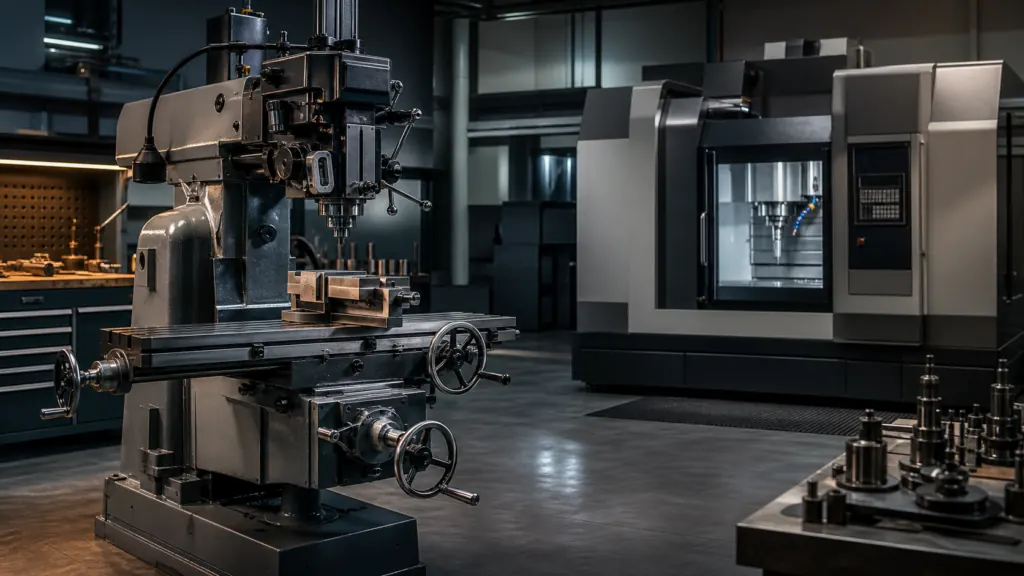
CNC and conventional machining can both produce useful, accurate components when the equipment, tooling and operator are suited to the work. The practical choice depends on geometry, repetition, preparation time and the quantity of acceptable parts required.
Here, conventional machining means a predominantly manually controlled mill or lathe. Manual equipment may have digital readouts or power feeds, so the distinction is not simply old versus new. CNC controls a programmed sequence of movements; the manual machinist directs more of the sequence during the operation.
Compare the complete job
| Question | Conventional machining | CNC machining |
|---|---|---|
| How is movement controlled? | The operator directs the sequence, with the aids available on the machine. | A verified program controls the planned sequence. |
| Where is preparation concentrated? | Workholding, tooling, measurement and planning at the machine. | Programming and verification as well as workholding, tools and offsets. |
| What happens on repeat orders? | The process depends heavily on retained instructions and operator knowledge. | Programs and setup documentation can support repeating the process. |
| What suits a simple one-off? | A straightforward task may need little preparation. | Programming overhead may matter, although conversational controls can help on suitable jobs. |
| What suits complex repeated paths? | Continuous manual execution can become difficult or time-consuming. | A suitable machine can execute programmed paths repeatedly. |
These are working distinctions, not universal performance rankings. Machine condition, workholding and the operator’s process knowledge remain important in both cases.
When a manual machine can be the sensible choice
A simple repair, facing operation, short drilling task or single turned feature may take less total preparation on a suitable manual machine. The machinist can inspect the work and adjust the approach as the job develops.
This flexibility is useful when the component is being repaired, the original geometry is incomplete or the exact task becomes clear only after inspection. It still requires a defined safe process and a way to verify the result.
Manual machining can also remain part of a CNC workshop. It may handle secondary operations, maintenance components or work that would otherwise interrupt a stable CNC batch.
When CNC becomes more attractive
CNC is worth evaluating when the same geometry returns, several features must be coordinated, toolpaths are complex or a stable series needs repeatable execution. Programs and documented setups can make repeat orders easier to restart.
A suitable fixture and tool arrangement may reduce handling between operations. However, adding CNC control does not eliminate programming, setting, inspection or tool wear. If those activities are poorly planned, a short automatic cycle can still sit within a slow overall process.
The introduction to CNC machines explains the technical workflow; the manufacturer benefits guide connects it to production measurements.
A time example: batch size changes the comparison
Illustrative assumptions only: manual preparation takes 15 minutes and processing takes 6 minutes per part. CNC preparation, including programming for this example, takes 90 minutes and processing takes 3 minutes per part. Both methods produce the required quality with no rejects. Inspection, handling and other costs are outside this simplified model.
For a batch of N parts:
- Manual time = 15 + 6 × N minutes.
- CNC time = 90 + 3 × N minutes.
| Batch | Manual | CNC |
|---|---|---|
| 10 parts | 75 minutes | 120 minutes |
| 25 parts | 165 minutes | 165 minutes |
| 50 parts | 315 minutes | 240 minutes |
The assumed processing times balance at 25 parts. This is not a general minimum CNC batch size, an equipment payback calculation or a statement that labour time equals elapsed machine time. Different geometry, preparation methods and repeat orders change the result.
Precision is a process question
CNC is not a guarantee of finished-part accuracy, and manual control does not automatically mean poor quality. Assess the required dimensions, machine capability, tool condition, temperature, workholding and measurement method.
Repeatability and accuracy also differ. A process may reproduce the same wrong dimension when an offset or setup is incorrect. Compare inspected parts from representative work, rather than assuming that the control method alone proves quality.
Use a mixed workflow when it fits
The alternatives do not have to be exclusive. A workshop may use CNC for a repeat series and conventional equipment for repairs or low-preparation secondary work. Include transfers, extra setups and the risk of losing the datum relationship when considering that route.
The objective is a dependable route to accepted parts. For a purchase decision, record the recurring jobs, the preparation work and the actual bottleneck before using the CNC machine selection checklist.
Frequently asked questions
Is CNC always faster?
No. A shorter automatic cycle can be outweighed by preparation on a simple one-off. Compare the complete batch and the work needed for a repeat order.
Does CNC remove the need for an experienced machinist?
No. Process planning, tooling, setup, inspection and fault diagnosis still require competence. The distribution of work changes rather than disappearing.
Can small batches justify CNC?
Yes. Complex geometry, demanding coordination between features or reusable programs may justify CNC at a small quantity. There is no universal batch threshold.
Decide from an actual job
Take a representative drawing and compare preparation, processing, handling and inspection for each feasible route. If a new CNC configuration is being considered, discuss that job with Roboteus and request a trial with an agreed scope.
If CNC is the preferred approach, compare a CNC router with a machining center before specifying the equipment. Review the basic CNC operating workflow alongside that decision to account for setup, programming and operator preparation.